
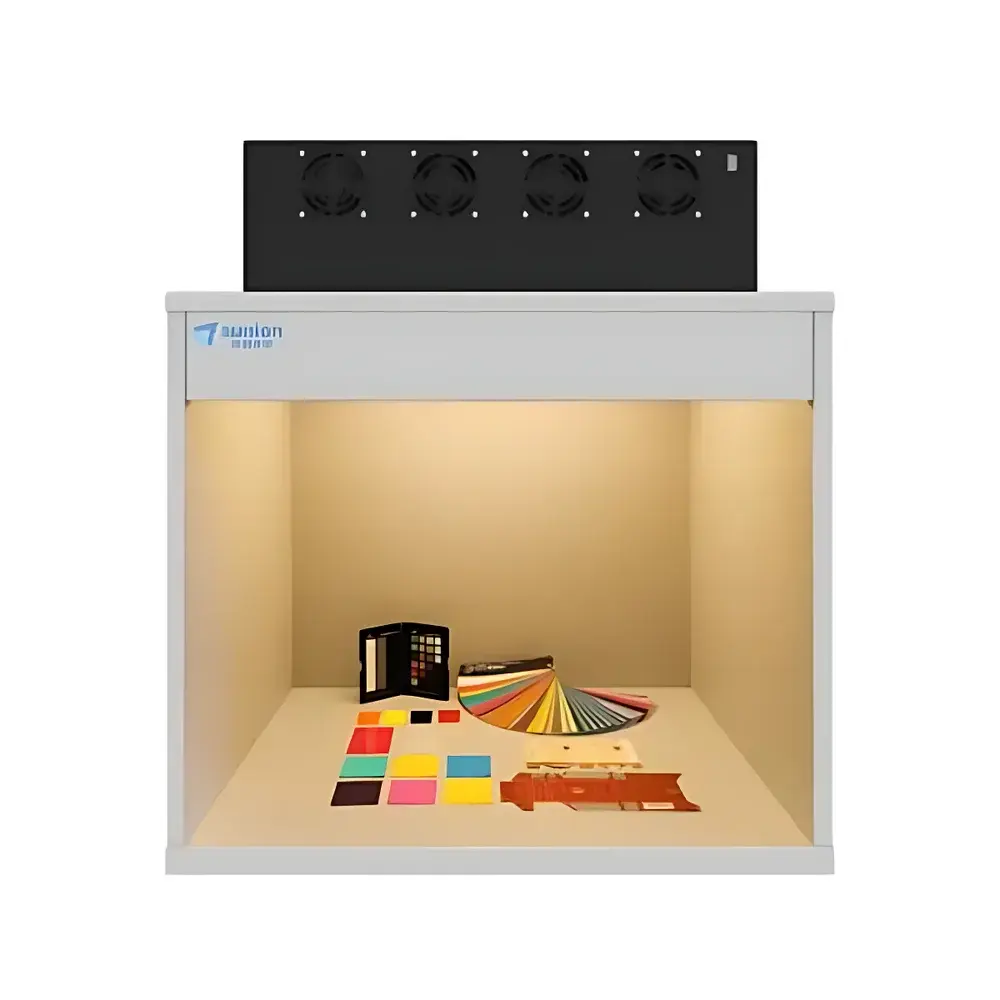
Auniontech AUT-SpectraLED Series Multi-Channel Tunable Spectral Light Source Cabinet
| Brand | Auniontech |
|---|---|
| Origin | Shanghai, China |
| Model | AUT-SpectraLED-GS / AUT-SpectraLED-Pro / AUT-SpectraLED-QC21 / AUT-SpectraLED-QC33 / AUT-SpectraLED-QC5 |
| Spectral Range | 360–780 nm (model-dependent) |
| Correlated Color Temperature (CCT) | 2000–20000 K, ±1% accuracy |
| Illuminance Range | 0.1–100,000 lux (adjustable) |
| LED Channels | 14 to 55 (configurable per model) |
| Luminous Stability (short-term) | ΔCCT ≤ ±20 K, ΔIlluminance ≤ ±1% |
| Luminous Stability (long-term) | ΔCCT ≤ ±32 K, ΔIlluminance ≤ ±2% |
| Preheat Time | ≤ 120 s |
| LED Lifetime | ≥ 15,000 h |
| Control Interface | Touchscreen + USB |
| Power Input | 110–240 V AC, 50/60 Hz |
| Dimensions (L×H×W) | 710×585×585 mm to 990×930×685 mm |
| Weight | 20–40 kg |
| Compliance | Designed for ISO 3664:2009, ASTM D1729, CIE S 002/E:2012, and GB/T 3978–2008 color evaluation environments |
Overview
The Auniontech AUT-SpectraLED Series is a precision-engineered, multi-channel tunable spectral light source cabinet designed for standardized visual color assessment under controlled photometric conditions. Built upon high-fidelity LED spectral synthesis architecture, the system enables programmable reconstruction of CIE-standard illuminants—including D50, D65, D75, A, C, F-series, and user-defined spectra—by independently modulating up to 55 narrowband LED channels spanning 360–1000 nm. Unlike traditional fluorescent or halogen-based light booths, the AUT-SpectraLED platform delivers spectrally accurate, stable, and repeatable illumination without UV degradation, thermal drift, or lamp aging artifacts. Its core function is to replicate standardized viewing environments defined in ISO 3664:2009 (graphic technology), ASTM D1729 (color matching), and CIE S 002/E:2012 (colorimetry), ensuring metrological traceability across supply chain quality gates—from R&D labs and production QC stations to third-party certification facilities.
Key Features
- Ultra-broad correlated color temperature (CCT) tuning range: 2000 K to 20000 K with ±1% calibration accuracy, enabling simulation of dawn, daylight, incandescent, and specialized industrial lighting conditions.
- High-dynamic-range illuminance control: 0.1 lux (sub-mesopic) to 100,000 lux (photopic saturation), supporting low-light material inspection, glare testing, and high-intensity spectral rendering.
- Multi-tier spectral fidelity: Models cover 360–700 nm (GS), 360–780 nm (Pro), and extended ranges up to 1000 nm (QC33), accommodating UV-A, visible, and near-infrared (NIR) applications such as fluorescence excitation and multispectral imaging validation.
- Long-term photometric stability: Short-term CCT drift ≤ ±20 K and illuminance variation ≤ ±1% over 30 minutes; long-term drift ≤ ±32 K and ≤ ±2% over 10,000 hours—validated per IEC 62471 and ISO/CIE 11664-1.
- High-resolution digital control: 12-bit per channel (4096 intensity levels), enabling fine-grained spectral shaping and reproducible spectral power distribution (SPD) profiles.
- Scalable storage architecture: Hardware stores up to 80 preloaded illuminants; software allows unlimited custom SPD import/export via CSV or CIE 15:2018-compliant .ies/.cie files.
- Integrated UV and directional D65 modules: Supports UV-induced fluorescence evaluation and directional lighting simulation per ISO 3664 Annex B for gloss-sensitive samples.
Sample Compatibility & Compliance
The AUT-SpectraLED cabinet accommodates flat, rigid, and semi-flexible samples up to 890 mm × 620 mm (QC-Pro model), with uniform irradiance distribution (±5% across central 80% area per ISO 3664). It complies with international standards governing color evaluation environments: ISO 3664:2009 (illuminant spectral power distribution, uniformity, and surround reflectance); ASTM D1729-22 (visual color comparison under standard lighting); CIE S 002/E:2012 (spectral measurement protocols); and GB/T 3978–2008 (Chinese national standard for colorimetric lighting). All models are engineered for GLP-compliant operation: full audit trail logging (via optional USB-connected PC), timestamped illuminant recall, and firmware-locked calibration certificates traceable to NIM (National Institute of Metrology, China). No external radiometric recalibration is required during routine use due to factory-traceable spectral characterization and onboard thermal compensation algorithms.
Software & Data Management
The system operates via an embedded Linux-based touchscreen HMI with intuitive drag-and-drop SPD editor, real-time CIE 1931 chromaticity diagram overlay, and automatic CCT/Ra/Mi calculation. Optional PC software (Windows/macOS/Linux) provides advanced capabilities: batch spectral profiling, inter-instrument spectral matching (for cross-site correlation), export of CIE XYZ, L*a*b*, and CIEDE2000 ΔE values, and integration with industry-standard QA platforms including Q-DAS, Minitab, and LabVIEW via TCP/IP or USB CDC. All illuminant definitions adhere to CIE 15:2018 spectral data format conventions. Audit logs record operator ID, timestamp, illuminant ID, spectral settings, and environmental sensor readings (ambient temperature/humidity)—supporting FDA 21 CFR Part 11 compliance when deployed in regulated manufacturing environments.
Applications
- Color quality control in textile dyeing, automotive paint finishing, and plastic extrusion—ensuring batch-to-batch consistency under multiple illuminants (e.g., D65 vs. A vs. F11).
- Print proofing and press calibration in commercial printing, where metamerism detection requires precise spectral matching beyond CRI metrics.
- Material science research: spectral response characterization of pigments, coatings, and nanocomposites under variable UV–VIS–NIR excitation.
- Camera sensor validation and spectral sensitivity mapping in machine vision and smartphone imaging R&D labs.
- Educational use in optical engineering and color science curricula, supporting hands-on instruction in CIE fundamentals, SPD synthesis, and observer metameric failure analysis.
- Regulatory conformance testing for medical device labeling, pharmaceutical packaging, and food-grade polymer transparency—all requiring documented illumination traceability per ISO 15223-1 and ICH Q5C.
FAQ
What spectral standards does the AUT-SpectraLED support out-of-the-box?
Preloaded illuminants include CIE D50, D65, D75, A, C, F1–F12, LED-B1/B2/B3, and UV-A (365 nm). Custom SPDs can be imported in CIE 15:2018 format.
Is the system suitable for ISO/IEC 17025-accredited laboratories?
Yes—each unit ships with a factory calibration certificate traceable to NIM, and optional annual recalibration services include uncertainty budgets per ISO/IEC 17025 Clause 6.5.
Can the cabinet be integrated into automated production lines?
Via USB or Ethernet, the system supports SCPI command set and Modbus TCP protocol for PLC-triggered illuminant switching and status reporting.
How is thermal management handled during extended operation?
Active thermoelectric cooling (TEC) and PID-controlled airflow maintain LED junction temperature within ±0.5°C, preventing spectral shift and luminance decay.
Does the system meet requirements for automotive OEM color specifications (e.g., BMW GS95024, VW TL-846)
Yes—the QC-Pro and QC5 models satisfy spectral tolerance bands and uniformity criteria specified in these OEM standards, with optional validation reports available upon request.




