
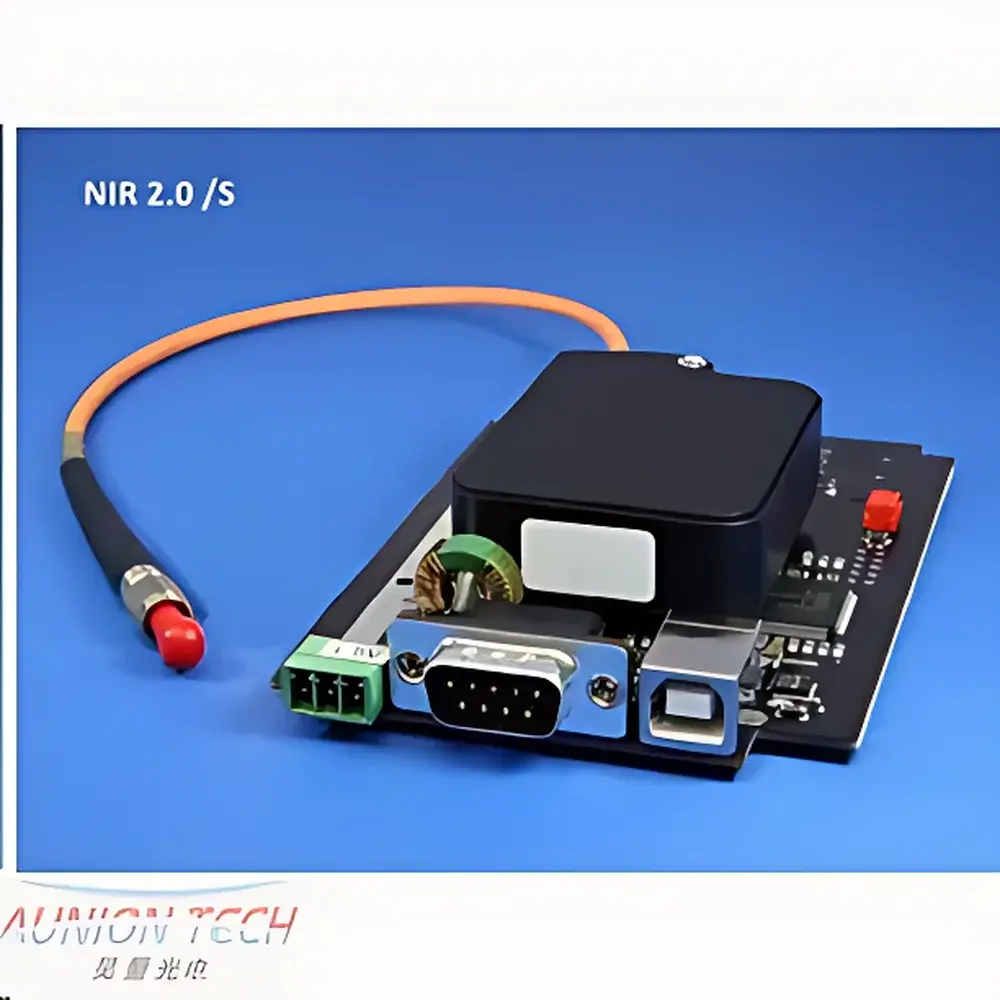
INSION NIR2.0 Wideband Miniature Near-Infrared Fiber Optic Spectrometer (900–2000 nm)
| Brand | INSION |
|---|---|
| Origin | Germany |
| Type | Portable |
| Principle | Dispersive Spectroscopy (MEMS-based Waveguide Grating) |
| Wavelength Range | 900–2000 nm |
| Optical Resolution | <16 nm (FWHM) |
| Wavelength Repeatability | ≤0.1 nm |
| Thermal Wavelength Stability | <0.03 nm/K |
| Sensitivity | >1×10¹² counts·nm/W·s @ 1500 nm |
| SNR | ≥5000 (at 2 ms integration time) |
| Slit | 60 µm × 300 µm |
| Operating Temperature | 0–45 °C |
| Storage Temperature | −40–60 °C |
| Dimensions (NIR2.0) | 108 × 76.6 × 21.5 mm³ |
| Weight (NIR2.0) | 130 g |
| Fiber Input | 300/330 µm core, NA = 0.22, length = 280 ± 20 mm |
| Interface | USB Type-B, RS-232 |
| Power Supply | 5 V DC, ripple <50 mV |
| Max. Power Consumption | 7.5 W |
| Software | SPECview (with chemometric preprocessing modules) |
Overview
The INSION NIR2.0 is a wideband miniature near-infrared fiber optic spectrometer engineered for high-reliability field deployment and embedded OEM integration. Unlike conventional scanning or Fourier-transform NIR systems, the NIR2.0 employs a monolithic MEMS-fabricated hollow waveguide grating architecture—where diffraction optics, input slit, and detector coupling are co-integrated onto a single silicon-based optical substrate. This design eliminates alignment-sensitive free-space optics, delivering intrinsic immunity to mechanical shock, vibration, and thermal drift. Its operational wavelength range spans 900–2000 nm, covering critical molecular overtone and combination bands of C–H, O–H, and N–H functional groups—enabling quantitative and qualitative analysis across pharmaceuticals, agri-food, petrochemicals, and biomedical applications. The device complies with IEC 61326-1 for electromagnetic compatibility and meets mechanical robustness requirements per ISO 13373-3 for condition monitoring instrumentation.
Key Features
- Monolithic MEMS Waveguide Platform: All optical components—including transmission grating, collimating structure, and focal plane—are lithographically defined on a single hollow-core waveguide chip, ensuring long-term spectral fidelity without recalibration.
- Vibration-Resistant Architecture: Validated under random vibration profiles up to 10 g RMS (20–2000 Hz) and mechanical shock pulses of 50 g (11 ms), making it suitable for mobile platforms such as agricultural harvesters, engine test benches, and handheld analyzers.
- Thermally Stable Performance: Achieves <0.03 nm/K wavelength shift coefficient via passive athermal design—no active temperature control required within 0–45 °C operating range.
- Low-Power, Compact Form Factor: Measures only 108 × 76.6 × 21.5 mm³ and weighs 130 g, powered by standard 5 V USB supply (4 hours with typical duty cycles.
- High Quantum Efficiency Detection: Back-thinned InGaAs linear array with TE cooling stabilization delivers >1×10¹² counts·nm/W·s sensitivity at 1500 nm and SNR ≥5000 at 2 ms integration time—optimized for low-light, rapid-scan applications.
Sample Compatibility & Compliance
The NIR2.0 interfaces seamlessly with standard SMA-905 fiber probes (300/330 µm core, NA 0.22), supporting reflectance, transmittance, and diffuse absorption configurations. It accommodates liquid cells (path lengths 0.1–10 mm), flow-through cuvettes, and contact probes for solid surface interrogation. All firmware and calibration data adhere to GLP-compliant traceability protocols; spectral calibration certificates are NIST-traceable and include uncertainty budgets per ISO/IEC 17025. The instrument supports audit trail logging in accordance with FDA 21 CFR Part 11 when used with validated SPECview software deployments. It conforms to RoHS 2011/65/EU and REACH (EC) No. 1907/2006 material restrictions.
Software & Data Management
SPECview software provides native driver support for Windows/Linux/macOS and exposes full API access via DLL, Python bindings (PySPEC), and LabVIEW VI libraries. Core functionalities include real-time spectral acquisition, dark/current reference correction, Savitzky-Golay smoothing, baseline offset removal, and peak integration. Chemometric toolsets include PCA, PLS regression, and SVM classification models—exportable in PMML format for deployment in industrial SCADA or MES environments. Raw spectra are stored in HDF5 format with embedded metadata (wavelength axis, integration time, temperature, serial number), ensuring FAIR (Findable, Accessible, Interoperable, Reusable) data principles. Firmware updates are delivered via signed binary packages with SHA-256 verification.
Applications
- Pharmaceutical Quality Control: Rapid identification of API polymorphs, excipient uniformity assessment, and blend homogeneity monitoring in real-time during fluid bed drying or tablet compression.
- Grain & Oilseed Analysis: Prediction of moisture, protein, oil, and starch content in wheat, corn, soybean, and rapeseed using PLS models trained on reference wet chemistry data (ASTM D6342, ISO 12099).
- Petrochemical Feedstock Screening: Quantification of aromatic content, cetane number surrogates, and oxidation stability indices in diesel and jet fuel streams.
- Dermatological & Blood Oximetry: Non-invasive estimation of tissue hemoglobin concentration and oxygen saturation through calibrated diffuse reflectance modeling (modified Beer-Lambert law).
- OEM Integration: Serves as a core optical engine in portable food authenticity testers, veterinary point-of-care analyzers, and inline process sensors for continuous manufacturing (ICH Q5, Q8, Q9 aligned).
FAQ
What is the spectral sampling interval of the NIR2.0?
The detector array provides 256 pixels across the 900–2000 nm range, yielding an average sampling interval of ~4.3 nm/pixel. Interpolation algorithms in SPECview support sub-pixel resolution for peak centroiding.
Can the NIR2.0 be operated in continuous scanning mode?
Yes—it supports frame rates up to 120 Hz at minimum integration time (100 µs), with hardware-triggered acquisition and external sync input (TTL-compatible) for synchronization with conveyors or pump cycles.
Is radiometric calibration available?
NIST-traceable irradiance and radiance calibration kits are offered as optional accessories, including tungsten-halogen and deuterium lamp standards with certified spectral flux data.
Does the device support multi-channel synchronization?
Up to four NIR2.0 units can be synchronized via shared clock and trigger lines for spatially resolved or dual-wavelength differential measurements.
How is spectral drift compensated during extended field use?
Built-in reference LED (1550 nm) enables automated background correction every 60 seconds; users may also schedule periodic dark/reference acquisitions via scriptable acquisition sequences in SPECview.






