
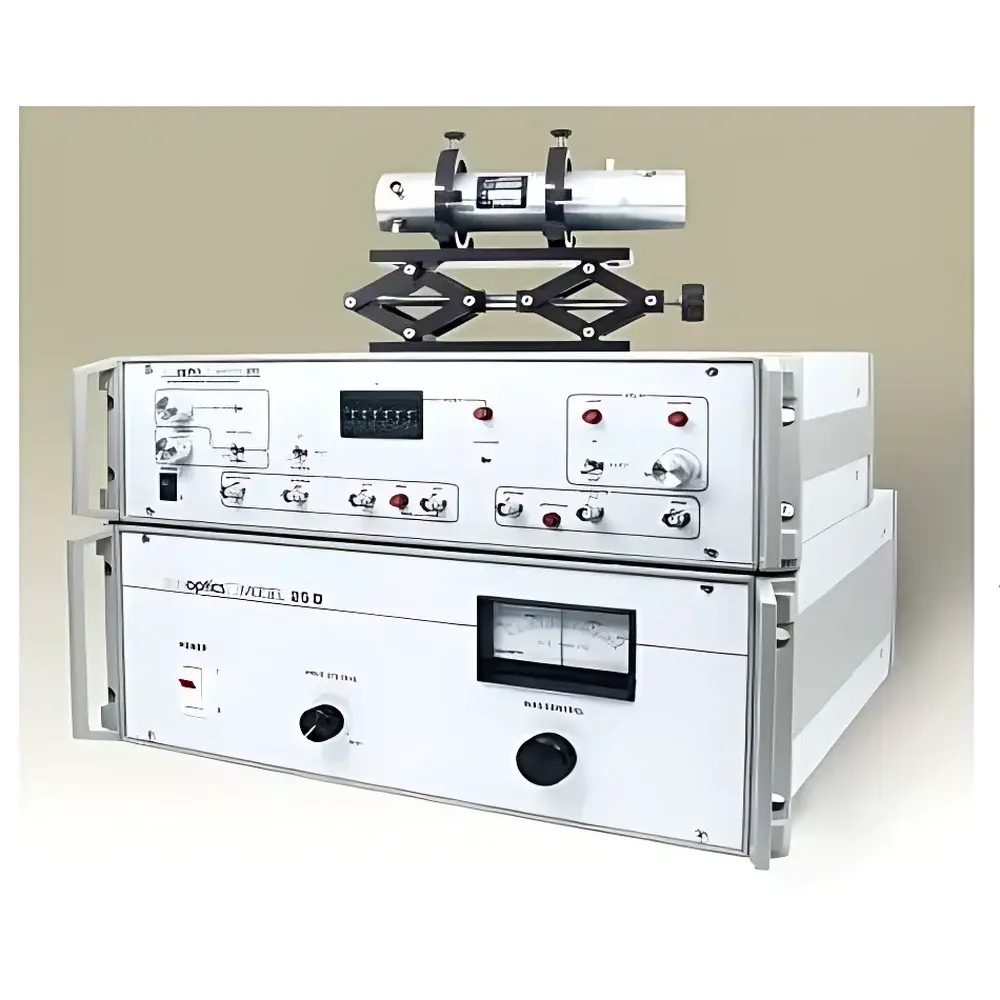
ConOptics Model 350-80 Pulse Picker System
| Brand | ConOptics |
|---|---|
| Origin | USA |
| Type | Electro-Optic Pulse Selector |
| Modulation Material | LiNbO₃ (Lithium Niobate) |
| Repetition Rate Range | 0–80 MHz (up to 100 MHz optional) |
| Operating Wavelength Range | 400–1100 nm |
| Drive Voltage | < 300 V (half-wave voltage dependent on wavelength and aperture) |
| Rise/Fall Time | < 10 ns |
| Extinction Ratio | > 100:1 |
| Aperture | 2 mm clear aperture |
| Compliance | RoHS, CE-marked for lab use |
| Component Category | Optical Instrument Component |
Overview
The ConOptics Model 350-80 Pulse Picker System is a high-speed electro-optic (EO) pulse selection instrument engineered for precise temporal gating of ultrafast laser sources—particularly Ti:sapphire femtosecond oscillators operating at fundamental repetition rates of 70–100 MHz. Based on the Pockels effect in lithium niobate (LiNbO₃), this device functions as a synchronized optical switch, enabling deterministic selection of individual pulses from a continuous pulse train without mechanical delay lines or lossy passive filtering. Its core architecture integrates a low-voltage, high-bandwidth EO modulator with a dedicated TTL-synchronized driver and precision timing interface, allowing users to decimate pulse trains while preserving pulse energy stability, temporal profile fidelity, and beam pointing accuracy. Unlike acousto-optic pulse pickers, the Model 350-80 delivers sub-nanosecond switching response and minimal group delay dispersion—critical for applications demanding phase coherence across selected pulses, such as pump-probe spectroscopy, regenerative amplifier seeding, and time-resolved nonlinear microscopy.
Key Features
- Electro-optic LiNbO₃ modulator with 100:1 static extinction ratio
- Programmable repetition rate selection from DC to 80 MHz (with factory calibration up to 100 MHz)
- Integrated TTL/CMOS-compatible sync input for lock-step operation with oscillator master clock or external trigger
- Low half-wave voltage design (<300 V typical at 800 nm), compatible with standard high-voltage pulse generators
- 2 mm clear aperture optimized for Gaussian beam profiles up to 1/e² diameter of 1.5 mm
- AR-coated optics for 400–1100 nm broadband transmission; specified for Ti:sapphire (700–900 nm), Yb-fiber (1030 nm), and Nd:YAG (1064 nm) wavelengths
- Rugged, kinematically mounted housing with SM1-threaded input/output ports and integrated thermal stabilization
Sample Compatibility & Compliance
The Model 350-80 is designed for integration into Class 3B and Class 4 laser laboratories compliant with IEC 60825-1 and ANSI Z136.1 safety standards. It supports collimated free-space beams with M² 100:1 (linear, vertical or horizontal orientation configurable via waveplate alignment). The system meets RoHS Directive 2011/65/EU and carries CE marking for electromagnetic compatibility (EMC Directive 2014/30/EU) and low-voltage safety (LVD Directive 2014/35/EU). While not certified under FDA 21 CFR Part 11, its analog control interface and deterministic digital triggering support GLP/GMP-aligned experimental documentation when paired with timestamped data acquisition systems.
Software & Data Management
The pulse picker operates in hardware-triggered mode and does not require proprietary software for basic functionality. However, ConOptics provides LabVIEW™ and Python API examples (via serial or USB-to-TTL interface) for automated repetition rate sweeps, gated acquisition synchronization, and interlock status monitoring. All timing parameters—including delay relative to master clock edge, pulse width gate window, and burst mode enable/disable—are configurable via ASCII command set. Audit trails of configuration changes can be logged externally using third-party DAQ platforms (e.g., National Instruments PXI, Keysight PathWave). No onboard non-volatile memory or user-accessible firmware updates are implemented, ensuring deterministic behavior in regulated environments.
Applications
- Seeding regenerative amplifiers with precisely timed, low-jitter pulse trains
- Reducing repetition rate for time-resolved fluorescence lifetime imaging (FLIM) and single-photon counting
- Generating variable-duty-cycle pulse bursts for laser micromachining process optimization
- Synchronization with delayed optical parametric amplifier (OPA) pump-probe delays
- Intensity gating in multi-photon excitation microscopy to minimize photodamage
- Calibration reference generation for ultrafast photodetector impulse response characterization
FAQ
What is the maximum optical power density the Model 350-80 can handle?
The device is rated for average powers up to 500 mW and peak intensities below 1 GW/cm² at 800 nm with 100-fs pulses—exceeding typical Ti:sapphire oscillator output specifications.
Can the pulse picker operate at non-harmonic division ratios (e.g., 1:3, 1:7)?
Yes—its digital trigger logic accepts arbitrary TTL sequences; it is not limited to integer divisors of the source repetition rate.
Is polarization sensitivity compensated internally?
No—input polarization must be aligned to the crystal’s extraordinary axis; external half-wave plates are recommended for polarization rotation.
Does ConOptics provide OEM integration support?
Yes—custom mounting brackets, fiber-coupled variants (with FC/APC or SMA connectors), and OEM driver board designs are available under NDA.
How is timing jitter characterized?
RMS jitter is ≤1.2 ps (measured against 80-MHz reference clock, 10 kHz–10 MHz bandwidth), dominated by driver electronics rather than EO crystal response.






