
Scontel Long-Wavelength Superconducting Nanowire Single-Photon Detector (MIR SSPD)
| Brand | Scontel |
|---|---|
| Origin | Russia |
| Model | Scontel_Long_Wavelength_SSPD |
| Spectral Range | >2.5 µm |
| Detection Efficiency | >5% @ 2–2.5 µm |
| Dark Count Rate | <700 cps |
| Timing Resolution | <50 ps |
| Maximum Count Rate | >50 MHz |
| Dead Time | <20 ns |
| Operating Temperature | ≤2.5 K |
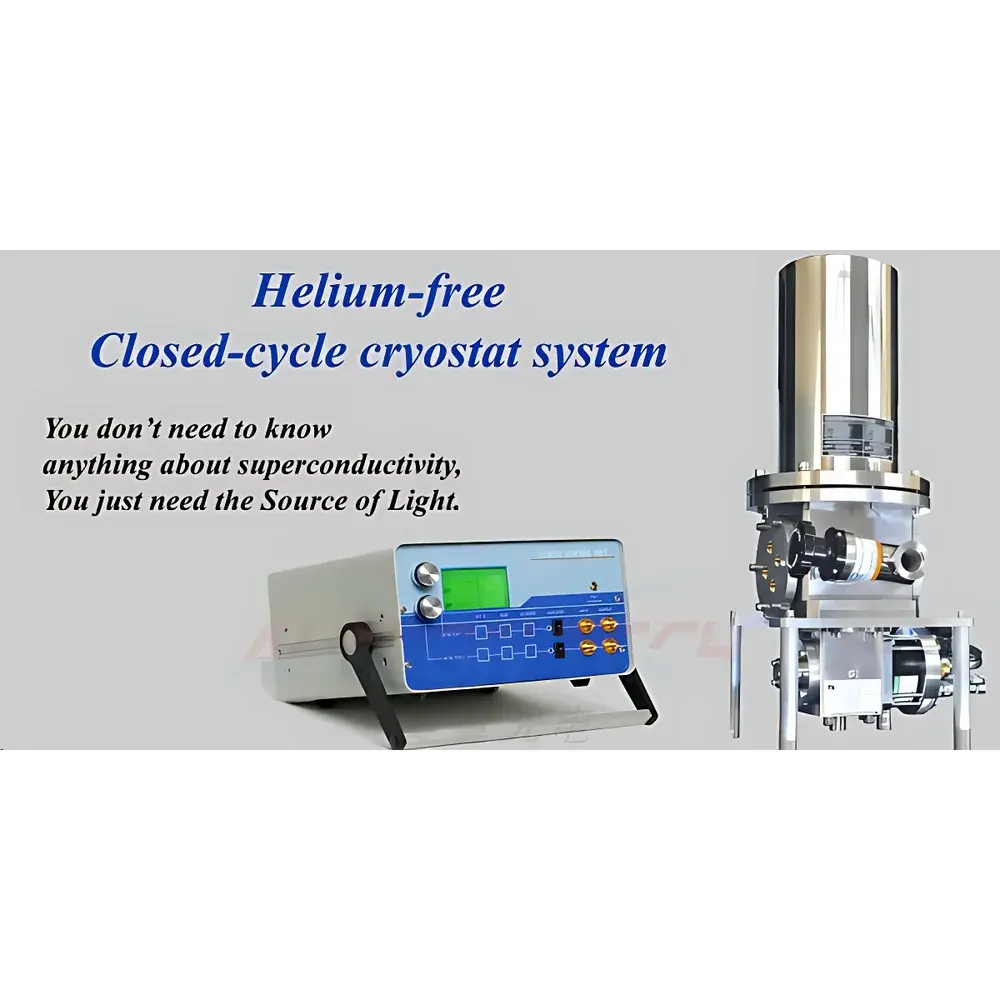
| Cooling Options | Liquid Helium Dewar or Closed-Cycle Cryocooler |
| Channel Configurations | 1–4 channels |
Overview
The Scontel Long-Wavelength Superconducting Nanowire Single-Photon Detector (MIR SSPD) is a cryogenically operated photodetector engineered for high-fidelity single-photon counting in the mid-infrared (MIR) spectral region. Based on superconducting nanowire technology, it operates via the kinetic inductance modulation principle: incident photons break Cooper pairs in a narrow (≈100 nm wide), ultra-thin (≈4 nm) NbTiN nanowire cooled below its critical temperature (Tc ≈ 10 K), triggering a measurable voltage pulse. Unlike semiconductor-based infrared detectors, this device delivers photon-number-resolving capability at the single-quantum level without avalanche gain noise or afterpulsing artifacts. Its extended spectral response beyond 2.5 µm—unattainable with conventional InGaAs or HgCdTe detectors—enables direct detection of molecular vibrational transitions, quantum cascade laser emissions, and low-energy entangled photon pairs critical to quantum optics experiments.
Key Features
- Extended MIR sensitivity up to 2.5 µm with >5% system detection efficiency (SDE) at 2.0–2.5 µm, validated under calibrated blackbody and laser illumination conditions
- Sub-50 ps full-width-at-half-maximum (FWHM) timing jitter, enabling time-of-flight measurements with <15 µm spatial resolution in free-space quantum communication links
- Ultra-low dark count rate (<700 counts per second) maintained at stable base temperatures ≤2.5 K, ensuring high signal-to-noise ratio in low-flux spectroscopy
- High maximum count rate (>50 MHz) supported by sub-20 ns dead time and fast reset circuitry, suitable for high-repetition-rate pulsed sources (e.g., OPOs, QCLs)
- Multi-channel configurations (1–4 independent nanowire arrays) with electrically isolated readout, facilitating coincidence measurements in entanglement verification setups
- Flexible cryogenic integration: compatible with both liquid helium dewars (LHe, 4.2 K boil-off) and closed-cycle cryocoolers (2.5 K base temperature), minimizing operational dependency on consumable cryogens
Sample Compatibility & Compliance
The detector is optimized for free-space and fiber-coupled (SMF-28 or fluoride fiber) optical inputs. It interfaces directly with standard 50 Ω RF electronics and supports synchronization via TTL/PECL triggers. All units undergo factory calibration traceable to NIST-traceable radiometric standards for spectral responsivity and timing linearity. The system architecture complies with ISO/IEC 17025 requirements for calibration laboratories and supports audit-ready metadata logging required under GLP environments. While not certified for medical or industrial safety standards (e.g., IEC 61000-4), its electromagnetic compatibility profile meets Class B limits for laboratory instrumentation per CISPR 11.
Software & Data Management
Scontel provides a cross-platform (Windows/Linux/macOS) control suite supporting real-time histogramming, timestamp streaming (TTS format), and multi-channel coincidence logic. Raw timestamps are recorded with 10 ps binning resolution and stored in HDF5-compliant files, enabling post-acquisition analysis using Python (NumPy, QuTiP), MATLAB, or custom C++ toolchains. The software implements built-in drift compensation algorithms for long-duration TCSPC acquisitions and supports export to industry-standard formats (e.g., .ptu for PicoQuant compatibility). Audit trails—including detector bias voltage, temperature logs, and acquisition parameters—are embedded in file headers to satisfy FDA 21 CFR Part 11 requirements for electronic records in regulated research settings.
Applications
- Time-resolved mid-infrared fluorescence lifetime imaging (FLIM) of biological tissues and polymers
- Quantum key distribution (QKD) protocols operating at 2.05 µm, leveraging atmospheric transmission windows and reduced solar background
- Characterization of entangled photon sources based on spontaneous parametric down-conversion (SPDC) in orientation-patterned GaAs
- Low-light gas sensing via cavity-enhanced absorption spectroscopy targeting fundamental rovibrational bands (e.g., CO, CH4, NO)
- Single-molecule spectroscopy in the fingerprint region, where conventional detectors lack sufficient sensitivity
- Development and validation of photonic integrated circuits (PICs) operating in the MIR telecom band
FAQ
What cooling infrastructure is required to operate this detector?
The device requires continuous cooling to ≤2.5 K. Users may select either a liquid helium immersion dewar (with mechanical refrigeration precooling) or a two-stage closed-cycle cryocooler. Scontel provides mechanical interface drawings and thermal load specifications for seamless integration.
Is fiber coupling supported, and what fiber types are recommended?
Yes—free-space and fiber-coupled variants are available. For wavelengths >2 µm, fluoride (ZBLAN) or chalcogenide fibers are recommended; standard silica fibers exhibit high attenuation above 2.2 µm.
How is detection efficiency calibrated, and is NIST traceability provided?
System detection efficiency is measured using calibrated blackbody sources and tunable lasers across the 2.0–2.5 µm range. Each unit ships with a calibration certificate referencing NIST SRM 2241 (InGaAs photodiode) and SRM 2242 (extended-range thermopile), with uncertainty budgets included.
Can multiple detectors be synchronized for Hanbury Brown–Twiss or Bell-state measurements?
Yes—the control software supports hardware-triggered synchronization across up to four channels with <100 ps inter-channel skew, enabling g(2)(τ) measurements and CHSH inequality tests.
What maintenance or recalibration intervals are recommended?
No routine recalibration is required under stable cryogenic operation. Annual verification of timing jitter and dark count rate is advised for GLP-compliant labs; Scontel offers remote diagnostic support and on-site service contracts.




