
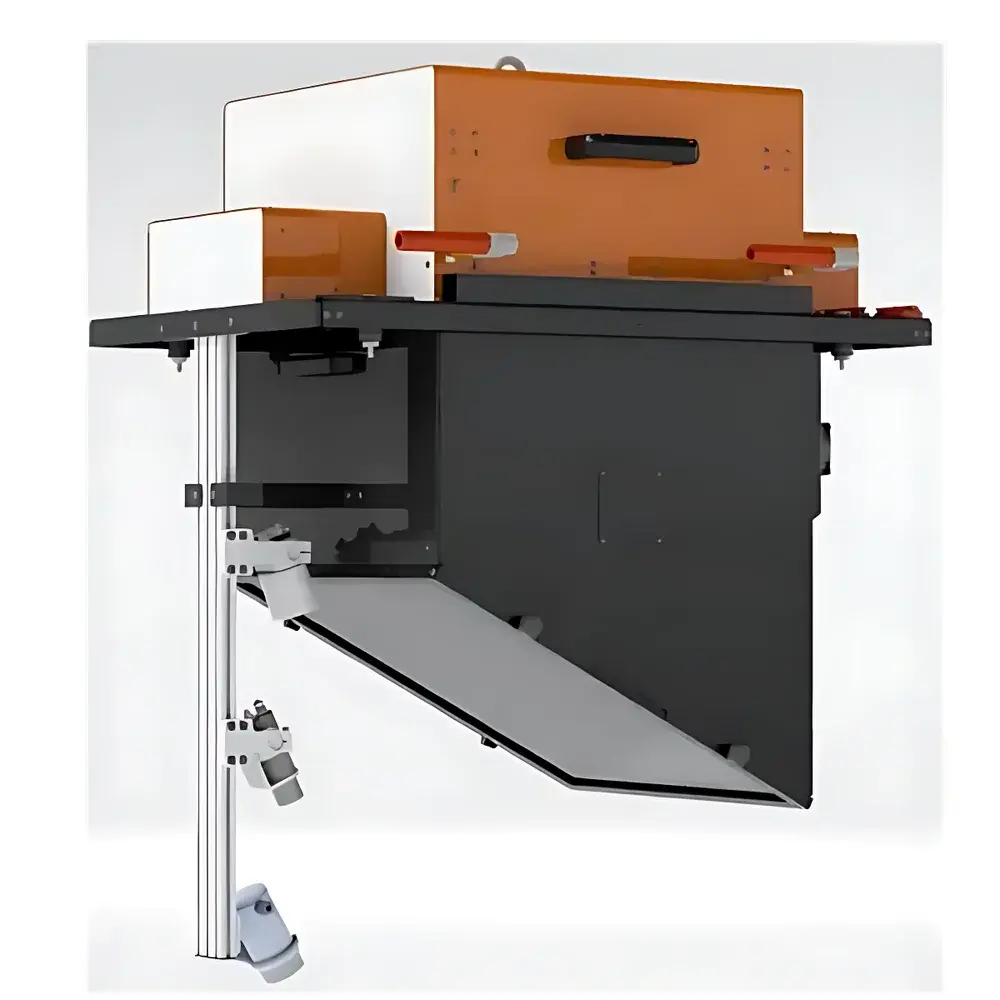
Auniontech AD360 Stacked Solar Cell Characterization System with LED-based Class AAA+ Solar Simulator
| Brand | Auniontech |
|---|---|
| Origin | Shanghai, China |
| Model | AD360 |
| Spectral Match (IEC 60904-9 Ed.3) | 0.95–1.05 (A+) |
| Spatial Uniformity (260 × 260 mm²) | <1% |
| Long-Term Instability (LTI) | <0.2% |
| Short-Term Instability (STI) | Synchronized |
| Illumination Area | Up to 260 × 260 mm² |
| Spectral Range | 350–1200 nm (25+ independently tunable LED channels) |
| Flash Duration | 10 ms to continuous |
Overview
The Auniontech AD360 Stacked Solar Cell Characterization System is a high-precision, LED-based solar simulator engineered for advanced photovoltaic R&D and production validation of tandem, perovskite-silicon, and multi-junction solar cells. Unlike traditional xenon or halogen-based simulators, the AD360 employs 25+ spectrally discrete, individually addressable LED channels spanning 350–1200 nm—enabling programmable, physically accurate spectral replication of AM1.5G, AM0, or custom spectra required for current-matching analysis in stacked architectures. Its optical architecture delivers Class AAA+ performance per IEC 60904-9 Ed. 3 (spectral match A+, spatial uniformity A+, temporal stability A+), verified via integrated, real-time spectroradiometric monitoring and NIM-traceable calibration. The system operates on a closed-loop feedback principle: an embedded miniature spectrometer and calibrated photodiode array continuously sample irradiance and spectral distribution during operation, dynamically adjusting LED drive currents to maintain long-term spectral fidelity (<0.2% LTI over 8 hours). This enables reliable, repeatable J-V, EQE, Suns-Voc, and MPP tracking under industrially relevant illumination conditions—critical for validating spectral response mismatch, interfacial recombination losses, and thermal drift in monolithic and mechanically stacked devices.
Key Features
- 25+ independently tunable LED channels with peak wavelengths optimized for PV-relevant bands (UV–NIR), enabling full-spectrum customization and dynamic AM1.5G reconstruction
- Optical engine certified to IEC 60904-9 Ed. 3 Class AAA+ (spectral match 0.95–1.05, uniformity <1% over 260 × 260 mm², STI synchronized)
- Real-time closed-loop spectral control: integrated spectroradiometer + photodiode array provide continuous feedback for long-term irradiance stability
- Modular dual-source configuration: optional secondary LED array for bifacial illumination and rear-side characterization of tandem cells
- Programmable exposure: adjustable pulse width from 10 ms to continuous DC mode, supporting both transient and steady-state measurements
- Industrial-grade mechanical architecture: vibration-damped optical bench, water-cooled LED arrays, and IP54-rated enclosure for cleanroom and pilot-line integration
- Native support for rapid characterization suites including RapidWAVE®-IV (capacitance-compensated J-V), RapidWAVE®-EQE (channel-resolved quantum efficiency), and Suns-Voc (series-resistance-independent Voc mapping)
Sample Compatibility & Compliance
The AD360 accommodates samples ranging from 20 × 20 mm² research coupons to full-size 260 × 260 mm² mini-modules, with configurable contact solutions including spring-loaded probe arrays, vacuum chuck stages, and temperature-controlled copper platters (−40°C to +120°C). For tandem cell evaluation, it supports automated spectral recalibration routines that decouple top- and bottom-cell contributions using sequential monochromatic excitation and bias-light superposition. All optical and electrical calibrations are traceable to national metrology institutes (NIM, PTB), and measurement workflows comply with IEC 61215-1-2 (tandem-specific test requirements), IEC 62108 (multi-junction qualification), and ASTM E927-19 (solar simulator classification). Data acquisition adheres to GLP-compliant audit trails, with timestamped metadata logging (spectral snapshot, irradiance, chamber ambient, contact resistance) satisfying ISO/IEC 17025 documentation requirements.
Software & Data Management
Control and analysis are unified under Auniontech’s PVLab Suite—a modular, Python-extendable platform compliant with IEEE 1547.1 data exchange standards. The software enforces role-based access control (RBAC) and provides 21 CFR Part 11–compliant electronic signatures, audit logs, and data integrity safeguards. Key modules include: RapidWAVE®-IV (with adaptive sweep algorithms compensating for junction capacitance and charge trapping); RapidWAVE®-EQE (single-channel LED excitation with lock-in detection and spectral deconvolution); PL/EL/IR imaging synchronizer (hardware-triggered acquisition across three modalities with sub-millisecond alignment); and MPP Tracker (adaptive perturb-and-observe algorithm with user-defined dwell time and convergence criteria). Raw spectral, temporal, and spatial datasets are stored in HDF5 format with embedded SI-unit metadata, enabling direct import into MATLAB, Python (SciPy/PVLib), or commercial TCAD tools for device simulation correlation.
Applications
- Current-matching optimization and spectral loss analysis in perovskite/Si, III-V/Si, and all-perovskite tandem cells
- Non-destructive defect mapping via synchronized PL/EL/IR imaging—identifying shunts, microcracks, interfacial delamination, and localized recombination
- Temperature-dependent J-V and Voc characterization using integrated high-speed pyrometer (±0.5°C accuracy, 9 mm spot size at 450 mm working distance)
- Front/rear contact resistance profiling using multi-point probing and four-wire Kelvin sensing
- Stability assessment under prolonged illumination (light-soaking protocols per ISOS-L-1) with in situ spectral drift monitoring
- Process window validation for deposition, annealing, and passivation steps in pilot-line environments
FAQ
What spectral standards does the AD360 support out-of-the-box?
The system ships with preloaded AM1.5G (IEC 60904-3), AM0 (ASTM E490), and custom spectra for common tandem configurations (e.g., perovskite bandgap 1.72 eV / Si 1.12 eV). Users may define new spectra via CSV input with wavelength-intensity pairs.
Can the AD360 perform simultaneous top/bottom cell characterization in monolithic tandems?
Yes—using synchronized PL/EL imaging with spectral filtering and bias-light modulation, the system isolates emission from each subcell. Combined with RapidWAVE®-EQE, it quantifies individual subcell external quantum efficiency without physical layer separation.
Is spectral recalibration required between measurement sessions?
No. The integrated spectroradiometer performs automatic in-situ verification before each flash sequence; only annual NIM-traceable recalibration is recommended for metrological compliance.
How is temperature controlled during extended illumination tests?
The system integrates a water-cooled LED engine and optional Peltier-stabilized sample stage. Real-time pyrometry feeds back to a PID loop controlling stage temperature within ±0.3°C over 24-hour tests.
Does the software support automated reporting for IEC certification submissions?
Yes—PVLab Suite generates IEC 61215-1-2 Annex A–compliant PDF reports, including spectral match tables, uniformity heatmaps, J-V curve overlays, and uncertainty budgets per GUM (JCGM 100:2008).



