
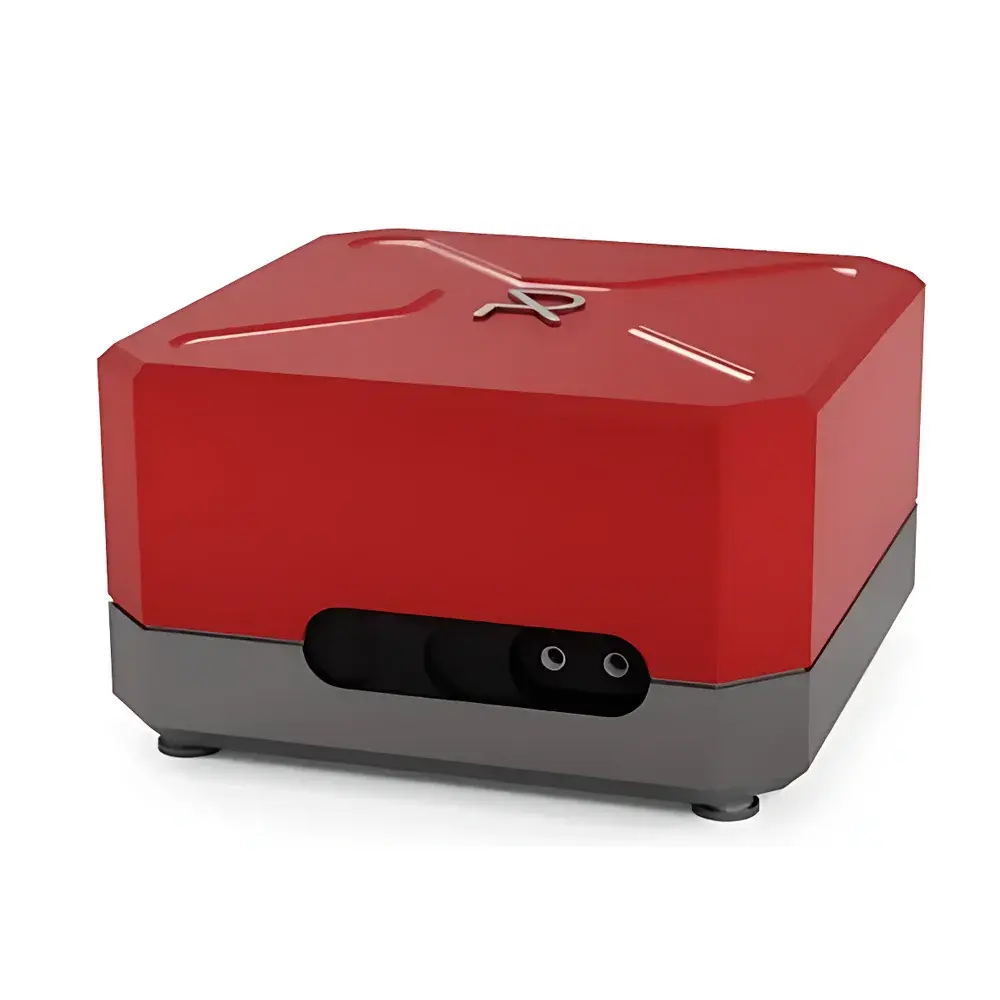
Auniontech PICUS High-Speed Tunable FOPO Laser for Coherent and Stimulated Raman Imaging
| Brand | Auniontech |
|---|---|
| Model | PICUS |
| Type | Fiber-Optic Picosecond Dual-Channel OPO Laser Source |
| Tuning Speed | 5 ms per wavelength step |
| Tuning Range | 700–3200 cm⁻¹ (Stokes) |
| Repetition Rate | 40 MHz |
| Pulse Duration | 7 ps (pump & Stokes) |
| Relative Intensity Noise (RIN) | –157 dBc/Hz (shot-noise limited, Stokes output) |
| Output | Polarization-Maintaining Single-Mode Fiber Coupled |
| Shock Resistance | Up to 25 m/s² |
| Dimensions | 40 × 40 × 20 cm |
| Cooling | Air-Cooled |
| FM Modulation Option | ±20 MHz (for FM-CARS/FM-SRS background suppression) |
| OEM Form Factor | 19-inch rack-mountable chassis |
Overview
The Auniontech PICUS is a fully fiber-integrated, dual-channel picosecond optical parametric oscillator (FOPO) laser engineered specifically for high-speed, broadband coherent anti-Stokes Raman scattering (CARS) and stimulated Raman scattering (SRS) microscopy. Unlike conventional solid-state OPO-based systems that rely on mechanical delay lines and bulk optics, the PICUS leverages chirped fiber Bragg grating (CFBG)-based spectral tuning within an all-polarization-maintaining (PM) fiber architecture. This eliminates moving parts, ensures diffraction-limited beam pointing stability across its full 700–3200 cm⁻¹ Raman shift range, and delivers synchronized pump and Stokes pulses with precisely matched temporal profiles (7 ps duration) and exceptional amplitude and phase stability. Its shot-noise-limited relative intensity noise (RIN) of –157 dBc/Hz at the Stokes output enables quantitative, high-fidelity SRS imaging—particularly critical for multi-color lipid/protein/DMSO discrimination in live biological tissues without resonant background contamination.
Key Features
- Sub-5-ms wavelength tuning per step across 700–3200 cm⁻¹—enabling video-rate hyperspectral CARS/SRS acquisition
- Fully fiber-coupled, polarization-maintaining dual-channel output with Gaussian beam quality and zero beam walk-off during scanning
- Air-cooled, compact footprint (40 × 40 × 20 cm), rack-mountable OEM version available (19-inch chassis)
- Shock-resistant design validated to 25 m/s²—ensuring operational robustness in mobile or integrated instrumentation environments
- Integrated FM modulation option (±20 MHz) for pump beam—supporting background-free FM-CARS and FM-SRS with no manual alignment required
- No mechanical delay lines; CFBG-based spectral tuning provides deterministic, repeatable, and maintenance-free wavelength selection
- Plug-and-play USB/Ethernet interface with vendor-provided control software compliant with standard LabVIEW and Python APIs
Sample Compatibility & Compliance
The PICUS is optimized for label-free, non-invasive chemical imaging of native biological specimens—including fresh adipose tissue, skin biopsies, and ex vivo organ sections—without fixation or staining. Its 40 MHz repetition rate and low RIN ensure sufficient photon flux for subcellular resolution while minimizing thermal load and photodamage. The system meets core requirements for GLP-compliant analytical microscopy: traceable wavelength calibration (NIST-traceable reference cells available), audit-trail-capable software logging, and deterministic pulse timing essential for time-resolved SRS lock-in detection. While not a medical device, its performance aligns with ISO 13694 (laser beam parameters) and IEC 60825-1 (laser safety class IV compliance documentation provided). All fiber components conform to Telcordia GR-1209-CORE specifications for long-term reliability under thermal and mechanical stress.
Software & Data Management
The PICUS is controlled via Auniontech’s proprietary PICUS Control Suite, a Windows-based application supporting real-time wavelength scanning, dual-channel synchronization, FM modulation parameter definition, and hardware-triggered acquisition. The software exports metadata-embedded TIFF stacks compliant with OME-TIFF standards, including calibrated wavenumber axis, dwell time, and pulse energy logs. API support includes MATLAB, Python (PyVISA + NumPy), and LabVIEW drivers—enabling integration into custom image acquisition pipelines (e.g., with NI PXI or Thorlabs Kinesis platforms). Raw pulse timing data and RIN spectra are exportable for third-party spectral analysis. Firmware updates preserve backward compatibility and include built-in self-diagnostics (fiber continuity, pump diode health, temperature drift compensation).
Applications
The PICUS serves as a turnkey excitation source for quantitative vibrational microspectroscopy in academic and industrial research settings. Primary use cases include: real-time monitoring of lipid droplet dynamics in live hepatocytes; spatially resolved mapping of protein secondary structure in amyloid plaques; high-throughput screening of polymer blend homogeneity (e.g., PS/PMMA); and rapid forensic identification of pharmaceutical crystallinity via DMSO solvation signatures. Its FM-CARS capability enables background-suppressed imaging of low-cross-section Raman modes (e.g., C–D stretches at 2100–2300 cm⁻¹) in deuterated metabolic probes. In clinical research, it supports intraoperative margin assessment—demonstrated in murine ear and human sebaceous gland imaging where lipid/protein ratio quantification correlates with histopathological grade.
FAQ
What is the maximum achievable spectral acquisition rate for a full 700–3200 cm⁻¹ scan?
At 100 spectral points, 256 × 256 pixels, and 10 µs dwell time per pixel, a complete hyperspectral dataset is acquired in ≤60 seconds.
Does the PICUS require water cooling or external vibration isolation?
No—air cooling and monolithic fiber architecture eliminate both requirements.
Can the FM modulation option be retrofitted to existing units?
Yes, field-upgrade kits including firmware and driver modules are available under service contract.
Is the Stokes output power tunable across the full spectral range?
Yes—output power remains >50 mW over 700–3200 cm⁻¹ with <±5% variation, calibrated and logged per wavelength step.
What level of technical support is provided for OEM integration?
Auniontech offers application engineering support, mechanical mounting drawings, electrical interface schematics, and pre-validation test reports for seamless subsystem integration.






