
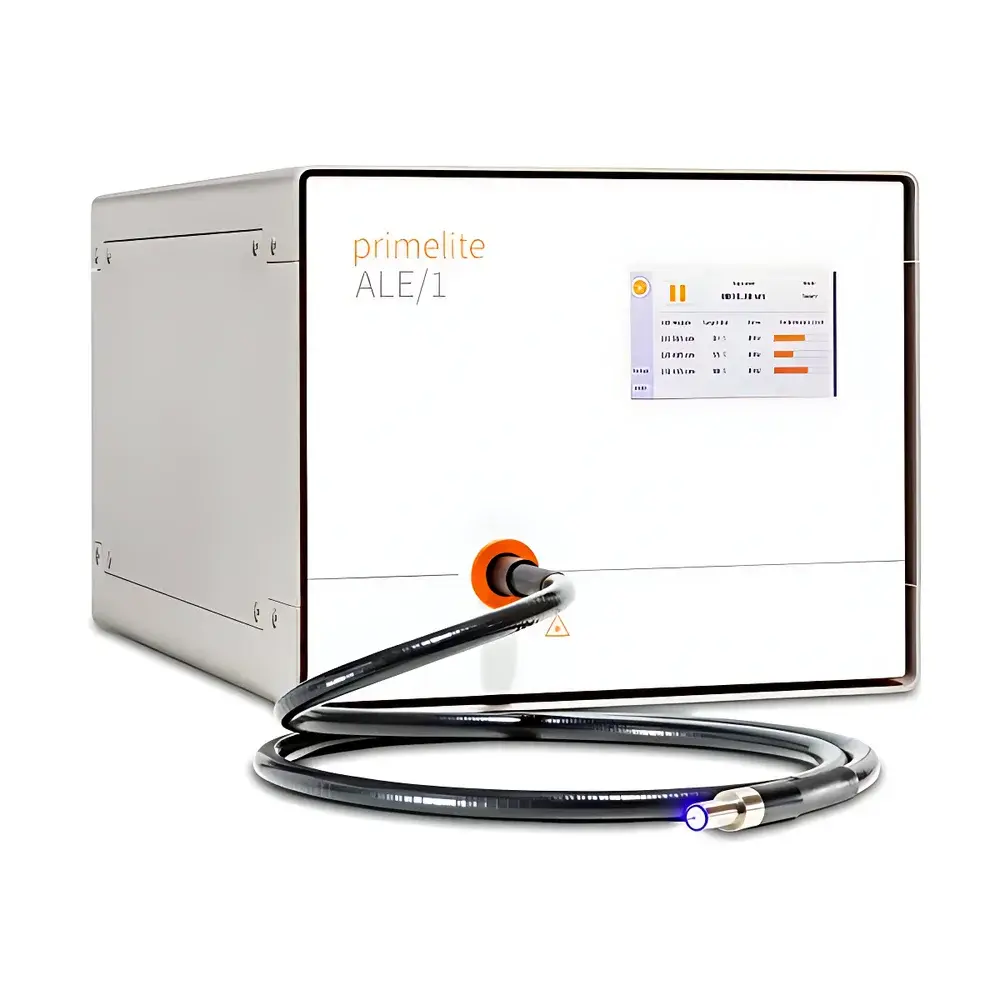
Auniontech ALE/1 High-Power Modular Multi-Band UV-LED Spot Light Source
| Brand | Auniontech |
|---|---|
| Origin | Germany |
| Model | ALE/1 |
| Spectral Range | 365–970 nm |
| Max. Total Radiant Output | 30 W |
| Max. Irradiance | 95,000 mW/cm² |
| Numerical Aperture | 0.60 (70° full angle) |
| LED Count | Up to 5 independently controlled emitters |
| Rise Time | <1 ms |
| Control Interfaces | Touch Display, USB (ALE PC Software), PLC Discrete I/O, AUX Trigger, Fieldbus (e.g., CANopen on request) |
| Cooling | Integrated liquid cooling |
| Dimensions (W×H×D) | 28 × 23 × 40 cm |
| Weight | 15 kg |
| Power Input | 110–240 VAC, 50–60 Hz, 1000 W max |
| Fiber Coupling | Ø5.0 / Ø6.5 / Ø8.0 mm AR-coated light guides (standard length 1.5 m, custom up to 15 m) |
Overview
The Auniontech ALE/1 is a high-power, modular multi-band UV-LED spot light source engineered for precision photopolymerization, UV curing, and spectral-process-critical applications in industrial manufacturing, microelectronics, and advanced materials R&D. Unlike conventional mercury arc lamps, the ALE/1 employs solid-state LED technology across the near-ultraviolet (NUV), visible (VIS), and near-infrared (NIR) spectrum—spanning 365 nm to 970 nm—to deliver stable, repeatable, and spectrally customizable irradiance without mercury, ozone generation, or warm-up delays. Its core architecture follows a platform-based optical engine design, enabling up to five discrete high-radiance LED emitters—including combinations of 365 nm, 385 nm, 405 nm, 435 nm, 470 nm, 520 nm, 620 nm, 660 nm, 690 nm, 730 nm, 770 nm, 810 nm, 850 nm, and 970 nm—to be co-aligned and intensity-controlled within a single compact housing. This enables deterministic spectral tailoring to match photoinitiator absorption profiles, maximize quantum efficiency, and eliminate unnecessary spectral waste—directly improving process yield and reducing total cost of ownership (TCO).
Key Features
- Modular spectral configuration: Select and combine up to five discrete LED wavelengths (365–970 nm) to match application-specific photochemical requirements.
- High radiant power density: Up to 30 W total optical output; irradiance exceeding 95,000 mW/cm² at the fiber exit (with Ø8.0 mm AR-coated light guide).
- Sub-millisecond dynamic control: LED rise/fall time <1 ms enables precise pulse-width modulation (PWM), synchronized exposure sequencing, and real-time dose control.
- Integrated closed-loop regulation: Onboard photodiode feedback continuously monitors optical output per channel and dynamically adjusts drive current to maintain setpoint stability ±2% over ambient temperature fluctuations.
- Passive and active thermal management: Liquid-cooled thermal architecture ensures long-term radiometric stability and extends LED lifetime beyond 20,000 hours at rated output.
- Plug-and-play integration: Standardized mechanical interface, fiber-coupled output, and native support for industrial communication protocols (PLC discrete I/O, USB, AUX TTL, CANopen) simplify retrofitting into legacy production lines or new equipment builds.
Sample Compatibility & Compliance
The ALE/1 is compatible with a broad range of UV-curable resins, adhesives, coatings, and bio-photopolymers requiring activation at discrete wavelengths. Its spectral flexibility supports ISO 11153 (UV curing equipment performance standards), ASTM D4459 (accelerated weathering of UV-cured materials), and industry-specific specifications for display bonding, PCB conformal coating, dental composite curing, and microfluidic device fabrication. While not a medical device itself, the system’s traceable intensity calibration, audit-ready parameter logging (via ALE PC software), and configurable user access levels align with GLP/GMP documentation practices. All electrical components comply with CE, UL 61010-1, and RoHS directives; optical safety conforms to IEC 62471 (Risk Group 3 for high-intensity UV configurations).
Software & Data Management
The ALE/1 is operated via an integrated touchscreen HMI or remotely using the vendor-supplied ALE PC Software (Windows-based). The software provides full channel-by-channel control—including independent intensity setting (20–100% in 0.1% increments), preset recall, exposure timing (ms–hours), and multi-step program sequencing. All operational parameters—including timestamped irradiance readings, thermal sensor logs, LED drive currents, and fault events—are recorded locally and exportable as CSV. For regulated environments, optional audit-trail functionality supports FDA 21 CFR Part 11 compliance through electronic signatures, role-based access control, and immutable log archiving. Integration with MES/SCADA systems is enabled via Modbus TCP or custom API upon request.
Applications
- Industrial UV curing of conformal coatings, potting compounds, and structural adhesives in automotive and aerospace assembly.
- Photolithography mask alignment and direct-write exposure in MEMS and micro-optics prototyping.
- 3D printing (SLA/DLP) light engines with tunable spectral output to optimize resin crosslinking kinetics.
- Biomedical device manufacturing: UV-curing of hydrogels, biosensors, and microfluidic chips under controlled wavelength conditions.
- Research-grade photochemistry: Wavelength-resolved reaction kinetics studies, photocatalyst activation, and optogenetic stimulation setups.
- Retrofit replacement of medium-pressure Hg lamps in legacy UV conveyor systems—reducing energy use by >60% and eliminating lamp disposal hazards.
FAQ
What is the maximum number of wavelengths that can be combined in one ALE/1 unit?
Up to five discrete LED emitters—each operating at a fixed center wavelength between 365 nm and 970 nm—can be integrated and independently controlled within a single ALE/1 optical engine.
Does the ALE/1 require external water cooling?
No. The system includes a self-contained, recirculating liquid cooling loop with internal heat exchanger; no external chiller or plumbing is required.
Can I replace individual LEDs in the field?
Yes. LED modules are designed for tool-free, sub-minute replacement by end users—minimizing downtime and supporting predictive maintenance strategies.
Is spectral calibration traceable to NIST or other national standards?
Each unit ships with factory-measured relative spectral irradiance data (±2 nm bandwidth). Absolute calibration certificates (traceable to PTB or NIST-accredited labs) are available as an optional service.
What light guide options are supported?
Standard configurations include Ø5.0 mm, Ø6.5 mm (AR-coated), and Ø8.0 mm (AR-coated) silica fiber bundles; lengths from 1 m to 15 m and custom termination optics (collimators, focusing lenses, diffusers) are available on request.




