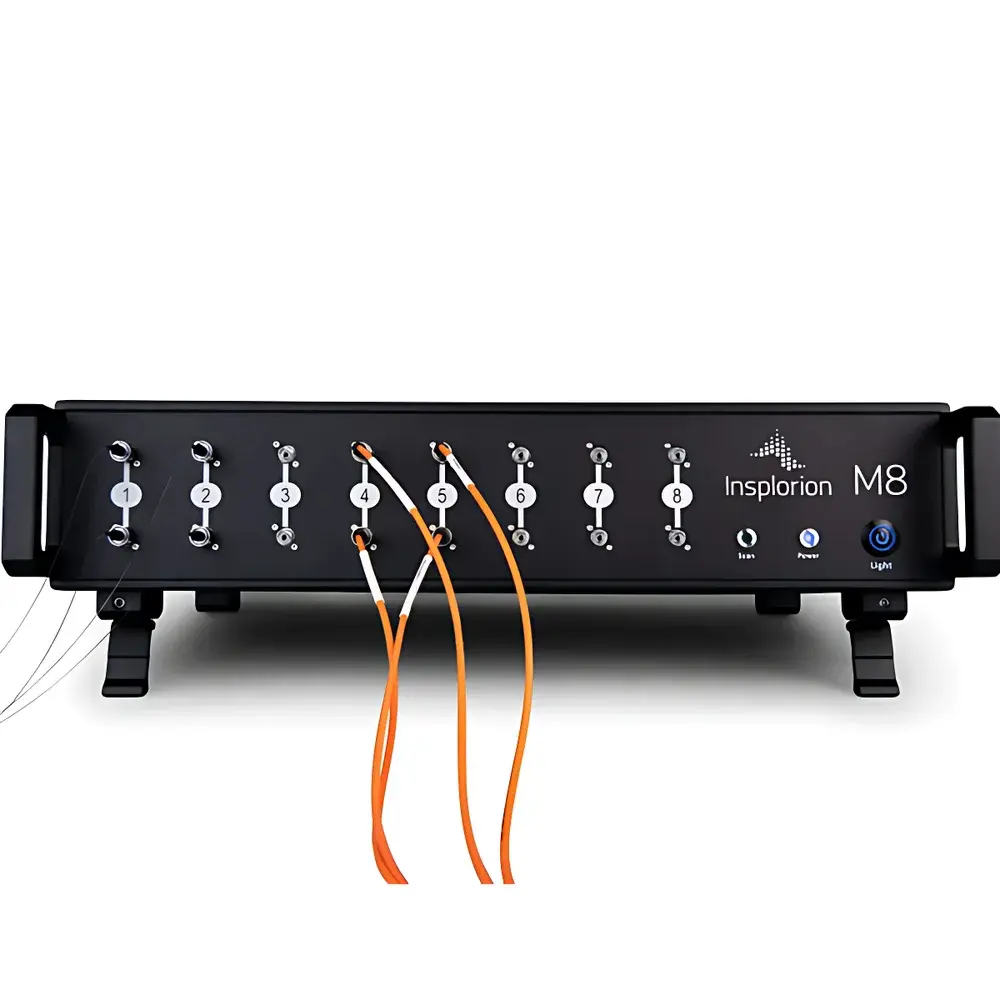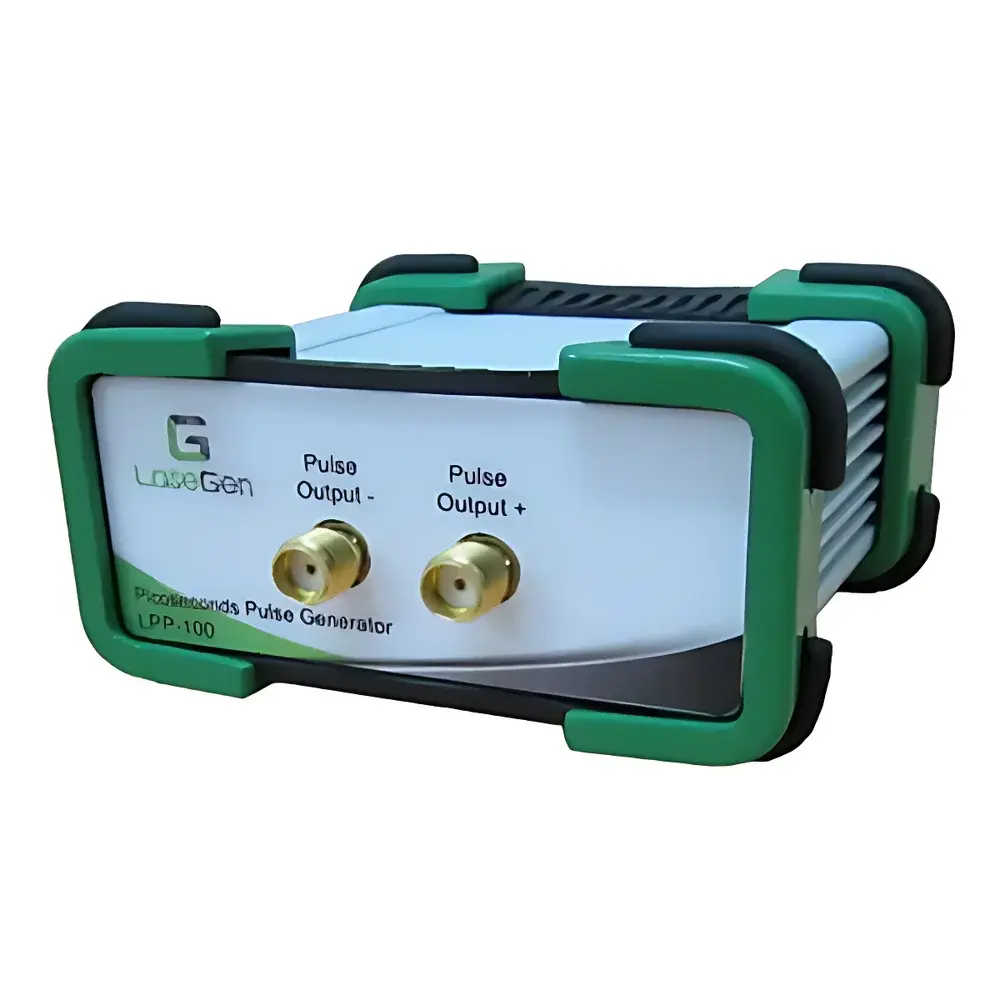
Auniontech LPP-100/LPP-200 Picosecond Pulse Generator + LRA-100 Picosecond Amplifier
| Brand | Auniontech |
|---|---|
| Origin | Shanghai, China |
| Model | LPP-100 (Fixed 30 ps), LPP-200 (Tunable 50–1000 ps), LRA-100 Amplifier |
| Output Coupling | AC |
| Input/Output Impedance | 50 Ω |
| Rise/Fall Time (20–80%) | 15–40 ps |
| Pulse Width (FWHM) | 30 ps (LPP-100), 50–1000 ps (LPP-200) |
| Additive Timing Jitter | < 500 fs |
| Repetition Rate | Single-shot to 5 GHz (LPP-100), 50 kHz to 150 MHz (LPP-200), 10 kHz to 2 GHz (LRA-100) |
| Output Amplitude | >250 mVpp (LPP-100 SE), >500 mVpp (LPP-200 SE), 3.5–6.5 Vpp (LRA-100) |
| Connectors | SMA (LPP series), K-type (LRA-100) |
| Power Supply | DC 3.3 V / 2 A (LPP-100), AC 100–240 V (50/60 Hz) (LPP-200), unspecified (LRA-100) |
Overview
The Auniontech LPP-100 and LPP-200 picosecond pulse generators—paired with the LRA-100 broadband amplifier—constitute a modular, high-fidelity signal generation platform engineered for ultrafast electronic and optoelectronic applications. These instruments operate on the principle of clock-triggered pulse shaping, leveraging fast-edge semiconductor switching and impedance-matched transmission line design to generate deterministic electrical transients with sub-20 ps rise/fall times and femtosecond-level timing stability. Unlike arbitrary waveform generators (AWGs) limited by sampling rate and memory depth, this dedicated pulse architecture delivers exceptional temporal fidelity without interpolation artifacts or DAC-induced jitter. The system is optimized for driving gain-switched laser diodes, optical pulse picking, RF photonic sampling gates, and digital comb synthesis where precise edge definition, low additive jitter (<500 fs), and repeatable pulse-to-pulse amplitude stability are critical. All units comply with 50 Ω impedance standards and feature SMA or K-type RF connectors for seamless integration into high-speed test benches and ultrafast photonics laboratories.
Key Features
- Sub-20 ps rise/fall time (20–80%): Achieved via optimized GaAs or SiGe driver topology; LPP-100 typ. 15 ps, LPP-200 typ. 17–40 ps depending on pulse width setting
- Ultra-low additive timing jitter: <500 fs RMS (integrated from 10 kHz to 10 MHz offset), enabling synchronization-critical experiments in pump-probe spectroscopy and time-of-flight measurements
- LPP-100: Fixed-output pulse width options at 30 ps (standard), 50/75/100 ps, or user-selectable 51–200 ps FWHM
- LPP-200: Continuously tunable pulse width from 50 ps to 1000 ps FWHM, calibrated and repeatable across full range
- LRA-100 amplifier: Delivers 3.5–6.5 Vpp differential output with <20 ps rise/fall time and minimal pulse distortion (no overshoot or ringing under matched load)
- Full bandwidth support: DC-coupled AC output path ensures preservation of fast transient integrity up to 20 GHz effective bandwidth (verified via S-parameter modeling)
- Robust trigger architecture: Accepts sine or square-wave reference clocks from 1 Hz to 5 GHz (LPP-100) or 50 kHz to 150 MHz (LPP-200); supports external synchronization with programmable delay
Sample Compatibility & Compliance
The LPP/LRA platform interfaces directly with standard 50 Ω RF instrumentation—including high-bandwidth oscilloscopes (≥20 GHz), electro-optic modulators, and gain-switched laser drivers—without requiring impedance-matching adapters. All units meet CE marking requirements for electromagnetic compatibility (EN 61326-1) and safety (EN 61010-1). While not certified to ISO/IEC 17025 for metrological traceability, the instruments are designed for use in GLP-compliant environments where documented calibration procedures and audit-ready configuration logs are maintained. Output jitter performance aligns with IEEE Std 1139-2008 definitions for phase noise and timing stability, supporting traceable uncertainty budgets in time-domain metrology workflows.
Software & Data Management
Both LPP-100 and LPP-200 support remote control via USB 2.0 and optional Ethernet interface (TCP/IP), compatible with SCPI command set (IEEE 488.2 compliant). Configuration files—including pulse width, repetition rate, and output polarity—are stored in non-volatile memory and recalled on power-up. The LRA-100 operates as a passive analog stage but includes status LEDs for input lock detection and overdrive warning. No proprietary software is required; integration with LabVIEW, Python (PyVISA), MATLAB, or Keysight PathWave is straightforward. All devices log internal temperature and supply voltage for health monitoring, and firmware updates are performed via signed binary upload to ensure integrity and version control—supporting FDA 21 CFR Part 11 compliance when deployed within validated laboratory information management systems (LIMS).
Applications
- Gain-switching excitation of ultrafast laser diodes (e.g., mode-locked VECSELs, DFB lasers) requiring precise current injection timing
- Optical pulse picking in regenerative amplifiers and cavity-dumped oscillators
- Time-gated detection in time-resolved fluorescence or THz-TDS systems
- Digital frequency comb generation via harmonic multiplication of periodic picosecond triggers
- Calibration of high-speed photodetectors and sampling oscilloscopes
- Testing of ultrafast logic families (ECL, CML) and GaN/SiC power gate drivers
- Quantum optics experiments requiring synchronized pump/probe sequences with sub-picosecond relative timing control
FAQ
What is the difference between LPP-100 and LPP-200?
The LPP-100 provides fixed pulse widths (30 ps standard, plus selectable 50/75/100/51–200 ps options), while the LPP-200 offers continuous electronic tuning from 50 ps to 1000 ps FWHM with calibrated step resolution.
Can the LRA-100 amplify arbitrary waveforms?
No—the LRA-100 is optimized for narrowband, high-slew-rate picosecond pulses. It is not suitable for wideband AWG outputs or complex modulated signals due to its tailored frequency response and saturation characteristics.
Is external triggering mandatory?
No—both LPP models include internal clock synthesis capable of generating stable repetition rates from single-shot to 5 GHz (LPP-100) or up to 150 MHz (LPP-200); external clock input is optional for synchronization with master timing sources.
Do these instruments require warm-up time for specification compliance?
Yes—full performance specifications (especially jitter and amplitude stability) are guaranteed after 30 minutes of continuous operation at ambient temperatures between 15 °C and 30 °C.
Are calibration certificates available?
Factory calibration reports (including rise time, pulse width, jitter, and amplitude verification at multiple settings) are provided with each unit; NIST-traceable calibration is available as an optional service with documented uncertainty budgets.