
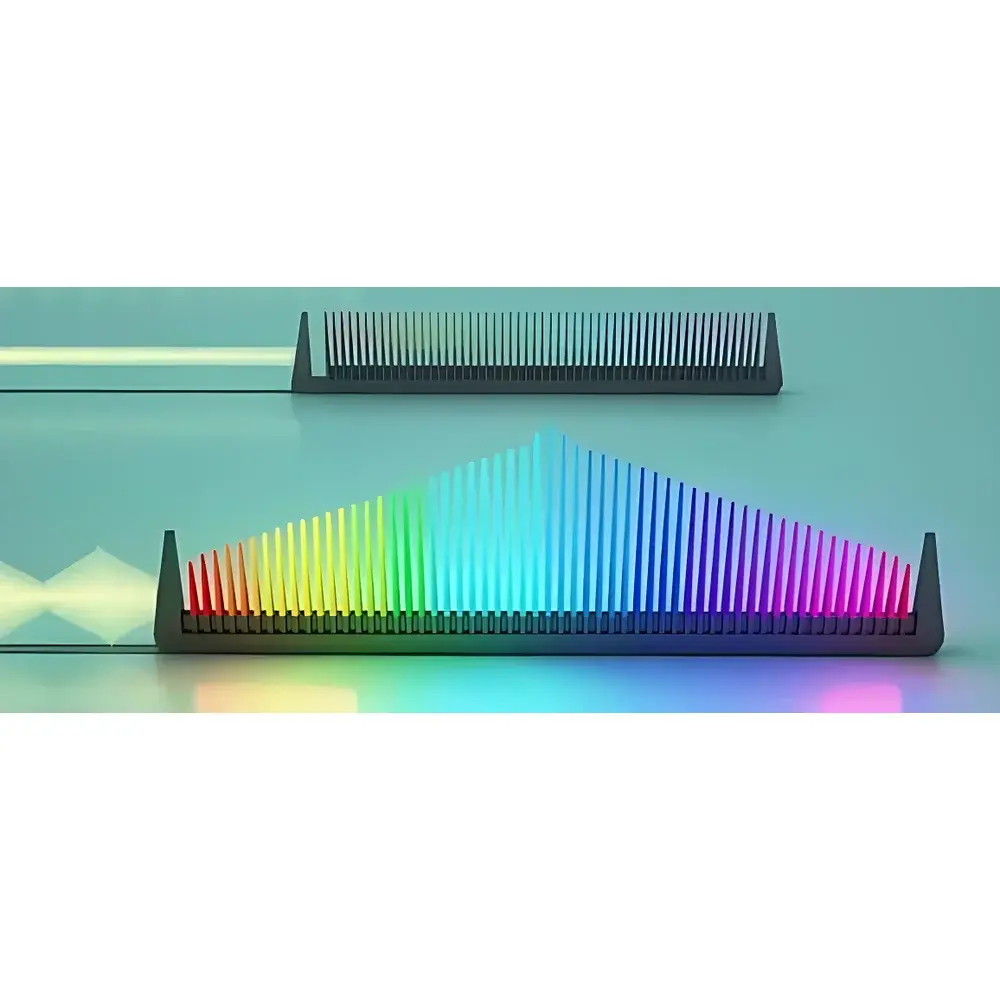
Auniontech 80 MHz Single-Cavity Dual-Comb Laser
| Brand | Auniontech |
|---|---|
| Model | 80 MHz |
| Laser Type | Mode-Locked Solid-State Femtosecond Oscillator |
| Repetition Rate Difference (Δf<sub>rep</sub>) | Tunable, Typically < 1 kHz |
| Output Wavelength | ~1030–1064 nm (Yb-doped solid-state) |
| Pulse Duration | < 200 fs (typ.) |
| Comb Spacing | 80 MHz (primary comb), Δf<sub>rep</sub> ≈ 100 Hz–1 kHz (secondary comb) |
| Noise Performance | Sub-100 attosecond timing jitter (integrated 10 Hz–10 MHz), < −160 dBc/Hz RIN (1 MHz offset) |
| Cavity Architecture | Monolithic, All-PM Fiber or Hybrid Bulk-Fiber |
| Compliance | CE Marked, RoHS Compliant |
| Software Interface | USB 2.0 / Ethernet, SCPI-compatible command set |
| Operating Environment | 15–30 °C, < 70% RH non-condensing |
Overview
The Auniontech 80 MHz Single-Cavity Dual-Comb Laser is a fully integrated, passively stabilized mode-locked femtosecond oscillator engineered for high-fidelity dual-comb generation without active repetition-rate locking. Unlike conventional dual-comb systems requiring two independent lasers with active feedback loops—complex, vibration-sensitive, and costly—this instrument generates two optical frequency combs within a single shared laser cavity. The two combs share identical carrier-envelope offset frequencies (fCEO) and nearly identical repetition rates (frep,1 and frep,2), differing only by a small, stable Δfrep (typically 100 Hz to 1 kHz). This architecture inherently suppresses common-mode environmental noise—including acoustic, thermal, and mechanical perturbations—resulting in exceptional mutual coherence and long-term relative timing stability. As a consequence, the system operates robustly in free-running mode, eliminating the need for fast electronic servo controllers, piezoelectric actuators, or optical delay lines traditionally required for ASOPS or heterodyne dual-comb spectroscopy.
Key Features
- Single-cavity monolithic design enabling intrinsic common-mode noise rejection and passive mutual stabilization
- Free-running operation with no active repetition-rate or carrier-envelope offset locking electronics
- Ultra-low timing jitter (< 100 as, integrated 10 Hz–10 MHz) and intensity noise (< −160 dBc/Hz at 1 MHz offset)
- Compact footprint (< 30 × 25 × 12 cm) and turnkey alignment-free operation
- 80 MHz fundamental repetition rate with precisely controllable inter-comb beat note via cavity dispersion tuning
- Fully polarization-maintaining (PM) output with >20 dB PER and collimated free-space or FC/APC fiber-coupled delivery options
- Integrated thermoelectric cooling and low-noise current drivers ensuring long-term power stability (< ±0.3% over 8 h)
Sample Compatibility & Compliance
This laser is compatible with standard free-space optical paths, fiber-pigtailed interferometers, and commercial dual-comb spectrometers requiring two mutually coherent femtosecond sources. It meets IEC 60825-1:2014 Class 4 laser safety requirements with integrated interlock circuitry and key-switch enable. The device conforms to EU Directive 2014/30/EU (EMC Directive) and 2011/65/EU (RoHS), and carries CE marking for laboratory use in EEA member states. For regulated environments—including GLP-compliant metrology labs or ISO/IEC 17025-accredited calibration facilities—the system supports optional audit-trail-enabled firmware (compliant with FDA 21 CFR Part 11 Annex 11 principles) when paired with Auniontech’s certified data acquisition software suite.
Software & Data Management
The laser includes native support for SCPI (Standard Commands for Programmable Instruments) over USB 2.0 and 10/100 Ethernet interfaces. A dedicated Windows/Linux SDK provides APIs in C++, Python (PyVISA), and MATLAB for full remote control of operating temperature, pump current, and cavity dispersion compensation. Real-time monitoring of output power, pulse train RF spectrum, and inter-comb beat signal is enabled via built-in 12-bit ADC channels sampled at 1 MS/s. All acquired data are timestamped with microsecond resolution and stored in HDF5 format, ensuring compatibility with scientific analysis frameworks such as SciPy, OriginPro, and LabVIEW. Optional time-stamped logging enables traceable calibration records per ISO/IEC 17025 Clause 7.7.
Applications
- Dual-comb spectroscopy (DCS) across near-IR and mid-IR (with difference-frequency generation modules)
- Absolute distance metrology with micrometer-level precision over meter-scale baselines
- Time-resolved pump–probe experiments in ultrafast condensed matter physics and photochemistry
- Terahertz time-domain spectroscopy (THz-TDS) using dual-comb electro-optic sampling
- Transient absorption and coherent anti-Stokes Raman scattering (CARS) with asynchronous acquisition
- Optical frequency synthesis and optical clock comparisons in metrology laboratories
- Non-contact picosecond ultrasonics for thin-film and multilayer material characterization
FAQ
Does this laser require external stabilization electronics to maintain dual-comb coherence?
No. Its single-cavity architecture ensures passive mutual coherence; no RF synthesizers, phase-locked loops, or fast piezo actuators are needed.
Can the repetition-rate difference (Δfrep) be tuned in real time?
Yes—via thermally controlled intracavity dispersion elements, Δfrep can be adjusted from 1 kHz with sub-Hz resolution and millisecond response time.
Is fiber coupling available as a standard configuration?
Yes—both free-space collimated and polarization-maintaining (PM980) fiber-coupled outputs are offered, with coupling efficiency >75% and extinction ratio >20 dB.
What is the typical amplitude noise floor (RIN) and how does it impact dual-comb SNR?
RIN is 70 dB dynamic range in heterodyne dual-comb detection without averaging.
Are OEM integration options supported for embedded instrumentation?
Yes—custom mechanical housings, DC-powered variants (12 V/24 V), and TTL-synchronized trigger outputs are available under NDA.




