
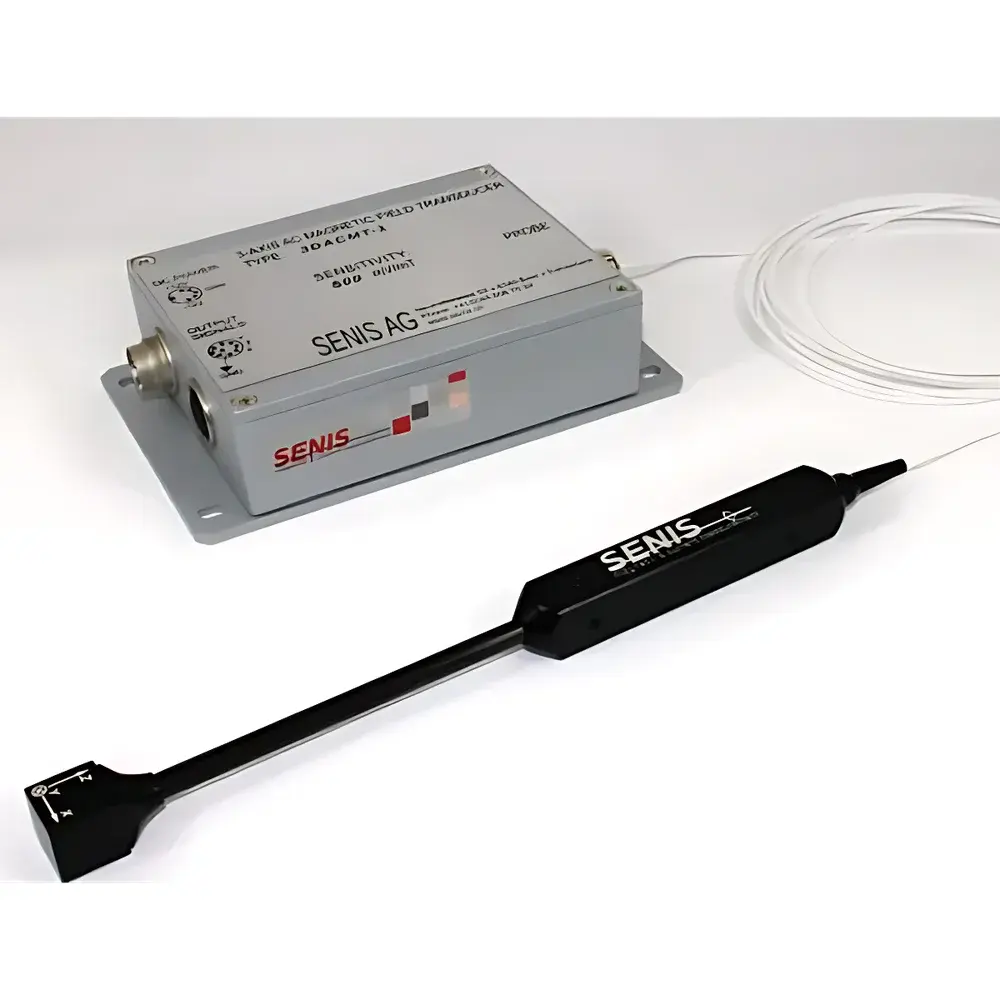
Auniontech 3DACMT-1 Triaxial AC Magnetic Field Transducer / Gaussmeter
| Brand | Auniontech |
|---|---|
| Origin | Shanghai, China |
| Model | 3DACMT-1 |
| Type | Triaxial AC Magnetic Field Transducer & Digital Gaussmeter |
| Frequency Range | 10 kHz – 200 kHz |
| Magnetic Field Resolution | <1.5 µT<sub>rms</sub> |
| Probe Volume | ≈3 cm³ |
| Linearity | ±1% full scale |
| Phase Accuracy | <3° (at 85 kHz) |
| Angular Accuracy | ±1° |
| Cross-Talk | Negligible |
| Output | Three isolated analog voltage signals (±5 V or 0–10 V configurable) |
| Sensor Core | Non-magnetic, orthogonal coil assembly with integrated analog integrator and low-noise amplifier |
| EMI Immunity | High (differential coil design, shielded housing) |
| Electric Field/Capacitive Coupling Rejection | Excellent |
Overview
The Auniontech 3DACMT-1 is a high-fidelity triaxial AC magnetic field transducer engineered for precision measurement and spatial mapping of time-varying magnetic fields in the 10 kHz to 200 kHz frequency band. Unlike conventional Hall-effect or fluxgate magnetometers, the 3DACMT-1 employs three mutually orthogonal air-core sensing coils—each individually integrated with matched analog integrators and low-noise amplifiers—within a compact, non-magnetic cubic housing (≈3 cm³). This architecture enables direct measurement of the vector components Bx, By, and Bz of the incident AC magnetic flux density without perturbing the field under test. The sensor operates on Faraday’s law of induction: the induced voltage in each coil is proportional to the time derivative of the magnetic flux linkage; the onboard analog integrator restores linearity by converting dΦ/dt to Φ, yielding output voltages directly proportional to instantaneous B-field magnitude per axis. Its fully passive, non-magnetic construction ensures zero field distortion—critical for metrology-grade characterization in near-field electromagnetic environments.
Key Features
- True triaxial vector measurement with common geometric center for all three orthogonal coils—enabling accurate directional analysis and spatial gradient estimation
- High-resolution AC field detection: <1.5 µTrms noise floor across full bandwidth, verified per IEC 61000-4-8 immunity testing protocols
- Exceptional phase fidelity: <3° phase error at 85 kHz supports time-domain waveform reconstruction and synchronous demodulation applications
- Angular accuracy of ±1° ensures reliable orientation-dependent field modeling—essential for coil alignment validation and magnetic dipole moment quantification
- Negligible inter-axis crosstalk (<−60 dB) eliminates need for post-acquisition matrix correction
- Electric field and capacitive coupling immunity achieved via balanced differential coil winding, grounded electrostatic shield, and common-mode rejection amplifier topology
- Robust analog outputs: Three galvanically isolated ±5 V (or 0–10 V) DC-coupled voltage signals—compatible with standard DAQ systems, oscilloscopes, and industrial PLCs without signal conditioning
Sample Compatibility & Compliance
The 3DACMT-1 is designed for non-invasive, contactless characterization of AC magnetic fields generated by power electronics, wireless power transfer (WPT) systems, inductive heating coils, and electromagnetic compatibility (EMC) test fixtures. Its miniature probe geometry allows deployment inside confined geometries—such as air gaps between transmitter and receiver pads in EV wireless charging systems—without introducing magnetic shunting or eddy current artifacts. The device complies with ISO/IEC 17025 calibration traceability requirements when used with NIST-traceable AC field reference sources. It supports GLP-aligned documentation workflows and is compatible with audit-ready data acquisition setups adhering to FDA 21 CFR Part 11 principles (when paired with compliant software platforms). No ferromagnetic materials are present in the sensing volume, satisfying ASTM A977/A977M criteria for non-perturbing field probes.
Software & Data Management
While the 3DACMT-1 operates as a hardware-transparent analog transducer, it is routinely deployed with third-party data acquisition systems—including National Instruments PXIe platforms, Dewesoft X, and MATLAB-based real-time acquisition toolchains—that support synchronized multi-channel sampling at ≥1 MS/s. Users commonly implement custom FFT-based spectral analysis, vector summation (|B| = √(Bx² + By² + Bz²)), and time-synchronized field mapping routines. Raw analog outputs retain full dynamic range and phase coherence, enabling post-processing for harmonic content analysis (e.g., THD assessment per IEC 61000-4-7) and transient field profiling. Calibration certificates include axis-specific sensitivity matrices and temperature drift coefficients (±0.02 %/°C), supporting automated compensation in Python- or LabVIEW-based analysis pipelines.
Applications
- Wireless power transfer (WPT) system validation: Quantitative 3D field mapping around SAE J2954-compliant EV charging pads to verify spatial uniformity, fringe field containment, and coupling efficiency
- Magnetic model verification: Experimental correlation of finite-element method (FEM) simulations (e.g., ANSYS Maxwell, COMSOL AC/DC Module) against measured B-field vector distributions under realistic excitation conditions
- EMI source localization: Identification of unintended magnetic emissions from inverters, DC-DC converters, and motor drives in automotive and aerospace subsystems
- Inductive sensor calibration: Reference-grade field generation and monitoring in closed-loop magnetic position or current sensing systems
- Material characterization: Non-contact evaluation of magnetic shielding effectiveness (SE) of nanocrystalline alloys or mu-metal enclosures at high frequencies
FAQ
What is the maximum measurable field strength for the 3DACMT-1?
The full-scale range is configurable via external gain settings on the connected DAQ system; typical operation spans ±10 mT to ±100 mT depending on integration time and noise budget.
Is the sensor suitable for DC or quasi-static field measurements?
No—the 3DACMT-1 is optimized exclusively for AC fields ≥10 kHz; its coil-based architecture lacks DC response due to fundamental integrator saturation limitations.
Can multiple 3DACMT-1 units be synchronized for array-based field tomography?
Yes—when driven by a common clock signal and sampled with a multi-channel synchronized DAQ, spatially distributed units enable time-resolved 3D field reconstruction with sub-millimeter positional registration.
Does the device require periodic recalibration?
Annual recalibration is recommended per ISO/IEC 17025 guidelines; drift is typically <0.1% per year under stable thermal conditions (23 ±2 °C).
Is firmware or driver software provided by Auniontech?
No—the 3DACMT-1 is an analog-output-only transducer with no embedded microcontroller; no drivers, SDKs, or firmware updates are required or supported.



