
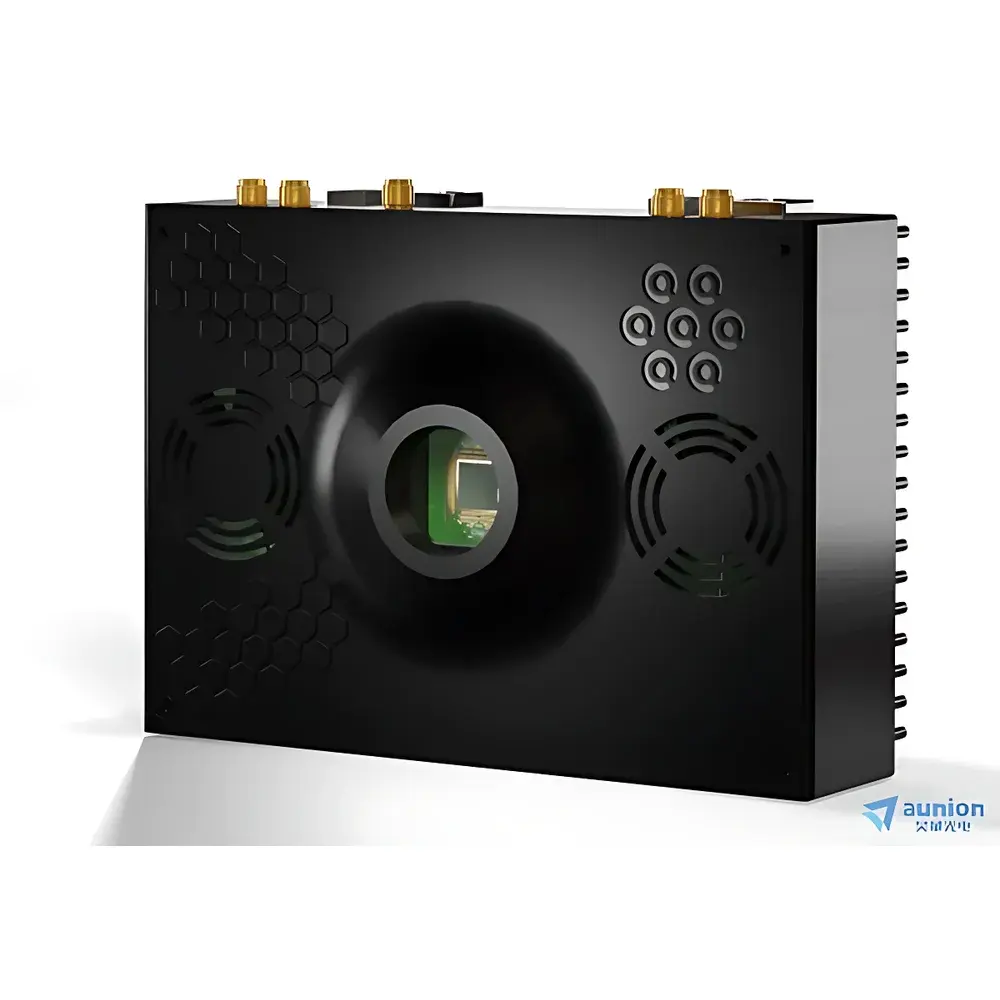
Auniontech SPAD512S 512×512 High-Speed Single-Photon Avalanche Diode (SPAD) Imaging Camera with Phasor Analysis
| Brand | Auniontech |
|---|---|
| Origin | Switzerland |
| Model | SPAD512S |
| Sensor Resolution | 512 × 512 pixels |
| Peak Photon Detection Efficiency | 50% @ 520 nm |
| Dark Count Rate | 25 cps (per pixel, typical) |
| Maximum Binary Frame Rate | 97,000 fps |
| 8-bit Frame Rate | 382 fps |
| Time-Gated Imaging Resolution | 18 ps step size for time-shifted gating |
| On-pixel Circuitry | Integrated quenching, gating, and 1-bit memory per pixel |
| Fabrication Process | Standard CMOS technology |
| Primary Applications | Time-resolved fluorescence lifetime imaging (FLIM), quantum optical imaging, widefield LiDAR, single-photon correlation microscopy |
Overview
The Auniontech SPAD512S is a high-performance, large-format single-photon avalanche diode (SPAD) imaging camera engineered for quantitative time-resolved optical measurements. Built upon the foundational architecture developed at École Polytechnique Fédérale de Lausanne (EPFL), this 512 × 512 pixel sensor represents a significant advancement in solid-state single-photon detection scalability. Unlike conventional CMOS or sCMOS sensors, each pixel integrates a fully autonomous SPAD detector with active quenching, fast electronic gating capability, and on-pixel 1-bit memory—enabling true photon-counting operation at microsecond-to-picosecond temporal resolution. The device operates on standard CMOS fabrication processes, ensuring robustness, reproducibility, and compatibility with industrial-grade optical integration workflows. Its core measurement paradigm combines time-gated acquisition with phasor-based fluorescence lifetime analysis, allowing direct transformation of time-domain decay data into frequency-domain representations without iterative curve fitting—thereby eliminating model-dependent assumptions and accelerating quantitative interpretation in complex biological or scattering media.
Key Features
- 512 × 512 monolithic SPAD array fabricated using industrial CMOS process, enabling wafer-scale uniformity and long-term operational stability
- Peak photon detection efficiency of 50% at 520 nm—optimized for common fluorophores including GFP, FITC, and Calcein
- Low intrinsic dark count rate of 25 counts per second per pixel (typical), minimizing background contribution in low-light applications
- Programmable time-gated imaging with 18 ps resolution for temporal binning, supporting TCSPC-like performance without external timing electronics
- Three native acquisition modes: intensity-only imaging, time-gated snapshot imaging, and full-frame FLIM via phasor analysis
- Real-time binary frame capture at up to 97,000 frames per second; 8-bit quantized imaging at 382 fps with integrated histogramming
- No moving parts or external scanning mechanisms—enabling widefield, shot-noise-limited lifetime mapping across heterogeneous samples
Sample Compatibility & Compliance
The SPAD512S is designed for use in controlled laboratory environments compliant with IEC 61000-6-3 (EMC emission standards) and IEC 61000-6-2 (immunity requirements). Its optical interface supports standard C-mount and F-mount configurations, facilitating integration with inverted and upright microscopes, macroscopic fluorescence setups, and free-space LiDAR test benches. The camera meets ISO 13406-2 ergonomic display requirements when used with calibrated monitor systems for phasor plot visualization. While not certified for clinical diagnostics under FDA 510(k) or CE-IVD, it conforms to general-purpose research instrumentation guidelines aligned with GLP documentation practices—including timestamped metadata logging, hardware-level exposure synchronization, and deterministic frame triggering for audit-trail integrity.
Software & Data Management
The SPAD512S ships with a cross-platform SDK (Windows/Linux/macOS) supporting Python, MATLAB, and C/C++ APIs. Native software includes PhasorLab—a validated application for real-time phasor transformation, cluster-based lifetime segmentation, and export of calibrated lifetime maps (τmean, τm, τa) in TIFF and HDF5 formats. All raw time-gated datasets retain full bit-depth fidelity and include embedded calibration metadata (pixel-wise DCR correction tables, PDE maps, gate timing offsets). Data provenance is preserved through hierarchical timestamps (system clock + FPGA-synchronized trigger edge), satisfying traceability requirements for ISO/IEC 17025-accredited laboratories. Optional add-ons support 21 CFR Part 11-compliant user access control, electronic signatures, and audit-log archiving for regulated QC/QA environments.
Applications
- Widefield fluorescence lifetime imaging microscopy (FLIM) for metabolic phenotyping in live-cell cultures and tissue sections
- Quantum optics experiments requiring spatially resolved photon coincidence detection and HBT interferometry
- Non-scanning, single-shot LiDAR for autonomous navigation in low-SNR environments (e.g., fog, smoke, underwater)
- Time-resolved reflectance spectroscopy in turbid media such as milk, blood phantoms, or pharmaceutical suspensions
- Single-molecule localization microscopy (SMLM) enhancement via temporal multiplexing and blinking kinetics discrimination
- Development and validation of machine learning models for label-free tissue classification using lifetime-encoded features
FAQ
Is the SPAD512S compatible with third-party microscope platforms?
Yes—the camera supports TTL-triggered synchronization and offers both hardware and software exposure control, enabling seamless integration with major OEM microscope systems including Zeiss, Leica, Nikon, and Olympus via standard GPIO interfaces.
Does the system require cryogenic cooling?
No—thermal management is achieved through passive heatsinking and regulated fan-assisted airflow; stable operation is maintained from 15°C to 30°C ambient without liquid nitrogen or thermoelectric coolers.
Can phasor analysis be performed offline on acquired datasets?
Yes—all raw time-gated data is saved in open-format HDF5 containers with complete metadata, permitting post-acquisition phasor transformation using the provided Python toolkit or custom scripts.
What is the minimum detectable lifetime component?
The effective temporal resolution supports discrimination of lifetime components down to ~100 ps in high-SNR conditions, limited primarily by the instrument response function (IRF) width and photon statistics—not by algorithmic constraints.
Is firmware update capability available?
Yes—field-upgradable firmware is delivered via signed binaries through the SDK, with version rollback and checksum verification to ensure system integrity during maintenance cycles.





