
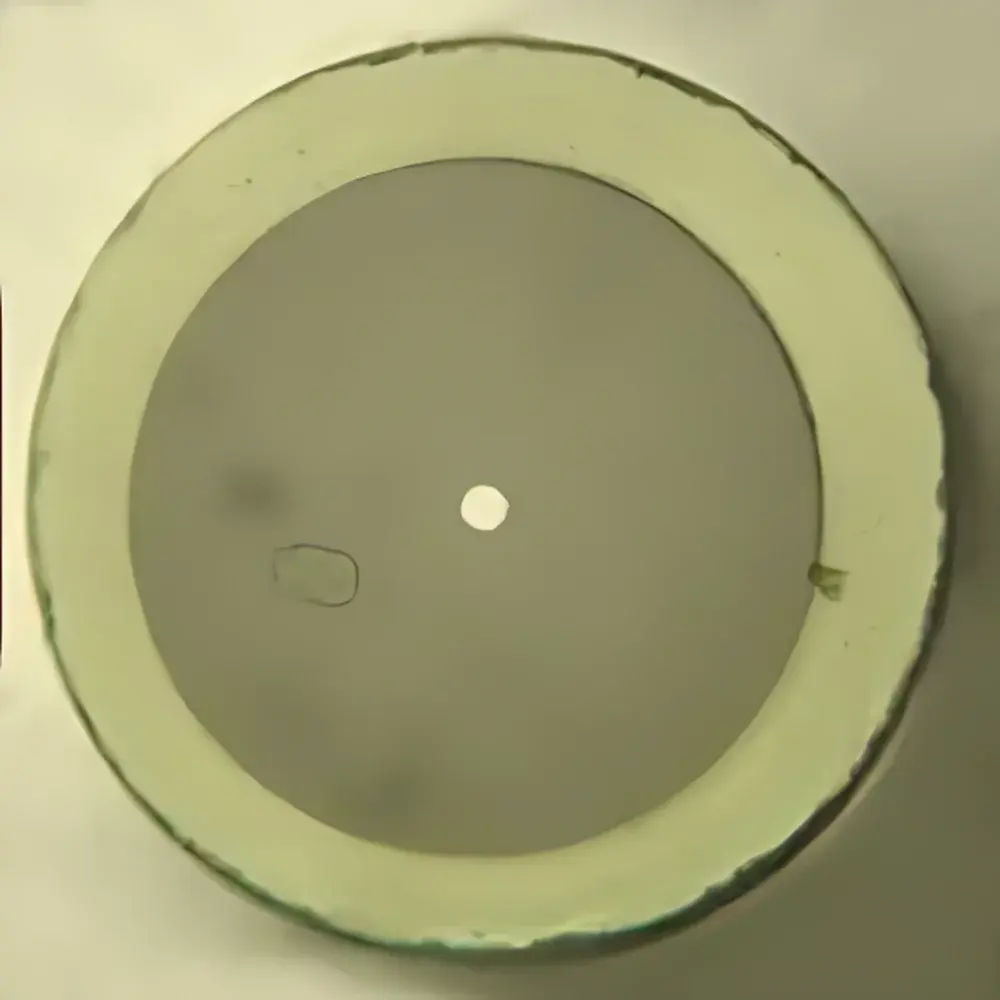
Auniontech IFG Single-Mode Indium Fluoride (InF₃) Fiber
| Brand | Auniontech |
|---|---|
| Model | IFG |
| Core Material | Indium Fluoride (InF₃) |
| Cladding Material | Fluoride Glass |
| Operating Wavelength Range | 300 nm – 5.5 µm |
| Typical Attenuation | <15 dB/km |
| Back Reflection (Fresnel) | ~4% (air interface) |
| Coating | UV-Cured Acrylate Epoxy |
| Operating Temperature | –180 °C to +150 °C |
| Numerical Aperture (typ.) | 0.22 |
| Mode Field Diameter (at 2.9 µm) | ~12 µm |
| Core-to-Cladding Ratio | Optimized for high-power single-mode guidance |
| Compliance | RoHS-compliant coating |
Overview
The Auniontech IFG Single-Mode Indium Fluoride (InF₃) Fiber is a specialty mid-infrared (MIR) optical waveguide engineered for low-loss, high-fidelity transmission across an exceptionally broad spectral window—from the near-UV (300 nm) through the visible and into the molecular fingerprint region (up to 5.5 µm). Unlike silica-based fibers, which exhibit strong multiphonon absorption beyond ~2.2 µm, InF₃-based fluoride glass leverages intrinsically low phonon energy (~500 cm⁻¹), enabling dramatically reduced intrinsic absorption in the 2–4.1 µm band—where attenuation can reach as low as 0.05 dB/m under optimized fabrication conditions. This physical property underpins its utility in coherent MIR applications requiring high quantum efficiency, minimal nonlinear distortion, and thermal stability. The fiber supports fundamental mode (LP₀₁) propagation with excellent modal purity and polarization-maintaining variants available upon request. Its robust mechanical design, combined with a thermally stable acrylate-epoxy dual-layer coating, ensures reliable operation across cryogenic (–180 °C) and elevated (up to +150 °C) environments—critical for field-deployable spectroscopic sensors and space-qualified instrumentation.
Key Features
- Ultra-broad transmission window: 300 nm – 5.5 µm, covering UV, visible, NIR, SWIR, MWIR, and part of LWIR
- Low intrinsic attenuation: <15 dB/km typical (measured at 2.9 µm); <0.05 dB/m achievable in 2–4.1 µm range under controlled draw conditions
- High laser-induced damage threshold (LIDT): >1 GW/cm² (nanosecond pulses at 2.9 µm), validated per ISO 21254-2
- Optimized core/cladding geometry for single-mode guidance with mode field diameter ~12 µm at 2.9 µm
- UV-cured acrylate-epoxy coating providing mechanical protection, microbend resistance, and hermeticity against moisture ingress
- Thermal resilience: continuous operation from –180 °C to +150 °C without delamination or coating degradation
- High spectral uniformity and low dispersion slope across the operational band—essential for ultrafast pulse delivery and broadband interferometry
Sample Compatibility & Compliance
The IFG fiber is compatible with standard FC/PC, SMA-905, and custom ferrule-based terminations. It meets material and safety requirements outlined in RoHS Directive 2011/65/EU. Mechanical and optical performance adheres to IEC 60793-2-40 (category A4 for multimode-like fluoride fibers) and IEC 61753-1 (Category U for uncontrolled environments). For regulated applications—including clinical diagnostics and pharmaceutical process analytical technology (PAT)—the fiber’s traceable manufacturing documentation supports alignment with FDA 21 CFR Part 11 data integrity expectations when integrated into validated systems. Batch-specific test reports (including cutback-measured attenuation, NA, and mode field diameter) are supplied with each shipment.
Software & Data Management
While the IFG fiber itself is a passive component, its integration into active optical systems benefits from compatibility with industry-standard control and characterization platforms. It interfaces seamlessly with Thorlabs’ FBC series beam analyzers, Toptica’s femtosecond MIR OPA systems, and Newport’s MIR spectrometers (e.g., iS50 FTIR). When deployed in automated sensing rigs, raw spectral data acquired via this fiber may be processed using MATLAB-based toolboxes compliant with ASTM E1421 (standard practice for multivariate analysis), or imported into LabVIEW-based GMP audit trails with timestamped metadata logging. Auniontech provides detailed spectral loss curves (300–5500 nm) in CSV and SDF format for modeling in OptiSystem, Lumerical MODE, or COMSOL Multiphysics.
Applications
- Laser remote sensing and open-path gas detection (e.g., CH₄, CO₂, NH₃, HF) using tunable diode lasers operating at 3.3 µm or 4.2 µm
- Fiber-coupled mid-IR Fourier-transform spectroscopy (FTIR) for real-time chemical identification in hazardous environments
- Endoscopic optical coherence tomography (OCT) at 3.3 µm for enhanced tissue contrast in dermatology and oncology
- Beam delivery for holmium (2.1 µm) and erbium (2.94 µm) fiber lasers in minimally invasive surgery
- Forward-looking infrared (FLIR) calibration sources and blackbody coupling in thermal imaging validation
- High-temperature pyrometry in metallurgical furnaces and semiconductor CVD reactors, where conventional silica fibers fail
- Supercontinuum generation in fluoride photonic crystal fibers pumped by MIR OPOs
FAQ
What is the maximum recommended bend radius for IFG fiber during installation?
For sustained reliability, maintain a minimum bend radius of ≥30 mm under static load; ≤15 mm is permissible for short-term handling only.
Can IFG fiber be spliced to silica fiber?
Yes—using fusion splicing with optimized arc parameters and mode-field adapters; typical splice loss is 0.3–0.8 dB at 2.9 µm, depending on alignment precision and tapering.
Is the fiber suitable for vacuum or UHV environments?
The UV-cured epoxy coating outgasses below 1×10⁻⁹ mbar·L/s·cm² (per ASTM E595), making it compatible with UHV-compatible optical feedthroughs when properly baked.
Do you provide polarization-maintaining (PM) versions?
Yes—PM-IFG variants with stress-applying parts (SAP) are available; extinction ratio >20 dB over 2–4 µm at room temperature.
What termination options are standard?
Standard offerings include FC/PC, SMA-905, and bare-fiber cleaved ends; custom angle-polished (APC) or lensed-tip configurations are available on request.



