
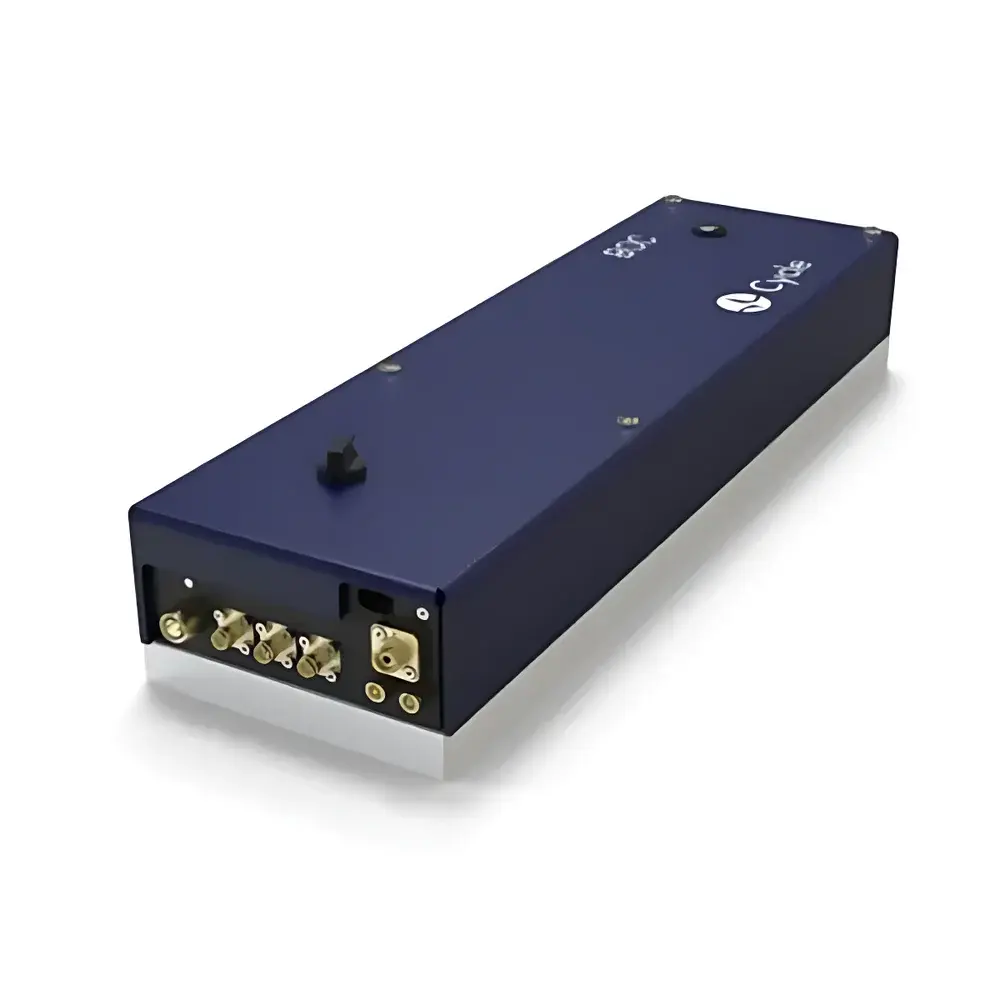
Auniontech BOC-ULTRA Multi-Beam Ultrafast Laser Timing Jitter Analyzer
| Brand | Auniontech |
|---|---|
| Model | BOC-ULTRA |
| Type | Balanced Optical Cross-Correlator (BOC) for Sub-Femtosecond Timing Difference Measurement |
| Origin | Shanghai, China |
| Detector Sensitivity | >5 mV/fs (at detector output, unamplified) |
| Detector Resolution | <0.5 fs |
| Integrated Detector Noise Floor | ≤10 kHz bandwidth |
| Timing Jitter | <15 fs (measured over 35 μHz–1 MHz bandwidth |
| Dimensions (L×W×H) | 300 × 270 × 66 mm |
| Weight | 5 kg |
| Optical Input Wavelength | <2000 nm (customizable per application band) |
| Optical Input Power | 10–50 mW (wavelength- and configuration-dependent) |
| Optical Input Interface | Polarization-Maintaining (PM) fiber with FC/SC connectors (free-space input optional) |
| Pulse Repetition Rate | <10 GHz (application-tuned) |
Overview
The Auniontech BOC-ULTRA is a precision-balanced optical cross-correlator engineered for sub-femtosecond timing jitter analysis of multiple ultrafast laser beams. It operates on the principle of balanced second-harmonic generation (SHG) interferometry, where two or more ultrashort pulses—either co-propagating or counter-propagating—are spatially overlapped in a nonlinear crystal (e.g., BBO or LBO) under phase-matched conditions. The resulting SHG signal is split and detected differentially across a pair of matched photodiodes, enabling common-mode rejection of intensity noise while preserving timing-sensitive interference fringes. This architecture yields exceptional immunity to laser amplitude fluctuations and environmental drift, making it uniquely suited for quantum-limited timing metrology in microresonator-based Kerr frequency combs, mode-locked oscillators, and multi-channel ultrafast synchronization systems.
Key Features
- Sub-15 fs integrated timing jitter measurement capability across 35 μHz–1 MHz detection bandwidth, traceable to primary optical clock standards
- Dual-channel balanced detection architecture with >5 mV/fs responsivity at detector output (unamplified), minimizing post-detection electronic noise contribution
- Integrated low-noise transimpedance amplifiers and optimized PID feedback loop for real-time stabilization of relative pulse delay
- Customizable optical input path supporting PM fiber coupling (FC/SC) or free-space alignment; compatible with wavelengths up to 2000 nm
- Compact, rack-mountable mechanical design (19″, 4U) with rigid aluminum chassis and vibration-damped baseplate for laboratory and cleanroom deployment
- Fully embedded control firmware supporting automated lock acquisition, drift compensation, and long-term stability monitoring
Sample Compatibility & Compliance
The BOC-ULTRA is designed for use with femtosecond and picosecond laser sources including Ti:sapphire oscillators, Er/Yb-fiber combs, and integrated microresonator soliton generators. It accommodates pulse durations from <50 fs to ~1 ps and repetition rates up to 10 GHz. All optical components comply with ISO 10110 surface quality standards; mechanical housing meets IEC 61000-6-2 electromagnetic immunity requirements. The system supports GLP/GMP-aligned operation through audit-trail-enabled logging (timestamped raw data, lock status, environmental sensor readings) and is compatible with FDA 21 CFR Part 11-compliant software environments when integrated via Ethernet or USB-C interfaces.
Software & Data Management
Control and analysis are performed via a vendor-provided Python SDK and GUI application built on Qt5, supporting real-time plotting, FFT-based jitter spectral density estimation, and Allan deviation calculation. Raw voltage traces (16-bit, 10 MS/s sampling) are streamed over TCP/IP for integration into EPICS control systems or Tango device servers. Data export formats include HDF5 (with metadata tags for laser parameters, calibration coefficients, and environmental conditions), CSV, and MATLAB .mat. Firmware updates are delivered via signed OTA packages with SHA-256 verification. Audit logs record all user actions—including parameter changes, lock acquisitions, and calibration events—with UTC timestamps and operator ID fields.
Applications
- Quantum-limited timing jitter characterization of counter-propagating soliton pairs in crystalline and SiN microresonators
- Validation of mutual stabilization effects in co-propagating soliton crystals, enabling sub-quantum-limit synchronization
- Multi-laser synchronization for pump–probe spectroscopy, attosecond science, and coherent beam combining
- Phase noise mapping of optical frequency combs used in optical atomic clocks and dual-comb spectroscopy
- Development and qualification of low-jitter electro-optic modulators and integrated photonic delay lines
- Calibration transfer between ultrafast timing standards in national metrology institutes
FAQ
What laser parameters must be specified prior to system configuration?
Pulse duration, center wavelength, repetition rate, average power, and polarization state must be provided to select optimal nonlinear crystal, dispersion compensation elements, and detector gain settings.
Can the BOC-ULTRA measure timing jitter between three or more independent laser sources simultaneously?
It natively supports dual-beam correlation; multi-beam analysis requires sequential pairwise measurements or external beam routing with calibrated path-length matching—full N-beam real-time correlation is not supported.
Is free-space optical input available as a standard option?
Yes—free-space input is offered as a factory-configurable option, including kinematic mirror mounts, collimation optics, and wavefront correction elements optimized for M² < 1.3 beams.
Does the system include NIST-traceable calibration documentation?
Each unit ships with a factory calibration report listing measured detector responsivity, noise floor, jitter floor, and SHG conversion efficiency at specified wavelengths; NIST-traceable recalibration services are available annually.
How is long-term thermal drift mitigated in the optical path?
The interferometric core is housed in a thermally stabilized aluminum enclosure (±0.1°C regulation); critical mounts use Invar spacers and low-expansion glass ceramics to maintain sub-microradian alignment stability over 8-hour continuous operation.





