
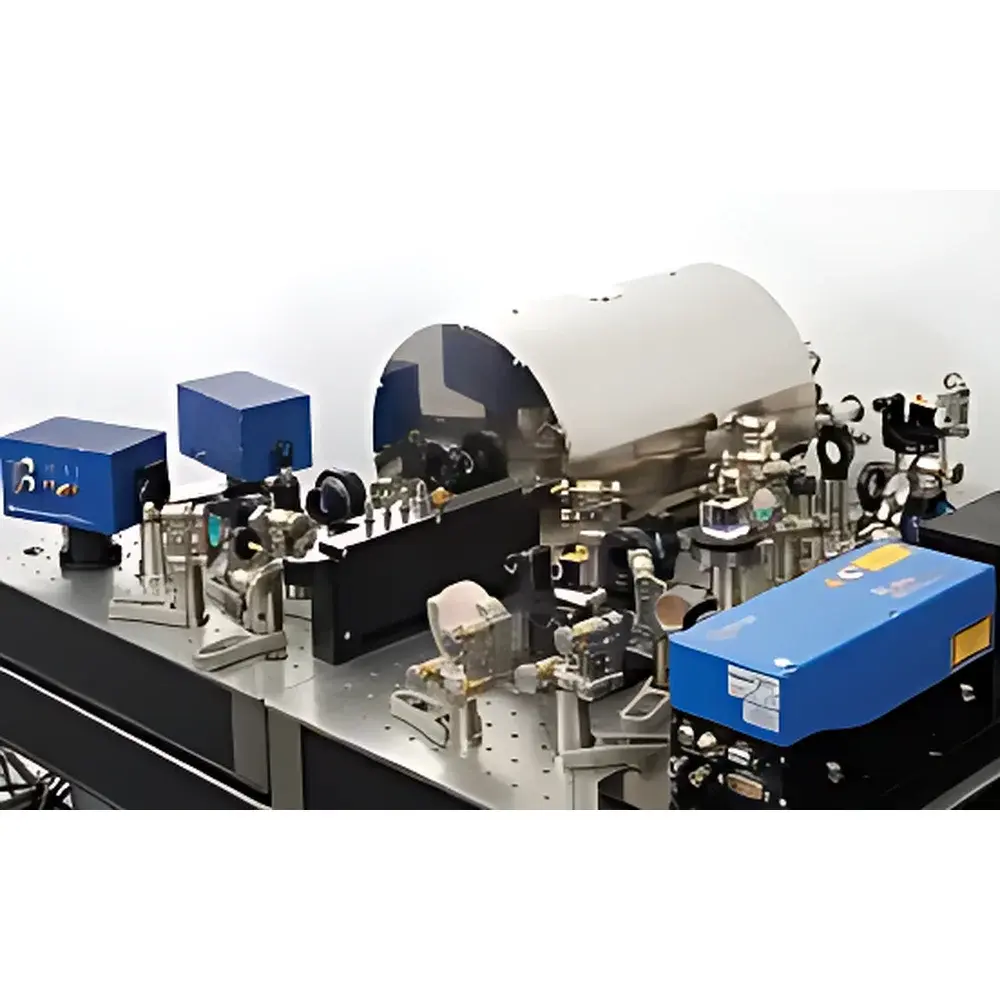
Stable Laser Systems 500–2050 nm Broadband Frequency-Stabilized Laser System
| Brand | Stable Laser Systems |
|---|---|
| Wavelength Range | 500–2050 nm |
| Output Power | >10 mW |
| Linewidth | <1 Hz (1 s integration, heterodyne beat note with linear drift removal) |
| Frequency Drift | <20 kHz/day |
| Operating Temperature Range | 18–25 °C |
| Cavity Thermal Zero-Drift Point | Directly Measured |
| Vacuum Chamber Pressure | <3×10⁻⁷ Torr |
| Cavity Finesse | >500,000 (wavelength-dependent) |
| Optical Isolation | Active Vibration Isolation Platform (e.g., Herzan AVI-350ML) |
| Cavity Type | Cylindrical or Spherical Ultra-Low-Expansion Resonator (e.g., ATF-6020-2 or ATF-6300) |
| Mirror Substrate | Fused Silica with High-Reflectivity Dielectric Coatings |
| Beam Delivery | Fiber-Coupled Output |
| Control Electronics | PDH Error Signal Monitoring, Cavity Reflected/Transmitted Power, Vacuum Level, Chamber Temperature, Thermal Sensor Resolution: ±1 mK |
| Power Supply | 110/115/230 VAC, 50–60 Hz, <100 W |
| Dimensions (Chamber + Optics) | 80 × 80 × 40 cm |
| Mass | 40–120 kg |
Overview
The Stable Laser Systems 500–2050 nm Broadband Frequency-Stabilized Laser System is a precision-engineered optical frequency reference platform designed for metrology-grade applications in atomic physics, optical clock development, quantum optics, and high-resolution spectroscopy. It operates on the principle of Pound–Drever–Hall (PDH) locking, where laser frequency is actively stabilized to a high-finesse optical cavity resonance. The system integrates ultra-low thermal expansion (ULE) cylindrical or spherical resonators housed in evacuated, temperature-controlled aluminum chambers—ensuring sub-Hz linewidths and long-term frequency stability under ambient laboratory conditions. Its broadband coverage—from visible (500 nm) through near-infrared (2050 nm)—is achieved via user-selectable gain media including external-cavity diode lasers (ECDLs), Ti:sapphire oscillators, fiber lasers, and semiconductor-based sources, each individually optimized for spectral purity and power efficiency.
Key Features
- Sub-Hz instantaneous linewidth (<1 Hz, measured via heterodyne beat note with 1-second integration and linear drift subtraction)
- Frequency instability <20 kHz/day over 18–25 °C ambient range, enabled by active cavity temperature stabilization at its zero-expansion point
- Vacuum-sealed resonator chamber (<3×10⁻⁷ Torr) with Viton O-ring front flange and indium-wire sealed stainless-steel CF-35 components, minimizing pressure-induced refractive index fluctuations
- High-finesse optical cavity (>500,000), fabricated from fused silica with custom-coated mirrors (planar + concave, ROC = 50 cm), delivering exceptional mode discrimination and signal-to-noise ratio for PDH error signal generation
- Fiber-coupled output with polarization-maintaining delivery, enabling seamless integration into interferometric setups, cavity-enhanced absorption spectrometers, or quantum memory interfaces
- Comprehensive real-time monitoring suite: PDH error signal, cavity reflected/transmitted power (with transverse mode imaging for λ < 1100 nm), vacuum pressure, chamber temperature (dual 10 kΩ thermistors), and heater current
- Active vibration isolation compatibility (e.g., Herzan AVI-350ML) and mechanical decoupling architecture to suppress seismic and acoustic perturbations
Sample Compatibility & Compliance
This system supports wavelength-specific configurations across the 500–2050 nm range—including but not limited to 698 nm (Sr⁺ clock transition), 729 nm (Ca⁺), 817 nm (Yb⁺ clock subharmonic), 1032/1064 nm (Nd:YAG/Yb:fiber harmonics), 1156 nm (He metastable transition), 1550 nm (telecom-band quantum communication), and 1756 nm (mid-IR spectroscopy). All configurations comply with ISO/IEC 17025 traceability requirements for calibration laboratories and support GLP/GMP-aligned documentation packages upon request. The vacuum chamber design adheres to UHV-compatible material standards (ASTM F2789), while electronic control units meet IEC 61000-6-3 EMC emission limits and IEC 61000-6-2 immunity specifications. Optional 21 CFR Part 11–compliant audit trail logging is available for regulated pharmaceutical or biotech environments requiring electronic record integrity.
Software & Data Management
The system includes a modular LabVIEW-based control interface supporting both local operation and remote SSH/TCP/IP access. Real-time data streams—including error signal voltage, photodiode currents, thermistor resistances, and vacuum gauge readings—are logged at configurable sampling rates (up to 10 kHz) with timestamped HDF5 file export. Built-in PID parameter auto-tuning assists rapid cavity lock acquisition, while multi-channel oscilloscope-style visualization enables diagnostics of transient thermal or mechanical disturbances. Exported datasets conform to FAIR principles (Findable, Accessible, Interoperable, Reusable), with metadata embedded per IEEE 1855–2016 standards for scientific instrumentation. Raw data formats are compatible with Python (via h5py), MATLAB, and OriginLab for post-acquisition spectral analysis, Allan deviation computation, and noise budgeting.
Applications
- Optical atomic clocks (Yb⁺, Sr⁺, Al⁺, Ca⁺) requiring sub-10⁻¹⁶ fractional frequency stability
- Cavity ring-down spectroscopy (CRDS) and noise-immune cavity-enhanced optical heterodyne molecular spectroscopy (NICE-OHMS) for trace gas detection
- Quantum memory protocols using rare-earth-doped crystals (e.g., Eu³⁺:Y₂SiO₅ at 580 nm or Pr³⁺:Y₂SiO₅ at 606 nm)
- Gravitational wave detector auxiliary laser stabilization (e.g., LIGO-style pre-stabilization chains)
- Frequency comb calibration and self-referencing in f–2f interferometry
- High-precision interferometry for nanometrology and gravitational reference sensor testing
FAQ
What laser sources are supported within the 500–2050 nm range?
The system accommodates semiconductor lasers (including ECDLs), Ti:sapphire oscillators, fiber lasers, and solid-state sources—each selected and aligned per customer wavelength and power requirement.
Can the system be configured for dual-wavelength operation (e.g., fundamental + SHG)?
Yes—integrated second-harmonic generation modules (e.g., 817 nm → 435.5 nm) are available as factory-installed options with collinear beam routing and independent power monitoring.
Is vacuum pumping hardware included?
The vacuum chamber includes CF-35 knife-edge ports for ion pump and metal-sealed valve integration; pumps and controllers are optional accessories specified per UHV protocol.
How is cavity temperature stabilized at its zero-expansion point?
Cavity temperature is measured directly via calibrated thermistors mounted on the spacer; feedback control adjusts heater current (6 Ω, 30 W) to maintain setpoint with ±1 mK stability.
What level of technical support is provided post-installation?
Stable Laser Systems offers remote commissioning, on-site alignment assistance (optional), and lifetime firmware updates; all systems ship with full schematics, cavity characterization reports, and NIST-traceable calibration certificates.




