
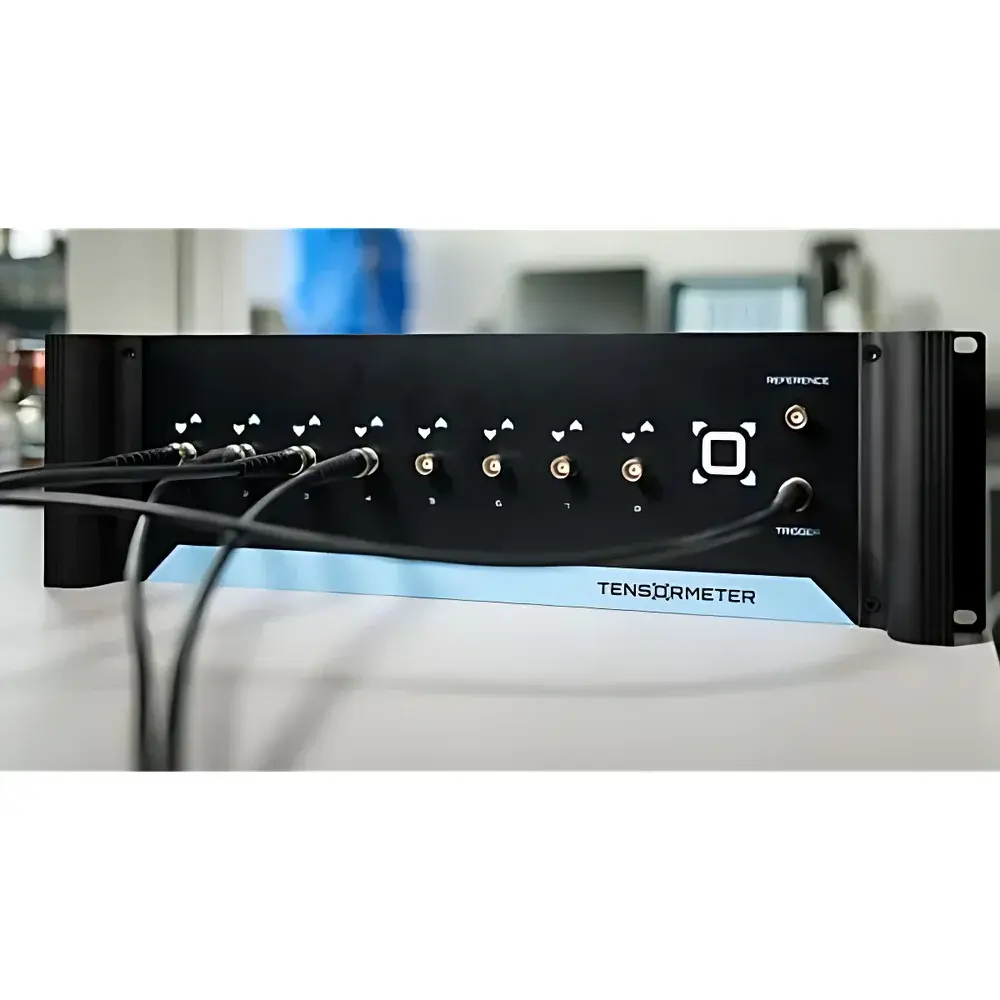
Auniontech RTM2 Synchronized Source-Measure System for Van der Pauw and Resistivity Tensor Characterization
| Brand | Auniontech |
|---|---|
| Origin | Shanghai, China |
| Manufacturer Type | Authorized Distributor |
| Product Category | Domestic (China-made) |
| Model | RTM2 Current/Voltage Source-Measure Unit with Integrated Switch Matrix |
| Instrument Type | Variable-Temperature Hall Effect & Resistivity Analyzer |
| Dynamic Range | >8 digits (10⁹–10¹² Ω) |
| Resistance Measurement Range | 1 nΩ to 1 TΩ |
| AC Bandwidth | DC to 60 kHz |
| Input Noise Floor | 1.5 nV/√Hz (BJT), 8 nV/√Hz (FET) |
| Switch Matrix | 8×4 reconfigurable analog ports (BNC) |
| Communication Interface | TCP/IP over Ethernet |
| Compliance | GLP/GMP-ready architecture, supports audit-trail-capable software integration |
Overview
The Auniontech RTM2 is a synchronized source-measure system engineered for high-precision, low-noise electrical characterization of bulk materials, thin films, and microdevices—without requiring photolithographic patterning. Built upon a fully reconfigurable 8×4 analog switch matrix, the RTM2 implements time-domain multiplexing to isolate and suppress systematic errors inherent in static four-terminal measurements. Its core architecture enables true van der Pauw (vdP) and full resistivity tensor (Rxx, Ryy, Rxy) extraction from arbitrarily shaped, unpatterned samples—eliminating geometric constraints imposed by conventional Hall bar or Kelvin bridge fabrication. The system operates on a dual-path measurement principle: simultaneous current sourcing and voltage sensing are dynamically routed across user-defined BNC ports, while phase-synchronous AC excitation (2 Hz–50 kHz) and lock-in compatible demodulation ensure sub-ppb-level relative stability. Unlike legacy setups relying on discrete SMUs, lock-in amplifiers, DMMs, and manual matrix switches, the RTM2 integrates all signal generation, routing, acquisition, and compensation functions into a single metrology-grade platform compliant with ISO/IEC 17025 traceability practices.
Key Features
- Integrated 8×4 analog switch matrix with <1 ppm/K gain drift and <0.1 ppm/K offset drift in ratiometric mode
- Reconfigurable BNC ports (8 front-panel): assignable as source, sense, reference, or guard—supporting Kelvin, Hall, and vdP geometries without hardware rewiring
- Ultra-low-noise analog front-end: 1.5 nV/√Hz (BJT input), <1 nΩ/√Hz resistance noise floor (transformer-coupled FET path)
- DC-to-60 kHz AC excitation with arbitrary waveform generation, 2 µs timing resolution, and programmable phase shift (0°–360°)
- Passive or active guarding via configurable BNC shielding—extending DC impedance measurement range to 0.5 TΩ || 5 pF
- TCP/IP-native communication protocol; native LabVIEW and Python SDK included—no proprietary drivers required
- Thermally stabilized architecture enabling <1 ppb long-term reproducibility under ambient lab conditions (23 ± 2°C)
Sample Compatibility & Compliance
The RTM2 accommodates planar samples of arbitrary geometry—including irregular flakes, sputtered films, CVD-grown 2D materials, and wafer-scale heterostructures—without lithographic definition. Its vdP-compatible switching sequences automatically decouple longitudinal and transverse resistances, satisfying ASTM F76–22 and ISO 9001 calibration requirements for sheet resistance and carrier mobility derivation. For regulated environments, the system’s deterministic I/O timing (<100 ns digital latency), non-volatile parameter storage, and full audit trail support align with FDA 21 CFR Part 11 and EU Annex 11 expectations. All firmware and firmware update logs are timestamped and cryptographically signed. Traceable calibration certificates (NIST-traceable voltage/current standards) are available upon request.
Software & Data Management
The RTM2 ships with a modular TCP command set enabling seamless integration into automated test environments (e.g., Python-based Jupyter workflows, LabVIEW production test suites, or MATLAB-based physics modeling pipelines). Predefined measurement templates include: van der Pauw resistivity, Hall coefficient (RH), magnetoresistance (MR), temperature-dependent ρ(T), and I–V nonlinearity analysis down to 10−6 % relative deviation. Raw data streams are output in IEEE 754-compliant binary format with embedded metadata (timestamp, excitation parameters, port configuration, thermal sensor readings). Software supports real-time averaging, FFT-based noise spectral analysis, and export to HDF5 or CSV for third-party statistical packages (OriginPro, Igor Pro, or custom Python analysis stacks).
Applications
- Van der Pauw characterization of unpatterned 2D materials (graphene, TMDCs, topological insulators)
- High-precision Hall effect mapping in magnetic heterostructures and spintronic devices
- Sub-ppm nonlinearity testing of thermoelectric and memristive materials
- In-situ resistivity monitoring during cryogenic or vacuum-based thin-film growth
- Production-line screening of TCOs (ITO, AZO), OLED anodes, and flexible sensor arrays
- Fundamental transport studies: weak localization, quantum corrections, and Berry curvature effects
FAQ
Does the RTM2 require photolithography for Hall measurements?
No. The integrated switch matrix enables automatic van der Pauw and Hall tensor measurements on as-deposited, unpatterned films using only four physical probe contacts.
Can the RTM2 operate inside a cryostat or vacuum chamber?
Yes. The front-panel BNC connectors support standard coaxial feedthroughs; optional low-thermal-EMF extension cables are available for 4 K–300 K operation.
Is firmware upgradable in the field?
Yes. Updates are delivered via secure HTTPS and applied through the TCP interface—preserving all user calibration constants and configuration profiles.
What standards does the RTM2 support for regulatory compliance?
The architecture meets GLP/GMP design principles; software logging satisfies FDA 21 CFR Part 11 electronic record requirements when deployed with validated IT infrastructure.
How is traceability ensured for resistance measurements?
All factory calibrations are performed against NIST-traceable transfer standards; certificate of calibration includes uncertainty budgets per ISO/IEC 17025 Annex A.





