
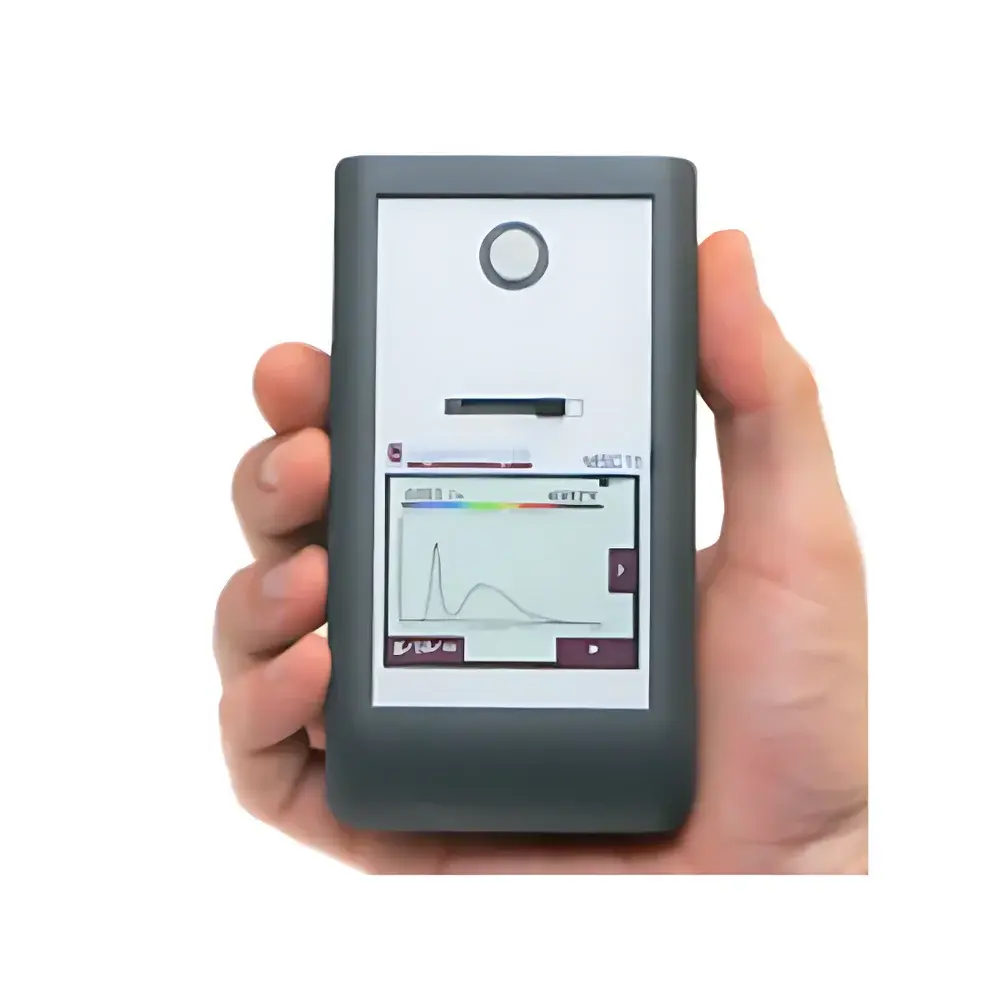
Gigahertz-Optik MSC15 Spectral Illuminance Meter
| Brand | Gigahertz-Optik |
|---|---|
| Origin | Germany |
| Model | MSC15 |
| Spectral Range | 360–830 nm |
| Spectral Bandwidth | 10 nm |
| Wavelength Repeatability | ±0.0002 |
| Cosine Error (f₂) | ≤3% |
| Illuminance Range | 1–350,000 lx |
| CCT Range | 1700–17000 K |
| Chromaticity Uncertainty (Δx, Δy) | ±0.002 (Standard Illuminant A, k=2) |
Overview
The Gigahertz-Optik MSC15 Spectral Illuminance Meter is a handheld, CIE-compliant spectroradiometer engineered for high-accuracy photometric, radiometric, and colorimetric characterization of modern light sources—particularly LEDs, OLEDs, and narrowband solid-state emitters. Unlike traditional filter-based photometers, the MSC15 employs a fast linear CCD array spectrometer with built-in V(λ) spectral responsivity correction per CIE S 023 and bandwidth correction per CIE 214, enabling traceable, first-principles measurement of spectral irradiance (W/m²·nm), illuminance (lx), correlated color temperature (CCT), chromaticity coordinates (x,y), and full spectral power distribution (SPD). Its optical architecture is optimized for field-deployable precision under variable geometries and incident angles, making it suitable for compliance testing against international lighting standards including IEC 60601-2-50 (phototherapy), CIE TN 003:2015 (melanopic metrics), WELL Building Standard, and horticultural PAR protocols.
Key Features
- Precision Spectral Engine: 360–830 nm spectral coverage with 10 nm FWHM resolution; calibrated CCD detector with factory-applied CIE V(λ) and f₁′/f₂ correction functions for photopic, scotopic, and melanopic weighting.
- Ultra-Low Cosine Error: Optimized diffuser and input optics deliver f₂ ≤ 3% cosine response—critical for accurate spatially integrated illuminance measurements across non-normal incidence conditions.
- Multi-Metric Real-Time Display: Color touchscreen interface shows >30 derived quantities simultaneously—including Ebi (bilirubin-weighted irradiance), PPFD (400–700 nm), melanopic lux, and TM-30-20 Rf/Rg—without requiring post-processing.
- Battery-Powered Field Operation: Integrated Li-ion battery supports >8 hours of continuous operation; USB 2.0 interface enables both charging and remote control via PC or laptop.
- Regulatory-Ready Calibration: Delivered with NIST-traceable calibration certificate covering spectral irradiance, illuminance, and chromaticity; optional annual recalibration maintains ISO/IEC 17025 compliance.
Sample Compatibility & Compliance
The MSC15 is validated for use with all common artificial light sources: white and monochromatic LEDs, fluorescent tubes, HID lamps, OLED panels, and medical phototherapy arrays. It meets essential requirements of multiple international standards: IEC 60601-2-50:2009+A1:2016 (neonatal phototherapy irradiance reporting), CIE S 023/E:2019 (spectral radiance measurement), ANSI/IES RP-16 (lighting terminology), and AS/NZS 1680.2.3 (hospital lighting). For horticultural applications, its PAR mode reports photosynthetic photon flux density (PPFD) in µmol/m²·s across the 400–700 nm photosynthetically active region. Melanopic calculations adhere to CIE TN 003:2015, supporting circadian lighting design per WELL v2 and UL 244A protocols.
Software & Data Management
The included SpectraWin software provides full instrument control, real-time spectral visualization, batch data export (CSV, XML, SDF), and automated report generation compliant with GLP/GMP documentation requirements. Audit trails record operator ID, timestamp, calibration status, and measurement configuration—meeting FDA 21 CFR Part 11 criteria when deployed in regulated environments. Raw spectral data can be imported into third-party platforms (e.g., MATLAB, Python via provided SDK) for custom metric derivation, including CQS, CIE 170-2, and user-defined spectral weighting functions. Firmware updates are delivered via secure HTTPS channel and require digital signature verification.
Applications
- LED product development and QC: CCT binning, CRI validation, spectral stability monitoring over thermal and temporal stress.
- Hospital and clinical lighting: Phototherapy lamp output verification, melanopic daylight equivalence assessment, and circadian stimulus quantification.
- Horticultural lighting: PPFD mapping, spectral quality evaluation for plant photomorphogenesis (e.g., phytochrome Pfr/Pr ratio estimation).
- Architectural lighting design: Daylight harvesting system commissioning, glare analysis support, and WELL Building Standard compliance reporting.
- Research laboratories: Fundamental photobiology studies, spectral mismatch correction in solar simulator calibration, and validation of computational lighting models.
FAQ
Is the MSC15 suitable for measuring UV-A or near-infrared emissions beyond 830 nm?
No—the MSC15 is strictly limited to the 360–830 nm range as defined by CIE S 023 and optimized for photobiologically relevant bands. For extended UV or NIR work, Gigahertz-Optik recommends the BTS256-UV or UVA-372 series.
Does the device support automatic calibration verification during operation?
Yes—built-in reference LED allows daily zero and gain checks without external hardware; results are logged and exportable as part of the measurement record.
Can MSC15 data be integrated into LMS (Lighting Management Systems) or BMS platforms?
Via SpectraWin’s OPC UA-compatible API or Modbus TCP extension module (optional), enabling direct integration with industrial automation and building management infrastructure.
What is the uncertainty budget for CCT measurement at low illuminance levels (e.g., <10 lx)?
At 1–10 lx, expanded uncertainty (k=2) for CCT is ±150 K due to signal-to-noise limitations; this is documented in the calibration certificate and accounted for in software uncertainty propagation algorithms.
Is firmware update capability available in offline environments?
Yes—updates are distributed as signed binary packages; offline installation requires manual transfer and cryptographic hash verification prior to execution.



