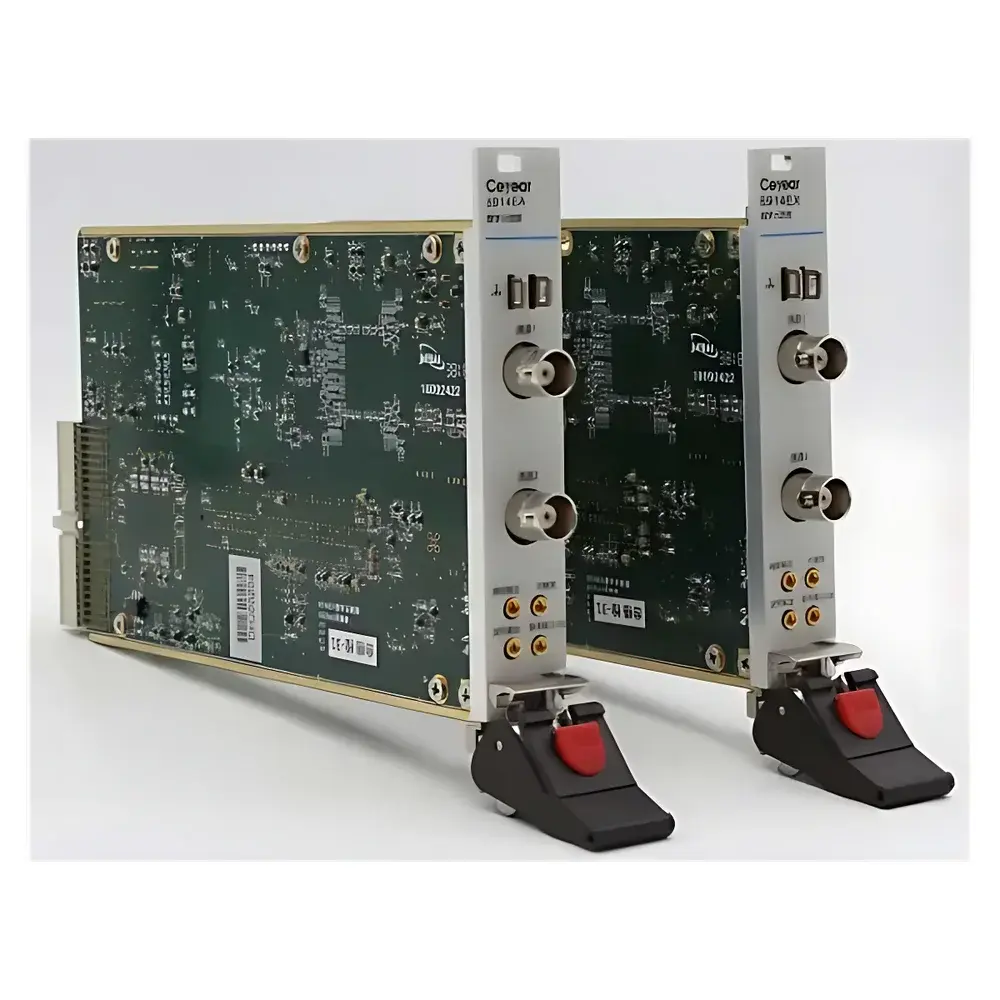
Auniontech 6914 Series PXI/PXIe Modular Digital Oscilloscope
| Brand | Auniontech |
|---|---|
| Form Factor | PXI (6914CA/DA/EA) & PXIe (6914CX/DX/EX) |
| Bandwidth | 350 MHz – 1 GHz |
| Sample Rate | 5 GSa/s (single-channel), 2.5 GSa/s (dual-channel) |
| Memory Depth | 200 Mpts per channel |
| Waveform Capture Rate | 1,000,000 wfms/s |
| Input Channels | 2 analog |
| Integrated Functions | Oscilloscope, Bus Analyzer (optional), 4-digit DVM + 6-digit frequency counter |
| Architecture | 3U single-slot modular |
| Compliance | PXI-5 PXI Express Specification Rev. 2.0, PXI-1 PXI Specification Rev. 3.0, IEEE 1504, SCPI-compliant |
Overview
The Auniontech 6914 Series PXI/PXIe Modular Digital Oscilloscope is engineered for high-performance automated test systems requiring the measurement fidelity and analytical depth of benchtop oscilloscopes in a compact, standards-compliant modular form factor. Leveraging Any Acquire Phosphor technology—a proprietary real-time waveform acquisition and display methodology—the 6914 Series delivers exceptional signal visibility through high-fidelity phosphor-style intensity grading, enabling rapid anomaly detection in complex or intermittent signals. Unlike conventional sequential sampling architectures, this implementation combines deep memory buffering with hardware-accelerated trigger processing to sustain a waveform capture rate of up to one million waveforms per second—critical for statistical analysis of jitter, runt pulses, and metastable transitions in digital and mixed-signal environments. As a native PXI/PXIe instrument, it integrates seamlessly into scalable test platforms built on industry-standard chassis and controllers, supporting deterministic timing, synchronized multi-module triggering, and tight integration with other measurement modules (e.g., arbitrary waveform generators, DMMs, or digital I/O) within the same backplane.
Key Features
- Triple-instrument functionality: Fully integrated oscilloscope, optional bus analyzer (supporting I²C, SPI, UART, CAN, LIN, USB 2.0, PCIe Gen1/Gen2), and embedded 4½-digit digital voltmeter with 6-digit frequency counter—all sharing the same analog front-end and probe interface.
- Any Acquire Phosphor technology: Real-time intensity-graded display with variable persistence emulation, enabling visual identification of low-probability events without post-processing or manual waveform stacking.
- High-resolution acquisition: Up to 5 GSa/s real-time sampling (single-channel), 2.5 GSa/s interleaved dual-channel operation; 200 Mpts/ch deep memory supports long-duration transient capture at full bandwidth.
- Modular 3U single-slot design: Compliant with PXI-5 (PXIe) and PXI-1 (PXI) mechanical and electrical specifications; features front-panel SMB triggers, rear-panel PXI trigger bus, reference clock I/O, and auxiliary digital I/O lines for system-level synchronization.
- Flexible probe ecosystem: Supports standard passive 10× probes, high-voltage single-ended (up to 1 kV CAT II), high-voltage differential (±6 kV common-mode), and AC/DC current probes—enabling safe, accurate measurements across power electronics, automotive, and industrial control applications.
Sample Compatibility & Compliance
The 6914 Series is designed for use with industry-standard passive and active probes compliant with IEEE 1149.1 (JTAG) and IEC 61000-4-2/4-4/4-5 ESD immunity requirements. Its analog input stage meets EN 61326-1:2013 (EMC for laboratory equipment) and operates safely within CAT II 300 V environments. All firmware and driver layers adhere to IVI-COM and IVI-C specifications, ensuring interoperability with LabVIEW, MATLAB, Python (PyVISA), and TestStand environments. The instrument supports audit-ready operation under GLP/GMP frameworks via optional traceable calibration certificates (NIST-traceable), and its internal logging architecture records timestamped configuration changes and measurement metadata—facilitating FDA 21 CFR Part 11 compliance when deployed with validated software workflows.
Software & Data Management
The 6914 Series ships with Auniontech’s Oscilloscope Control Suite (OCS), a SCPI-compliant application programming interface supporting both local GUI operation and remote automation over TCP/IP, VXI-11, or PXI system controller interfaces. OCS provides full access to all measurement functions—including parametric statistics (min/max/mean/std dev over >10,000 acquisitions), histogram-based noise analysis, FFT spectral estimation with adjustable windowing and overlap, math channel construction (e.g., derivative, integral, envelope), and limit/mask testing with pass/fail reporting. Data export options include CSV, HDF5, and MATLAB .mat formats, with optional encryption and digital signature support for secure data handover in regulated environments. Firmware updates are delivered via signed package files validated against SHA-256 checksums and RSA-2048 signatures.
Applications
This oscilloscope is optimized for deployment in PXI/PXIe-based ATE systems used in semiconductor final test, avionics BIT validation, automotive ECUs (including ADAS sensor interface characterization), power converter R&D, and field-deployable maintenance diagnostics. Its combination of high bandwidth, deep memory, and bus analysis capability makes it suitable for validating high-speed serial links (e.g., MIPI D-PHY, LVDS, FlexRay) and identifying timing violations in FPGA-based control loops. In production test, the instrument enables concurrent analog stimulus-response verification and digital protocol decoding—reducing test station footprint and eliminating cross-platform synchronization overhead. For R&D labs, its phosphor display mode accelerates debugging of switching power supply instability, PLL lock failures, and electromagnetic interference coupling paths.
FAQ
What PXI/PXIe chassis configurations are officially supported?
The 6914 Series has been validated with National Instruments PXIe-1085, Keysight M9018B, and Auniontech’s own 7-slot hybrid chassis (model UCH-7M), supporting both legacy 32-bit/33 MHz PXI and PCIe Gen2 x4 interconnects.
Is bus analysis included by default?
Bus analysis functionality is available as an optional license-enabled feature; base firmware includes only oscilloscope and DVM modes.
Can the DVM operate simultaneously with oscilloscope acquisition?
Yes—the DVM shares channel inputs but operates in time-multiplexed mode; voltage and frequency measurements do not interrupt active waveform acquisition.
Does the instrument support third-party probe compensation?
Yes—user-defined probe attenuation factors and frequency response correction tables can be loaded via OCS, enabling custom calibration for non-standard probes.
What is the maximum sustained data throughput over PXIe?
At full 5 GSa/s single-channel acquisition, raw waveform streaming to host memory is limited by PXIe Gen2 x4 bandwidth (~1.6 GB/s theoretical); typical sustained transfer rates are 800–1100 MB/s depending on host DMA efficiency and buffer management settings.