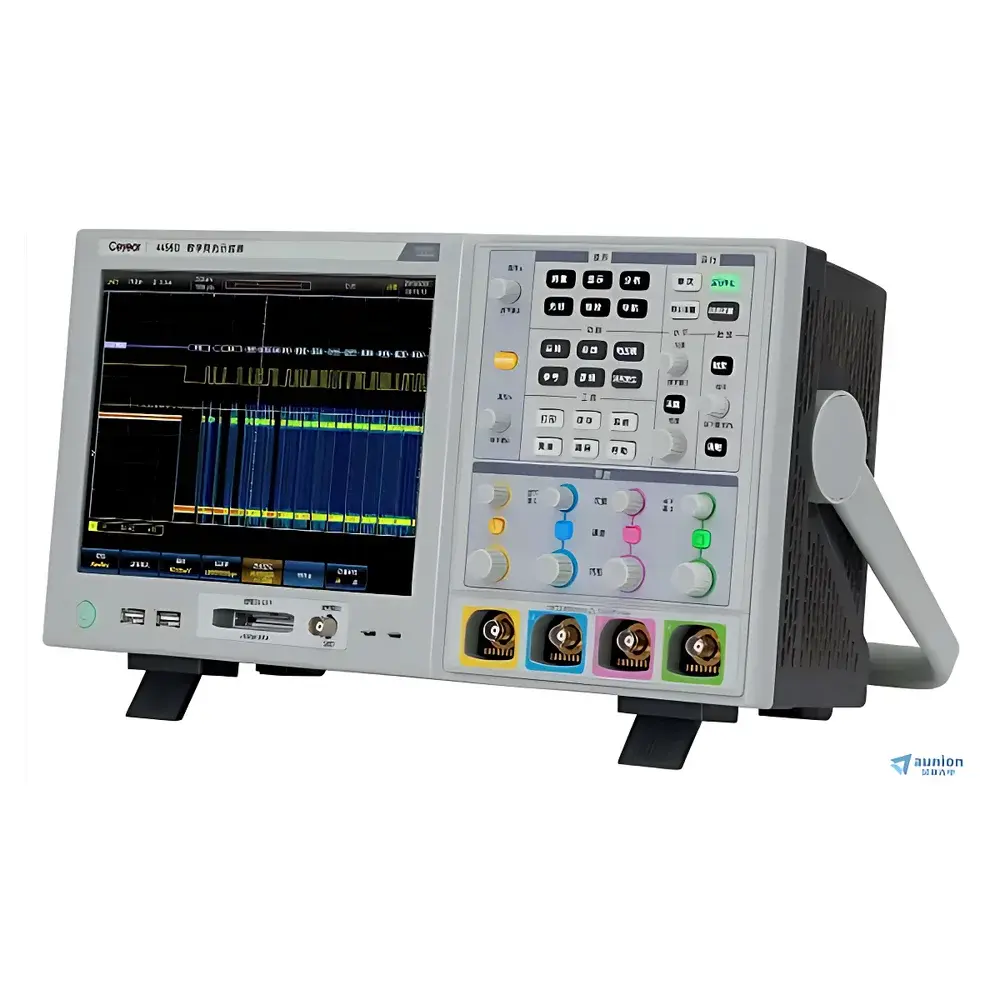
Auniontech 4456 Series Digital Phosphor Oscilloscopes (350 MHz – 1 GHz Bandwidth)
| Brand | Auniontech |
|---|---|
| Model | 4456 Series |
| Bandwidth | 350 MHz – 1 GHz |
| Sample Rate | Up to 5 GSa/s (single-channel), 2.5 GSa/s or 1.25 GSa/s (4-channel) |
| Memory Depth | 500 Mpts/CH |
| Waveform Capture Rate | 1,000,000 wfms/s |
| Display | 10.4" capacitive touchscreen (1024 × 768) |
| Form Factor | Portable, rack-mountable (6U), 6 kg |
| Standard Functions | Oscilloscope, Digital Voltmeter |
| Optional Modules | Logic Analyzer, Arbitrary Function Generator, Bus Protocol Analyzer |
Overview
The Auniontech 4456 Series Digital Phosphor Oscilloscopes are high-performance, multi-function test instruments engineered for precision signal acquisition and analysis across R&D, manufacturing validation, education, and field service applications. Based on real-time digital phosphor architecture, the series leverages high-speed parallel acquisition paths and deep memory buffering to emulate the intensity-graded persistence of analog CRT displays—enabling visualization of rare glitches, intermittent anomalies, and statistical signal behavior without compromising waveform fidelity. Each model operates within a configurable bandwidth range of 350 MHz to 1 GHz, supporting both standard and cost-optimized configurations (4456C/D/E and 4456CM/DM/EM variants respectively). The core acquisition engine delivers up to 5 GSa/s sampling on a single channel—with deterministic down-sampling to 2.5 GSa/s (standard) or 1.25 GSa/s (economy) in full 4-channel mode—ensuring time-correlated multi-domain measurements while maintaining Nyquist compliance for signals up to the specified analog bandwidth limit.
Key Features
- Five-in-One Instrumentation Architecture: Integrates oscilloscope, digital voltmeter (DVM), optional logic analyzer (16-channel), arbitrary function generator (20 MHz, 12-bit), and serial bus protocol analyzer (I²C, SPI, UART, CAN, LIN, FlexRay, USB PD) within a unified firmware framework.
- Any Acquire Phosphor Technology: Proprietary acquisition pipeline combining variable-deep memory allocation, hardware-accelerated waveform rendering, and real-time intensity grading to reveal signal density, jitter distribution, and anomaly frequency with sub-millisecond update latency.
- High-Resolution Touch Interface: 10.4-inch capacitive LCD (1024 × 768) supports multi-touch gestures for pan/zoom, parameter adjustment, and menu navigation—reducing reliance on physical knobs in lab and production environments.
- Comprehensive Triggering & Analysis Suite: Includes edge, pulse width, slew rate, setup/hold, window, timeout, and serial packet-level triggers; advanced math (FFT, integration, differentiation, envelope), histogram, cursor-based measurement statistics (min/max/avg/std dev), and automated power integrity analysis (Ripple, Vrms, switching frequency).
- Modular Expandability: Field-upgradable options via licensed feature keys; probe compatibility spans passive 10×/100×, high-voltage single-ended (≥2.5 kV), differential (±6 kV), AC/DC current (1 MHz–100 MHz), and active RF probes (1 GHz).
Sample Compatibility & Compliance
The 4456 Series is designed for broad electrical signal characterization—from low-frequency sensor outputs to high-speed digital edges and switched-mode power supply transients. Input channels support ±5 V full-scale (with 50 Ω termination) and ±40 V (1 MΩ), accommodating mixed-signal debugging across analog front-ends, FPGA I/O banks, automotive CAN FD buses, and USB 2.0 eye diagrams. All models comply with IEC 61000-4 electromagnetic immunity standards and meet CE, RoHS, and FCC Part 15 Class B regulatory requirements. Firmware implements secure boot, role-based access control, and audit-trail logging compatible with GLP/GMP workflows. Optional software modules support IEEE 1588 PTP synchronization and SCPI-compliant remote control over LAN (LXI Class C), USB-TMC, and GPIB interfaces.
Software & Data Management
Instrument control and data export are enabled via embedded web server (HTML5 UI), PC-based UltraScope application (Windows/macOS), and native Python/LabVIEW drivers. Raw waveform data exports in CSV, MATLAB (.mat), and binary formats—including full metadata (timebase, vertical scale, trigger position, calibration coefficients). Automated test sequences can be scripted using built-in QuickScript (JavaScript-based) or external frameworks. For traceability-critical environments, optional 21 CFR Part 11 compliance package provides electronic signatures, user authentication, change history, and immutable audit logs synchronized with system clock (NTP-enabled).
Applications
- Analog and mixed-signal circuit design verification (op-amp stability, filter response, ADC/DAC linearity)
- Digital system debug (clock skew, metastability, timing margin analysis, DDRx eye diagram evaluation)
- Power electronics characterization (gate drive timing, MOSFET switching loss, inrush current, ripple/noise spectral content)
- Automotive ECU validation (CAN/LIN bus decoding, sensor signal integrity, ISO 16750 transient immunity testing)
- Embedded firmware development (RTOS task timing, interrupt latency, peripheral register access profiling)
- Educational laboratories (teaching Fourier theory, sampling theorem, modulation schemes, control loop dynamics)
- Production line functional testing and failure root-cause analysis with pass/fail template testing and statistical process monitoring.
FAQ
What is the difference between standard and economy models?
Standard models (4456C/D/E) maintain 2.5 GSa/s sample rate in 4-channel mode; economy variants (4456CM/DM/EM) operate at 1.25 GSa/s under identical channel loading—optimized for cost-sensitive applications where aggregate throughput exceeds instantaneous bandwidth needs.
Is probe compensation included with purchase?
Yes—each unit ships with calibrated passive probes (10×, 500 MHz rated) and integrated probe compensation output. High-bandwidth active and differential probes require separate ordering and factory calibration certificates.
Can the instrument perform automated compliance testing per industry standards?
While not pre-loaded with certified test suites (e.g., USB-IF, MIPI D-PHY), the platform supports custom limit testing, mask generation, and statistical reporting required for internal compliance verification against IEEE, JEDEC, or CISPR specifications.
How is firmware updated and validated?
Updates are delivered as signed .bin files via USB or network; cryptographic signature verification occurs prior to flash programming, and rollback capability preserves last-known-good configuration.
Does the logic analyzer module support state and timing analysis simultaneously?
Yes—the optional LA module provides concurrent asynchronous (state) and synchronous (timing) acquisition modes, with independent clock domain handling and cross-triggering with analog channels.
Related Products