
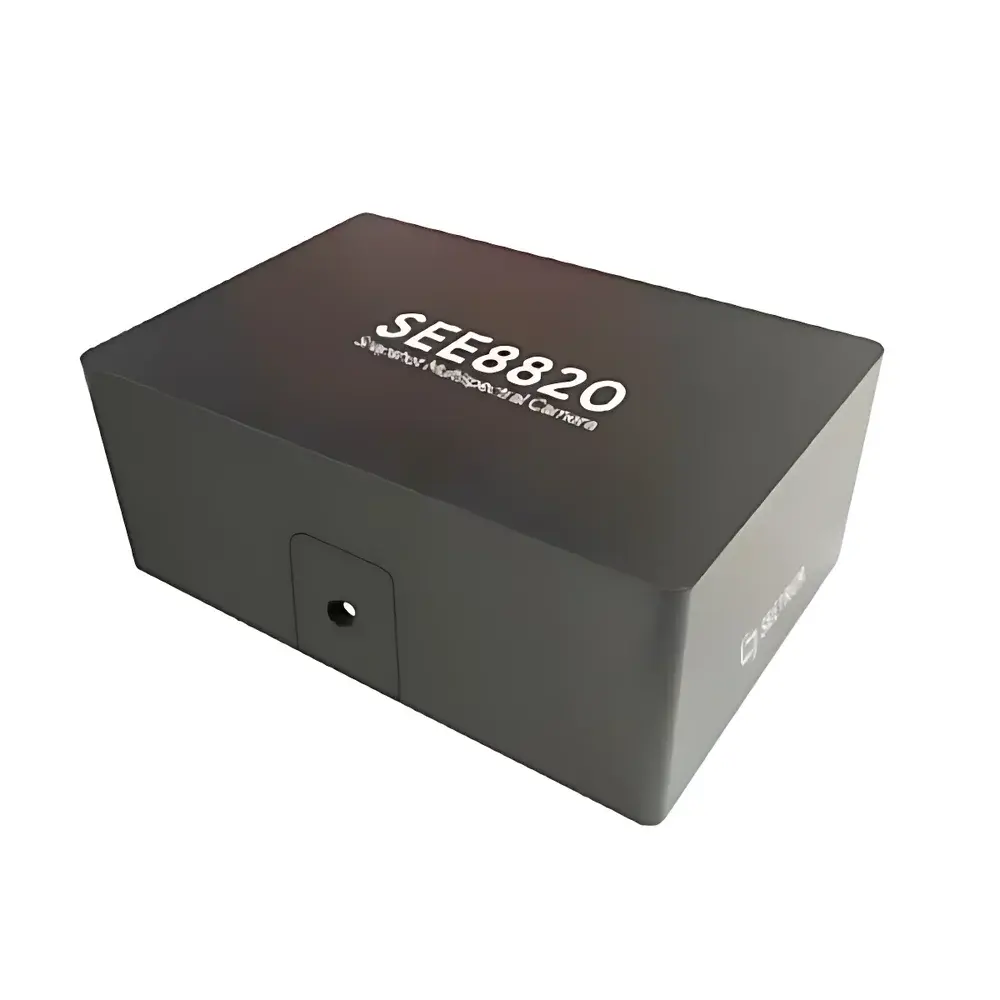
Auniontech SEE8820 Snapshot Hyperspectral Imaging Camera
| Brand | Auniontech |
|---|---|
| Model | SEE8820 |
| Spectral Range | 380–980 nm |
| Number of Spectral Channels | 30 (software-configurable up to 31) |
| Spectral Resolution | 50 nm |
| Spatial Frame Rate (Snapshot Mode) | 30 fps |
| Reconstructed Frame Rate (Offline) | 1.2 fps |
| PC-Based Reconstruction Rate (with NVIDIA RTX 3080) | 5–8 fps |
| CIE1931 Colorimetric Accuracy (x,y) | 0.006–0.02 |
| Radiometric Accuracy | ±5% |
| Dimensions | 125 × 100 × 52 mm |
| Weight | 400 g |
| Onboard Compute Platform | NVIDIA Jetson Orin Nano (8 GB RAM) |
| Interfaces | USB 3.0, HDMI, WLAN |
| Power Supply | 12 V DC |
| Power Consumption | 15 W |
| Software Suite | Acquisition, Spectral Reconstruction, Multispectral Analysis, SDK (PC & Embedded Versions) |
Overview
The Auniontech SEE8820 Snapshot Hyperspectral Imaging Camera is an engineered solution for real-time, single-shot spectral data acquisition across the visible to near-infrared (VNIR) spectrum (380–980 nm). Unlike scanning-based or tunable-filter hyperspectral systems, the SEE8820 employs a monolithic snapshot architecture based on coded aperture spectral imaging (CASI) — integrating a custom-designed optical modulation layer directly onto the sensor plane. This replaces conventional Bayer color filter arrays with spatial-spectral encoding elements, enabling simultaneous capture of spectrally modulated intensity patterns across all 30 (configurable up to 31) spectral bands in a single exposure. The system solves the inverse problem of spectral reconstruction via constrained optimization algorithms, leveraging calibration-derived forward models and regularization techniques to resolve underdetermined linear systems. Designed for industrial process monitoring, material verification, and laboratory-grade spectral analysis, the SEE8820 delivers high reproducibility in spectral radiance measurement with CIE1931 chromaticity accuracy as low as Δ(x,y) = 0.006 under controlled illumination and calibration conditions.
Key Features
- True snapshot acquisition at 30 fps native frame rate — no mechanical scanning, no temporal misregistration between spectral bands
- Onboard NVIDIA Jetson Orin Nano (8 GB) for real-time preprocessing, spectral unmixing, and edge inference
- Calibration-traceable spectral response with 50 nm effective spectral resolution and <±5% radiometric linearity across dynamic range
- Software-configurable channel count (up to 31 bands) and spectral step size (down to 20 nm increments)
- Compact form factor (125 × 100 × 52 mm) and low power envelope (15 W @ 12 V), suitable for embedded integration in OEM inspection systems
- Multi-interface connectivity: USB 3.0 (for host-controlled acquisition), HDMI (live preview output), and WLAN (remote configuration and streaming)
Sample Compatibility & Compliance
The SEE8820 is optimized for reflective and transmissive sample analysis under controlled illumination (e.g., D65, A, or user-defined SPD sources). It supports standard reflectance calibration using NIST-traceable ceramic tiles and enables quantitative color difference evaluation per ISO 11664-4 (CIEDE2000) and ASTM E308. While not certified for medical device use, its radiometric stability and repeatability meet requirements for GLP-compliant material characterization workflows. The embedded software stack includes audit-trail logging for acquisition parameters, calibration timestamps, and reconstruction settings — supporting traceability in regulated environments where documentation of spectral data provenance is required. No moving parts or liquid crystal elements ensure long-term operational consistency in factory-floor deployments.
Software & Data Management
Auniontech provides a comprehensive cross-platform software suite including: (1) a real-time acquisition GUI for exposure control, region-of-interest selection, and live spectral preview; (2) offline spectral reconstruction engine with GPU-accelerated deconvolution (compatible with Windows/Linux); (3) multivariate analysis toolkit supporting PCA, spectral angle mapper (SAM), and endmember extraction; and (4) full-featured SDK with C/C++, Python, and MATLAB bindings. All software modules support HDF5 and ENVI-compatible BIL/BIP formats. The SDK implements secure API authentication and supports metadata embedding per ISO/IEC 11172-5 (MPEG-2 Systems) conventions. Audit logs record user actions, parameter changes, and calibration events — aligning with FDA 21 CFR Part 11 principles for electronic records where applicable.
Applications
- Industrial textile quality control: Detection of batch-to-batch dye variation invisible to RGB imaging, enabling automated pass/fail classification based on spectral distance metrics
- Pharmaceutical tablet coating uniformity assessment via NIR spectral mapping (700–980 nm) without contact or sample preparation
- Food safety screening: Identification of surface contaminants (e.g., fecal matter, mold spores) through characteristic absorption features in the 400–750 nm range
- Art conservation analysis: Non-invasive pigment identification and degradation mapping using reflectance spectroscopy signatures
- Agri-tech phenotyping: Estimation of chlorophyll content, water stress, and nitrogen status via vegetation indices derived from reconstructed spectral cubes
FAQ
What distinguishes snapshot hyperspectral imaging from push-broom or tunable-filter approaches?
Snapshot systems like the SEE8820 capture full spatial-spectral data in one exposure, eliminating motion artifacts and enabling high-speed inspection of dynamic scenes. Push-broom systems require precise line-scanning synchronization; tunable filters suffer from sequential acquisition latency and mechanical wear.
Is factory recalibration required after extended operation?
No routine recalibration is needed under stable thermal conditions. The system includes temperature-compensated dark current correction and built-in non-uniformity correction (NUC) routines. Annual verification against reference standards is recommended for metrological traceability.
Can the SEE8820 be integrated into existing machine vision platforms?
Yes — via USB 3.0 Gen 1 interface and GenICam-compliant driver layer. Trigger input/output lines support hardware synchronization with conveyors or robotic arms.
Does the SDK support custom spectral unmixing algorithms?
Yes — the reconstruction pipeline exposes raw modulated measurements and forward model matrices, allowing users to implement proprietary inversion methods within the provided Python or C++ framework.
What lighting configurations are recommended for optimal performance?
Diffuse, collimated broadband illumination (e.g., halogen or LED with flat SPD from 380–980 nm) is advised. Directional lighting may introduce specular artifacts; polarization control is supported via optional external filters.
Related Products




