
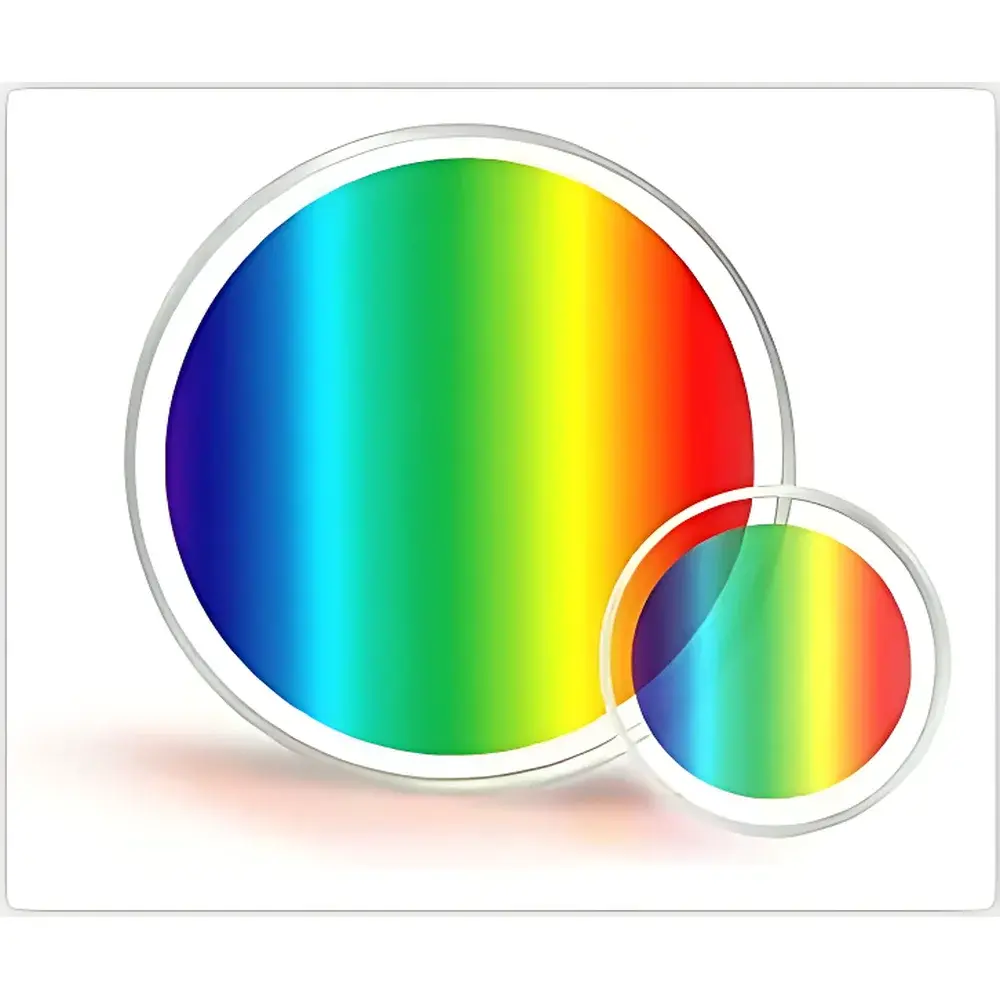
Auniontech High-Efficiency Volume Phase Holographic (VPH) Transmission Grating for High-Sensitivity Spectrometers
| Brand | Auniontech |
|---|---|
| Origin | Germany |
| Distributor Type | Authorized Distributor |
| Import Status | Imported |
| Price Range | USD 7,000 – 14,000 |
| Wavelength Range | 350–2500 nm |
| Groove Density | 150–6000 lines/mm |
| Peak Diffraction Efficiency | Up to 99% (Bragg condition) |
| Polarization Sensitivity | <±2% efficiency variation (s- vs p-polarized) |
| Thermal Stability | <0.5% efficiency drift over 0–100°C cycling |
| Substrate Material | Fused silica (low CTE) |
| Surface Quality | 60–40 scratch-dig |
| Wavefront Distortion | Standard <λ/8 RMS @ 632.8 nm |
| AR Coating | Standard R <1.0% |
| Cleaning Compatibility | Compatible with acetone or isopropanol wipe cleaning |
Overview
Auniontech’s Volume Phase Holographic (VPH) transmission gratings are precision optical components engineered for demanding spectroscopic applications where high signal-to-noise ratio, broadband performance, and polarization insensitivity are critical. Unlike ruled or etched surface gratings, VPH gratings rely on periodic modulation of the refractive index within a photosensitive volume medium—specifically dichromated gelatin (DCG)—embedded between two optically polished fused silica substrates. This volumetric Bragg diffraction mechanism enables near-theoretical first-order diffraction efficiency (>99% at design wavelength), minimal ghosting, negligible wavefront distortion, and inherently low stray light—key advantages for low-light applications such as Raman spectroscopy, fluorescence detection, and push-broom hyperspectral imaging. The grating operates in transmission geometry, supporting compact, alignment-tolerant optical layouts including Littrow and Offner configurations. Its thermal and mechanical stability—derived from fused silica substrates and hermetic DCG encapsulation—ensures long-term calibration integrity under laboratory and field-deployable conditions.
Key Features
- Peak diffraction efficiency up to 99% at Bragg wavelength; >80% over bandwidths exceeding 200–300 nm
- Polarization-insensitive response: s- and p-polarized efficiencies match within ±2% across full operational bandwidth
- No ghost orders and <10% the scatter level of conventional ruled gratings—directly improving spectral contrast and dynamic range
- Low wavefront distortion: standard specification <λ/8 RMS @ 632.8 nm; enhanced option <λ/12 RMS
- Thermally stable performance: <0.5% relative efficiency variation over 0–100°C thermal cycling
- Robust handling and maintenance: compatible with standard optical cleaning protocols using acetone or isopropanol
- Extended lifetime: DCG medium exhibits archival stability comparable to photographic emulsions—validated for >20 years under controlled storage
- Customizable parameters: groove density (150–6000 l/mm), central wavelength (350–2500 nm), substrate size (up to 50.8 × 6.0 mm), and AR coating bandwidth
Sample Compatibility & Compliance
These VPH gratings are compatible with collimated, quasi-monochromatic, and broadband illumination sources—including supercontinuum lasers, LED arrays, and thermal emitters—provided beam diameter and incident angle remain within specified tolerances. They are routinely integrated into ISO/IEC 17025-accredited spectrometer platforms used in pharmaceutical QC (USP ), environmental monitoring (EPA Method 418.1), and materials characterization labs. While the gratings themselves are passive optical components and not subject to regulatory certification, their use supports compliance with FDA 21 CFR Part 11 when embedded in validated spectrometer systems featuring audit-trail-enabled software and electronic signature controls. All fused silica substrates meet MIL-O-13830A surface quality standards (60–40 scratch-dig), and AR coatings conform to ISO 9211-3 specifications for reflectance uniformity and environmental durability.
Software & Data Management
VPH gratings do not incorporate embedded firmware or digital interfaces. However, they are fully interoperable with industry-standard spectroscopic data acquisition and analysis ecosystems—including Ocean Insight OceanView, Thorlabs ThorImageLS, Andor Solis, and custom LabVIEW or Python-based platforms (e.g., PySpectra, SpecUtils). When integrated into OEM instruments, grating parameters (central wavelength, groove density, incidence angle) are programmatically referenced in calibration look-up tables to correct for dispersion nonlinearity and pixel-wavelength mapping. For traceable calibration, users may employ NIST-traceable line sources (e.g., Hg/Ar lamps) to validate wavelength accuracy to ±0.05 nm and photometric linearity to ±1.5% across the grating’s operational range. Auniontech provides comprehensive Zemax-compatible .DAT files and RCWA-simulated diffraction efficiency curves for optical modeling and system optimization.
Applications
- High-throughput Raman spectrometers requiring maximum photon collection efficiency in 532–1064 nm excitation bands
- Push-broom airborne/spaceborne hyperspectral imagers (VNIR–SWIR: 400–2500 nm) demanding low polarization artifacts and thermal resilience
- Compact broadband absorption spectrometers for gas-phase analysis (e.g., CH4, CO2, NH3) in industrial process control
- Time-resolved fluorescence lifetime systems where minimized optical loss preserves weak decay signals
- OEM spectrometer modules for medical diagnostics, including portable blood oximetry and tissue spectroscopy platforms
- Research-grade monochromators and tunable filter assemblies requiring high out-of-band rejection and flat efficiency profiles
FAQ
What distinguishes VPH gratings from ruled or etched surface gratings?
VPH gratings rely on refractive index modulation within a bulk holographic medium, eliminating groove-edge scattering and ghost orders inherent to surface-relief structures. This yields higher first-order efficiency, lower polarization dependence, and superior wavefront fidelity.
Can these gratings be used in reflective configurations?
No—they are designed exclusively as transmissive elements. For reflective operation, a separate mirror or folding optic must be incorporated into the optical path.
Do you provide mounting hardware or kinematic cells?
Yes—custom-designed fused silica or Invar mounts with ±1 arcsec angular adjustability and thermal expansion matching are available upon request for OEM integration.
Is laser-induced damage threshold (LIDT) data available?
LIDT has been measured at 1 J/cm² (10 ns, 1064 nm, 10 Hz) for standard AR-coated versions; enhanced coatings support up to 3 J/cm² under identical conditions.
How is calibration traceability ensured for custom gratings?
Each batch undergoes interferometric verification of groove spacing and Bragg angle, with certificates referencing NIST-traceable wavemeters and autocollimators per ISO/IEC 17025 requirements.





