
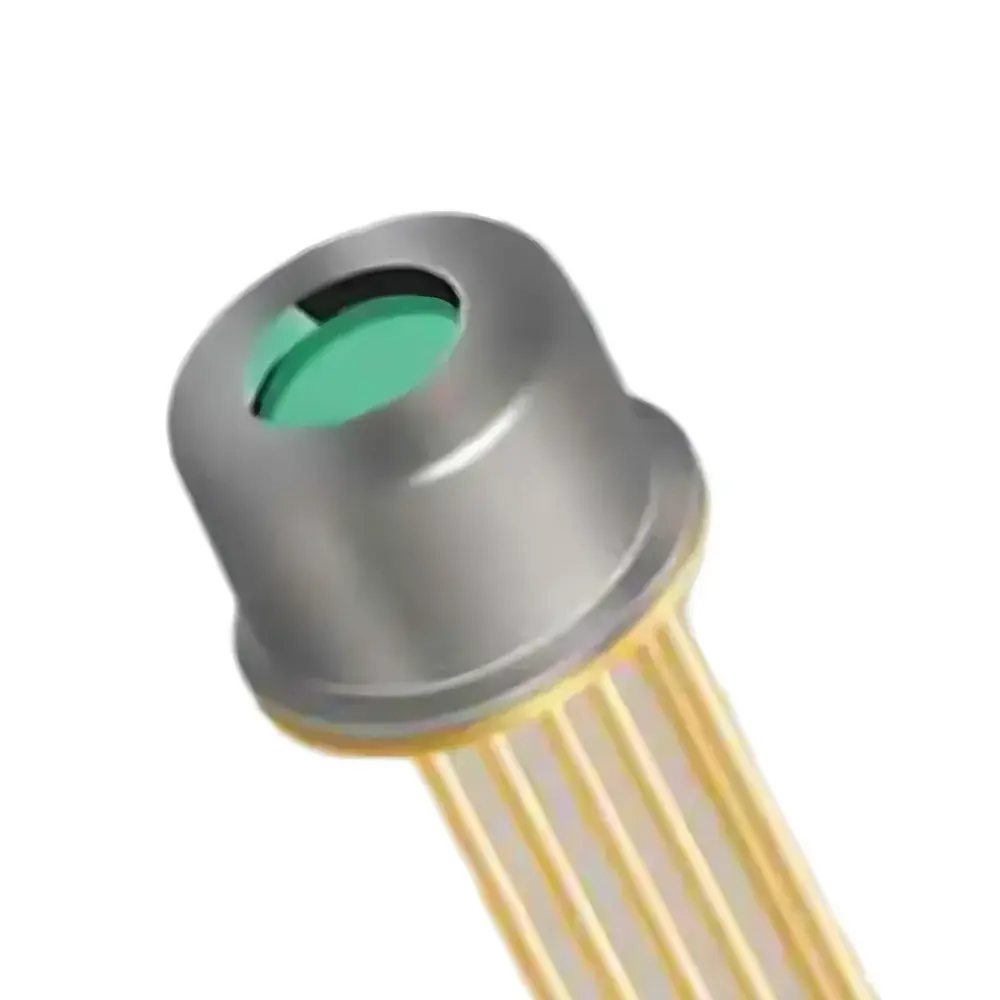
Vixar TO-46-Packaged 795 nm Single-Mode High-Power VCSEL Laser Diode
| Brand | Vixar |
|---|---|
| Origin | Shanghai, China |
| Manufacturer Type | Authorized Distributor |
| Product Category | Domestic |
| Model | Continuous-Wave (CW) VCSEL Laser Diode |
| Output Power | 1.2 mW (typ.) |
| Wavelength | 794.98 nm |
| Polarization Extinction Ratio | 20–25 dB |
| Threshold Current | 0.8–1.2 mA |
| Operating Voltage | 2.3 V |
| Side Mode Suppression Ratio | ≥25 dB |
| Beam Divergence (1/e²) | 10–25° |
| Spectral Bandwidth | 70 MHz (unmodulated) |
| Package | TO-46 |
| Chip Temperature Range | 30–90 °C (TEC-controlled) |
| TEC Max ΔT | 70 °C |
| TEC Cooling Capacity | 0.4 W |
| NTC Thermistor | 10 kΩ, β = 3930 K⁻¹ |
| Operating Temp Range | −10 to +55 °C |
| Storage Temp Range | −40 to +125 °C |
Overview
The Vixar TO-46-Packaged 795 nm Single-Mode High-Power VCSEL Laser Diode is a precision-engineered vertical-cavity surface-emitting laser optimized for atomic physics applications requiring narrow-linewidth, polarization-stable, and spatially coherent optical sources. Operating at a nominal wavelength of 794.98 nm—strategically aligned with the D1 transition line of rubidium-87 atoms (794.76 nm) and closely matching the absorption peak of cesium-133—the device delivers stable continuous-wave (CW) output with >1.2 mW typical power under 3.5 mA drive current. Its monolithic single-transverse-mode (TEM00) emission ensures diffraction-limited beam quality, minimal wavefront distortion, and compatibility with high-finesse optical cavities and atomic vapor cells. The integrated thermoelectric cooler (TEC), NTC thermistor, and hermetically sealed TO-46 package enable precise temperature stabilization (±0.01 °C resolution achievable via external controller), critical for long-term frequency stability in atomic clocks and quantum magnetometers.
Key Features
- Single-spatial-mode (TEM00) emission with near-circular beam profile and low M² (<1.1 typical)
- Polarization extinction ratio (PER) of 20–25 dB, enabling robust operation in polarization-sensitive interferometric and spectroscopic setups
- Narrow spectral bandwidth of ≤70 MHz (FWHM, unmodulated), supporting sub-MHz laser locking via saturated absorption or modulation transfer spectroscopy
- High side-mode suppression ratio (SMSR) ≥25 dB ensures dominance of the fundamental longitudinal mode—essential for minimizing mode-hopping-induced phase noise
- Low threshold current (0.8–1.2 mA) and high wall-plug efficiency (>25% typical), reducing thermal load and enabling compact, low-power system integration
- Integrated TEC with ±70 °C maximum temperature differential and 0.4 W cooling capacity, allowing active chip temperature control from −10 °C to +90 °C
- Standard TO-46 metal-can package with built-in NTC thermistor (10 kΩ, β = 3930 K⁻¹) for closed-loop thermal management compliant with industrial and laboratory environmental specifications
Sample Compatibility & Compliance
This VCSEL is designed for integration into ultra-high-vacuum (UHV)-compatible atomic sensor platforms, including compact Rb/Cs vapor cell systems, optically pumped magnetometers (OPMs), and chip-scale atomic clocks (CSACs). Its hermetic TO-46 packaging meets MIL-STD-883H requirements for mechanical shock, vibration, and humidity resistance. While not certified to ISO/IEC 17025 as a standalone measurement instrument, the device supports traceable calibration workflows when paired with NIST-traceable wavemeters and power meters. It complies with RoHS 2011/65/EU and REACH (EC) No. 1907/2006 directives. For GMP/GLP-regulated environments (e.g., medical-grade OPM development), full audit trails for temperature setpoint logging, drive current monitoring, and lifetime wear data can be implemented using compatible third-party DAQ systems adhering to FDA 21 CFR Part 11 electronic record requirements.
Software & Data Management
Vixar provides comprehensive datasheets, spectral characterization reports (including L-I-V curves, wavelength vs. temperature/current maps, and far-field intensity profiles), and application notes on thermal management and optical alignment. While the diode itself is analog-driven and does not embed firmware or digital interfaces, it is fully compatible with industry-standard laser drivers (e.g., Thorlabs LDCxx, Wavelength Electronics LDTCxx) featuring analog voltage/current control, temperature PID loops, and USB/Ethernet communication. Integration with LabVIEW, Python (via PyVISA), or MATLAB enables automated parameter sweeps (e.g., wavelength tuning vs. current at fixed temperature), real-time power stabilization, and long-term drift analysis—critical for atomic reference stability qualification per IEEE Std 1139 and ITU-T G.811.
Applications
- Atomic frequency standards: Pump/probe lasers for Rb and Cs vapor-cell atomic clocks, supporting Allan deviation <1×10⁻¹² at 1 s averaging
- Optically pumped magnetometers: Circularly polarized excitation source for alkali-metal spin-exchange relaxation-free (SERF) and Mx configurations
- Quantum inertial sensing: Coherent population trapping (CPT) and Ramsey interferometry in miniaturized cold-atom gyroscopes
- Biomagnetic imaging: Low-noise excitation for fetal magnetocardiography (fMCG) and magnetoencephalography (MEG) systems based on SERF magnetometers
- Gas spectroscopy: High-resolution absorption measurements targeting Rb-based buffer-gas cells or isotopic methane detection near 795 nm
- Free-space optical interconnects: Low-divergence, polarization-maintaining source for short-range quantum key distribution (QKD) testbeds
FAQ
What is the recommended operating current range for optimal lifetime and spectral stability?
For continuous operation with >10,000-hour MTTF, maintain drive current between 2.5 mA and 3.5 mA at stabilized chip temperatures of 40–45 °C. Exceeding 4.0 mA increases thermal rollover risk and accelerates facet degradation.
Can this VCSEL be directly modulated at GHz frequencies?
No. This device is optimized for CW operation and exhibits limited modulation bandwidth (<100 MHz) due to its relatively large photon lifetime and carrier recombination dynamics. For high-speed modulation, external Mach–Zehnder or electro-absorption modulators are recommended.
Is the TO-46 package compatible with standard butterfly-style fiber-pigtailed mounts?
The TO-46 footprint is mechanically incompatible with butterfly packages; however, custom collimation optics (e.g., aspheric lens mounts with SMF-28 pigtails) can be integrated using kinematic alignment stages meeting ISO 10110 surface form tolerances.
Does Vixar provide wafer-level or bare-die versions for hybrid integration?
Yes—Vixar offers die-on-carrier (DOC) and wafer-level formats with optional anti-reflection coatings and backside metallization for flip-chip bonding into photonic integrated circuits (PICs) or micro-optical assemblies.
How is wavelength calibrated and traceable to primary standards?
Each production lot undergoes spectral verification using a High-Finesse WS7 wavemeter referenced to an iodine-stabilized HeNe laser (NIST-traceable at 633 nm); absolute wavelength uncertainty is ±0.005 nm (k=2) at 795 nm.





