
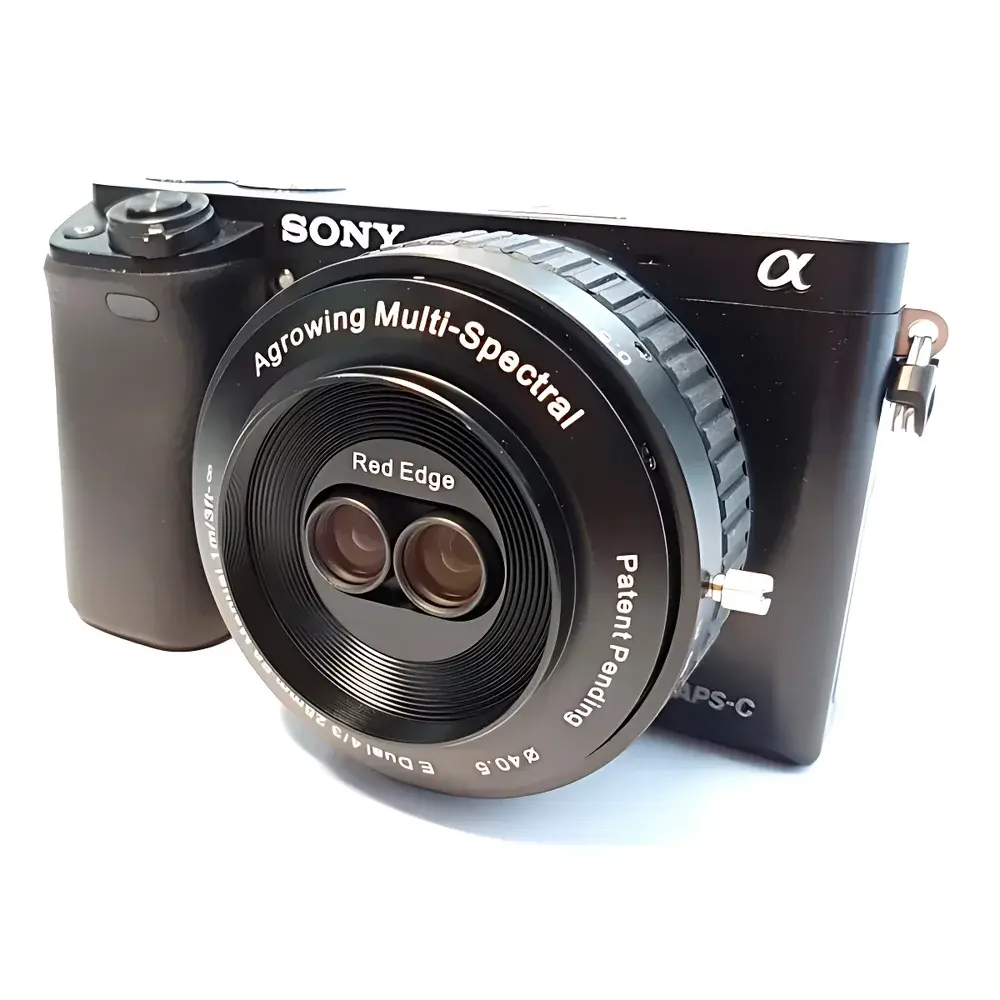
Argowing Ultra-High-Resolution Multispectral Camera System (Sony-Based Modular Platform)
| Key | Brand: Auniontech |
|---|---|
| Origin | Imported (Developed by Agrowing, Israel |
| Sensor Platform | Sony) |
| Model | Argowing Ultra-High-Resolution Multispectral Camera |
| Spectral Bands | 4–13 configurable narrowband channels (15–35 nm FWHM) |
| Central Wavelengths | 405, 430, 450, 490, 525, 550, 560, 570, 630, 650, 685, 710*, 735, 850 nm |
| Pixel Resolution per Band | Up to 10.0 MP (3850 × 2600) |
| Spatial Sampling | ≤0.5 mm/pixel at typical operational working distances |
| Lens Material | All-glass, metal-housed optics |
| Focus | Manual, range 0.4 m to ∞ (model-dependent) |
| Aperture | f/5.6–f/6.0 |
| Dimensions | 60 × 35.2 mm (core sensor module) |
| Weight | 144–191 g (lens-dependent) |
| Video Capability | Raw multispectral video capture supported |
| Compliance | Designed for ISO 17025-aligned field calibration workflows |
Overview
The Argowing Ultra-High-Resolution Multispectral Camera System is a modular, Sony-sensor-based platform engineered for precision agricultural remote sensing, plant phenotyping, and high-fidelity spectral data acquisition in controlled and field environments. Unlike conventional multispectral systems relying on single-sensor + filter wheel or low-resolution RGB+NIR architectures, the Argowing system implements a synchronized multi-lens optical design—each lens dedicated to a discrete narrowband spectral channel—to eliminate parallax, temporal misalignment, and chromatic registration drift. Its core measurement principle is spatially co-registered, simultaneous multispectral imaging via physically separated but geometrically calibrated optical paths. This architecture ensures pixel-level spectral fidelity without interpolation or post-acquisition warping, enabling robust quantitative reflectance analysis across vegetative indices (e.g., NDVI, PRI, MCARI), pigment mapping, and stress biomarker detection at sub-millimeter ground sampling distances (GSD). The system leverages Sony’s industrial-grade CMOS sensors—including IMX series and Alpha-series backside-illuminated (BSI) sensors—selected for high quantum efficiency (>75% at 650 nm), low read noise (<2.5 e⁻ RMS), and linear response over 12+ bit dynamic range.
Key Features
- True simultaneous multispectral capture across 4 to 13 user-selectable bands, with bandwidths as narrow as 15 nm FWHM, eliminating motion-induced spectral misregistration.
- Pixel-accurate geometric alignment maintained across all bands—no software-based co-registration required—even at varying object distances (0.4 m to infinity).
- All-glass, metal-barreled lenses designed for thermal stability and long-term mechanical repeatability; resistant to humidity, vibration, and UV-induced degradation.
- Modular compatibility with Sony MCU R10C, Alpha 6×00, Alpha 7R II–IV platforms, allowing integration into UAV payloads, robotic platforms, or stationary gantry systems.
- Native support for raw 12-bit or 14-bit TIFF output per band, preserving full radiometric integrity for downstream calibration against NIST-traceable reflectance standards.
- Configurable filter sets—including dual-lens interchangeable options for 710 nm vs. 650 nm emphasis—enable mission-specific spectral optimization with minimum order quantities (MOQ) applied only to custom filter fabrication.
Sample Compatibility & Compliance
The Argowing system is validated for use in open-field agriculture, greenhouse phenotyping, forest canopy monitoring, and laboratory-scale plant physiology studies. It supports both reflective and transmissive sample configurations when mounted on fixed-stage microscopes or macro-imaging rigs. Optical path design conforms to ISO 19505-2 requirements for multispectral imaging system characterization, including uniformity testing, spectral crosstalk assessment (<3% adjacent-band leakage), and spatial resolution verification via slanted-edge MTF analysis. For regulated applications—including GLP-compliant crop trait validation or FDA-recognized digital agriculture trials—the system supports audit-ready metadata embedding (EXIF/XMP) and optional integration with time-synchronized GPS/IMU modules. Calibration certificates traceable to PTB (Physikalisch-Technische Bundesanstalt) reference standards are available upon request.
Software & Data Management
Raw image acquisition is managed via open-protocol SDKs supporting Windows/Linux/macOS, with native drivers for Python (NumPy/PIL), MATLAB, and ENVI-compatible .hdr/.dat workflows. The bundled Argowing Capture Suite provides real-time preview, exposure bracketing, dark-frame subtraction, and batch geotagging. All spectral data is stored in vendor-neutral formats compliant with HDF5 and GeoTIFF 1.5 specifications—enabling direct ingestion into machine learning pipelines (e.g., PyTorch/TensorFlow) for supervised classification of disease states, nutrient deficiencies, or water-use efficiency metrics. Full audit trail logging—including sensor temperature, exposure time, lens ID, and filter position—is recorded per frame and exportable for 21 CFR Part 11–compliant environments when paired with validated electronic signature modules.
Applications
- Precision agriculture: High-density crop scouting at ≤0.5 mm GSD for early detection of fungal hyphae, aphid infestation patterns, or chlorosis onset.
- Plant phenomics: Time-series multispectral imaging of Arabidopsis, maize, or wheat under controlled-environment growth chambers with automated ROI segmentation.
- Post-harvest quality control: Detection of bruising, mold, or sugar content gradients in fruits and vegetables using 405–850 nm spectral signatures.
- Ecological monitoring: Canopy-level pigment ratio mapping (e.g., Carotenoid/Chlorophyll index) across heterogeneous forest plots using UAV-mounted configurations.
- Material science research: Spectral fingerprinting of thin-film coatings, mineral composites, or printed electronics where narrowband reflectance discrimination is critical.
FAQ
What spectral calibration standards are supported?
The system ships with factory calibration coefficients derived from NIST SRM 2036 (diffuse reflectance standard) and SRM 2035 (spectral irradiance standard), with optional on-site recalibration services available.
Can I integrate this camera with DJI Matrice or Mavic Enterprise platforms?
Yes—mechanical and electrical interfaces for DJI SkyPort and OSDK are in final validation; firmware v2.3+ (Q3 2024 release) adds native gimbal synchronization and telemetry passthrough.
Is radiometric correction included in the base software?
Yes—per-pixel dark current subtraction, flat-field normalization, and relative spectral response (RSR) compensation are applied during raw-to-reflectance conversion; absolute calibration requires user-provided reference panel measurements.
What is the minimum order quantity for custom filter sets?
Custom interference filters require MOQ of 50 units per wavelength configuration; standard 4- and 6-band kits ship from stock with no MOQ.
Does the system support synchronized triggering with external sensors (e.g., LiDAR, weather stations)?
Yes—TTL trigger input/output ports support hardware-synchronized acquisition at up to 10 Hz frame rate across all bands, with jitter <10 µs.






