
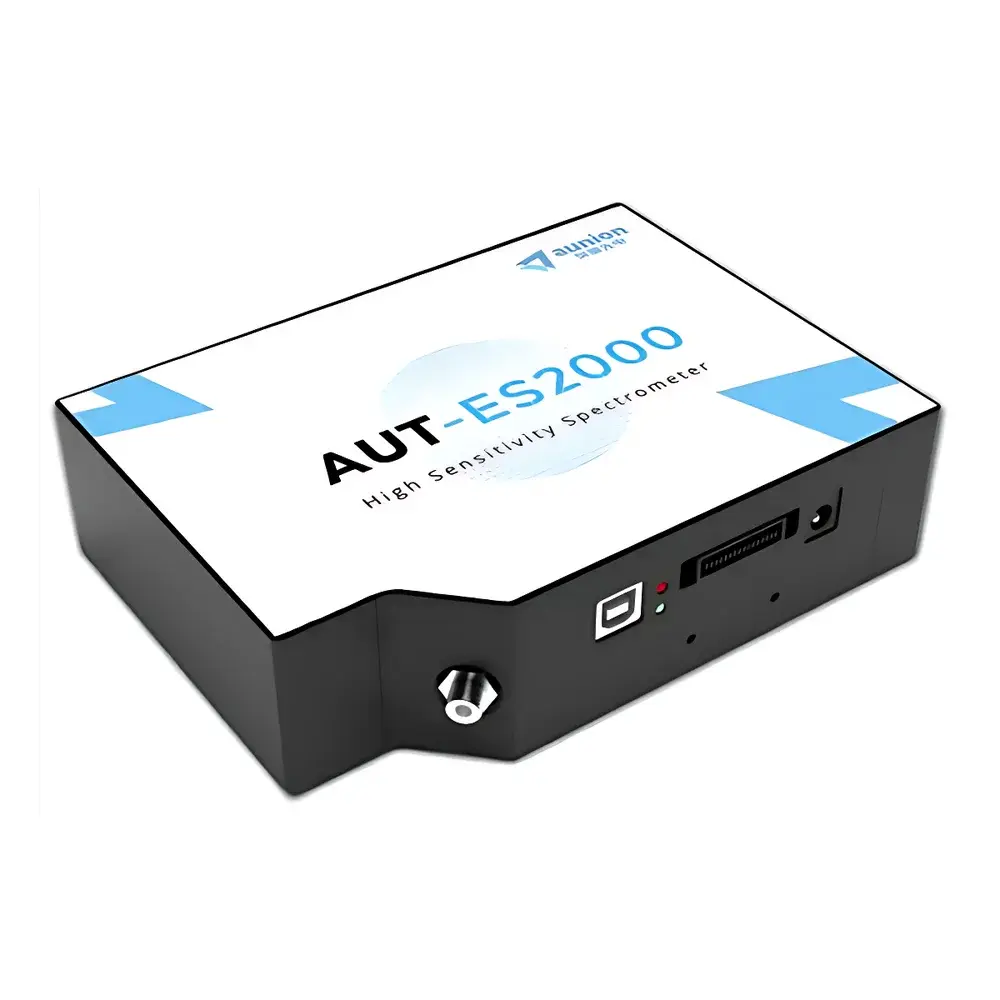
Auniontech AUT-ES2000 & AUT-HRS4000 Fiber Optic Spectrometers
| Brand | Auniontech |
|---|---|
| Origin | Shanghai, China |
| Model | AUT-ES2000 / AUT-HRS4000 |
| Spectral Range | 370–1050 nm (typical) / 200–1100 nm (broadband) |
| Detector | Hamamatsu S1042 back-illuminated FFT-CCD (AUT-ES2000) / Toshiba TCD1304DG linear CCD (AUT-HRS4000) |
| Pixel Count | 2048 × 64 / 3648 |
| Pixel Size | 14 µm × 14 µm / 8 µm × 200 µm |
| Integration Time | 7 ms – 120 s / 4 ms – 60 s |
| Stray Light | <0.1% @ 600 nm / <0.2% @ 600 nm, <0.10% @ 435 nm |
| Dimensions | 157 × 115 × 41 mm³ |
| Interface | USB 2.0, SPI (external trigger) |
Overview
The Auniontech AUT-ES2000 and AUT-HRS4000 are research-grade fiber optic spectrometers engineered for precision spectral acquisition in demanding laboratory and industrial environments. Based on the principle of dispersive spectroscopy—where incoming light is collimated, diffracted by a ruled or holographic grating, and focused onto a photosensitive detector array—these instruments deliver high-fidelity wavelength-resolved intensity data across the UV-VIS-NIR spectrum. The AUT-ES2000 employs a Hamamatsu S1042 back-illuminated, frame-transfer CCD with 2048 × 64 pixels, optimized for quantum efficiency >90% in the 300–800 nm range and low read noise, making it especially suitable for low-light applications such as fluorescence spectroscopy, Raman excitation monitoring, and agricultural quality sorting. In contrast, the AUT-HRS4000 integrates a Toshiba TCD1304DG linear CCD with 3648 pixels and narrow 8 µm pitch, enabling enhanced spectral resolution through higher dispersion sampling density—ideal for thin-film characterization, plasma emission analysis, and narrow-band optical filter validation.
Key Features
- Modular optical design supporting interchangeable slit widths (10–200 µm), gratings (300–2400 grooves/mm), and entrance optics to tailor resolution, throughput, and stray light rejection
- Thermally stabilized housing (±0.1 °C internal regulation) minimizing wavelength drift during extended integrations (>60 s)
- Low-stray-light optical path architecture: <0.1% at 600 nm (AUT-ES2000), verified per ASTM E275-20 methodology for spectral purity assessment
- Dual interface support: High-speed USB 2.0 for streaming acquisition and SPI-compatible external triggering for synchronization with pulsed lasers, gated detectors, or process control systems
- Robust mechanical construction with aluminum alloy chassis and anodized finish, compliant with IEC 61326-1 for electromagnetic compatibility in laboratory settings
Sample Compatibility & Compliance
Both models accept standard SMA 905 fiber inputs (core diameters 50–600 µm), enabling seamless integration with remote sampling probes, integrating spheres, cuvette holders, and flow cells. The spectrometers operate within ambient temperature ranges of 15–35 °C and relative humidity ≤70% non-condensing—conditions aligned with ISO/IEC 17025 calibration environment recommendations. Firmware and driver software comply with Windows/Linux 64-bit OS requirements and support export of spectral data in industry-standard formats (CSV, ASCII, HDF5). All units undergo factory calibration traceable to NIST-traceable tungsten-halogen and mercury-argon lamp standards, with certificate documentation provided per ISO/IEC 17025 clause 7.7.
Software & Data Management
Bundled AunionSpec v4.x software provides real-time spectral visualization, dark/baseline correction, peak identification (with FWHM and centroid calculation), and multi-curve overlay. Advanced users may access low-level SDKs (C/C++, Python, LabVIEW, MATLAB) for custom automation—including batch acquisition, pass/fail thresholding, and integration into LIMS or MES platforms. Audit trail functionality records user actions, parameter changes, and calibration events—supporting GLP/GMP workflows where data integrity and 21 CFR Part 11 compliance are required. Raw detector frames (including full 2D FFT-CCD images from the AUT-ES2000) are preserved for post-acquisition spatial-spectral deconvolution or stray light modeling.
Applications
- Quality control in food grading (e.g., chlorophyll and anthocyanin index mapping in kiwifruit via reflectance spectra at 670 nm and 550 nm)
- Optical coating metrology: measuring transmission/reflection edge steepness and uniformity across 200–1100 nm for anti-reflective and dichroic filters
- Plasma diagnostics: time-resolved emission line profiling of Ar I (696.5 nm), N II (500.5 nm), and Hα (656.3 nm) in low-pressure discharge sources
- UV-Vis absorption kinetics: monitoring reaction progress in catalytic systems using flow-through cuvettes and sub-second integration
- LED and OLED spectral radiance characterization, including CCT, CRI, and dominant wavelength calculations per CIE 15:2018
FAQ
Are these spectrometers calibrated before shipment?
Yes—each unit undergoes full spectral and radiometric calibration using NIST-traceable standards. A calibration certificate detailing wavelength accuracy (±0.2 nm), irradiance responsivity (at 365, 546, and 852 nm), and linearity (R² > 0.9999 over 4-decade dynamic range) is included.
Can I use third-party software like OceanView or SpectraSuite?
No—the AUT-ES2000 and AUT-HRS4000 are not compatible with Ocean Insight’s drivers. However, native SDKs provide equivalent functionality and greater control over FFT-CCD binning modes and linear CCD overscan regions.
Is vacuum or purged operation supported for UV measurements below 200 nm?
The standard optical bench is air-filled. For deep-UV work (<200 nm), optional nitrogen-purged housings and MgF₂-coated optics are available upon request—enabling stable operation down to 190 nm with reduced O₂ absorption artifacts.
What is the maximum achievable optical resolution (FWHM)?
Resolution depends on grating choice, slit width, and pixel binning. With a 2400 g/mm grating and 10 µm slit, the AUT-HRS4000 achieves ≤0.15 nm FWHM across 350–800 nm; the AUT-ES2000 achieves ≤0.3 nm under identical conditions due to its 2D detector geometry and fixed optical magnification.






