
Auniontech SPAD-370900 Ultra-Low-Dark-Count Single-Photon Avalanche Diode Detector
| Brand | Auniontech |
|---|---|
| Spectral Range | 370–900 nm |
| Peak Sensitivity | 450 nm |
| Dark Count Rate | ≤7 cps |
| Timing Jitter | <200 ps |
| Active Area | 50 µm diameter |
| Fiber Coupling | FC/APC |
| Max. Input Optical Power | 50 pW |
| Count Rate Linearity | Up to 3.5 Mcps |
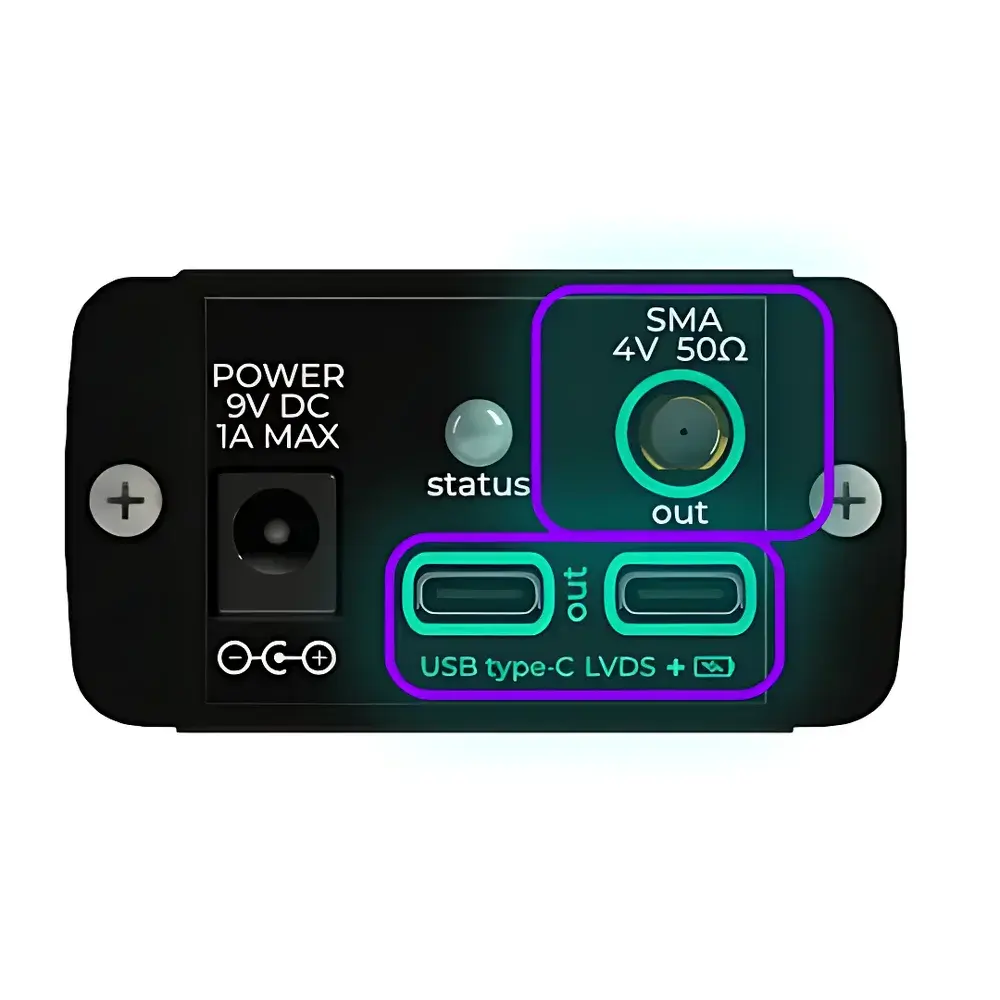
| Output Signal | LVDS (FLIM Labs proprietary) via USB-C & LVTTL (4 V, 50 Ω) via SMA |
| Operating Temperature | −10 °C to +40 °C |
| Storage Temperature | −20 °C to +70 °C |
| Power Supply | USB-C (5 V) or 9 V DC (2.1/5.5 mm barrel, 1 A max) |
| Dimensions | 100 × 60 × 30 mm |
| Weight | 235 g |
| Software API Support | Rust, C, C++, C#, Python, Node.js, .NET |
| Data Export Formats | MATLAB, HDF5, SVG |
| Compliance | GLP-ready data logging, timestamped audit trail enabled in firmware |
Overview
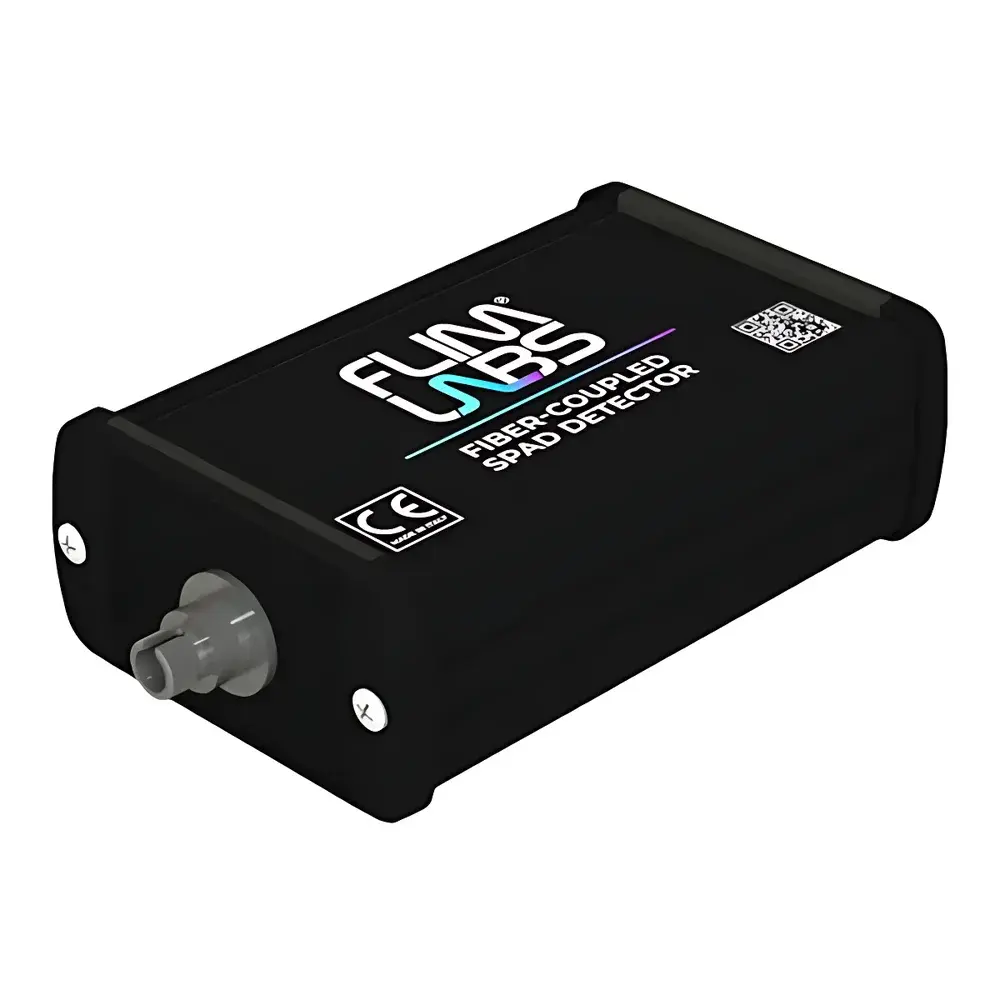
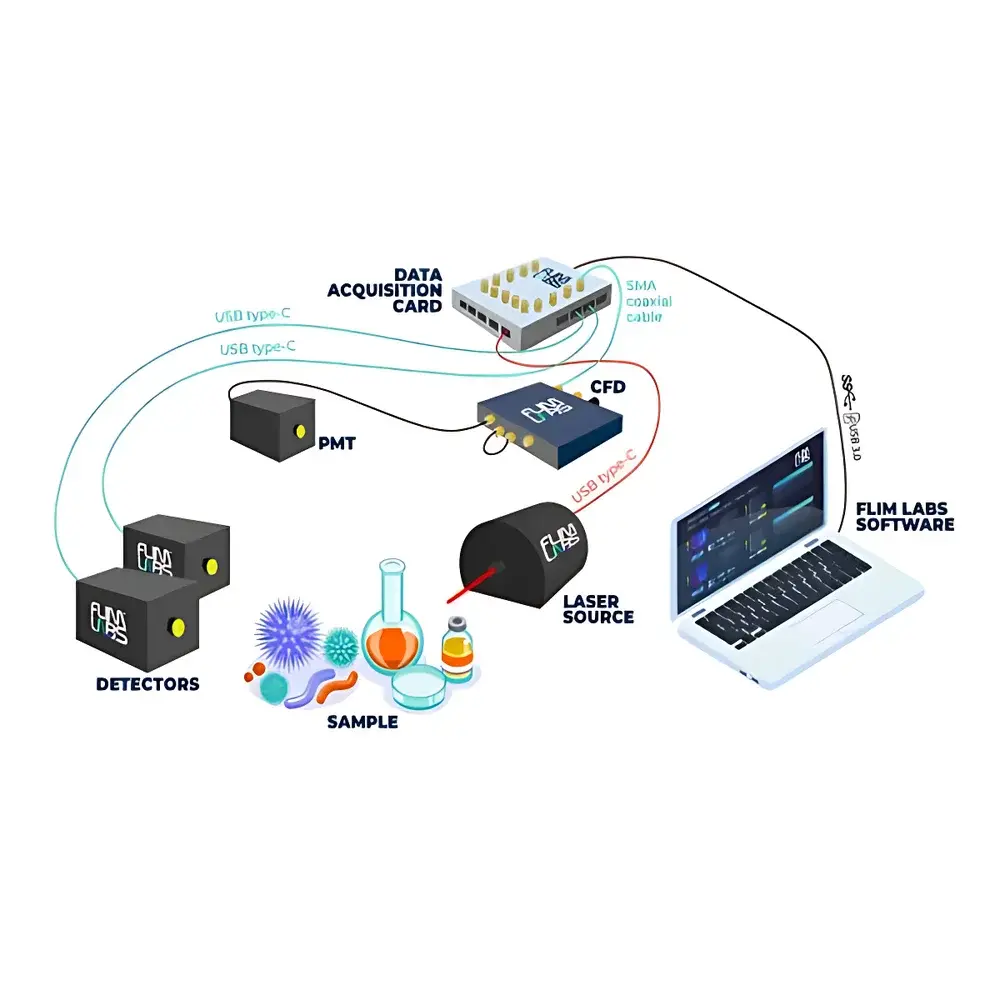
The Auniontech SPAD-370900 is a compact, USB-powered, fiber-coupled single-photon avalanche diode (SPAD) detector engineered for high-fidelity time-resolved photoluminescence measurements. Operating on the principle of Geiger-mode avalanche multiplication in silicon, it delivers photon-level sensitivity across the visible to near-infrared spectrum (370–900 nm), with peak quantum efficiency centered at 450 nm. Its ultra-low dark count rate (≤7 cps) and sub-200 ps timing jitter enable precise temporal resolution essential for fluorescence lifetime imaging microscopy (FLIM), time-correlated single-photon counting (TCSPC), and time-resolved spectroscopy. Designed as a modular component within quantitative optical measurement systems, the detector integrates seamlessly with pulsed laser sources, constant-fraction discriminators (CFDs), time-to-digital converters (TDCs), and synchronized acquisition hardware—making it suitable for both benchtop research and embedded instrumentation applications.
Key Features
- Ultra-low dark count performance (≤7 cps) achieved through thermoelectric stabilization and optimized quenching circuitry
- Sub-200 ps full-width-at-half-maximum (FWHM) timing jitter ensures high temporal fidelity in TCSPC histograms
- Fiber-coupled input with FC/APC interface for low-reflection, polarization-maintaining alignment stability
- Dual-output architecture: LVDS signal over USB-C (proprietary FLIM Labs protocol) for high-speed synchronization and LVTTL over SMA for legacy TDC compatibility
- Compact form factor (100 × 60 × 30 mm) and lightweight design (235 g) support portable and space-constrained setups
- Flexible power options: bus-powered via USB-C (5 V) or external 9 V DC supply (2.1/5.5 mm barrel connector)
- Onboard thermal management maintains stable operation across −10 °C to +40 °C ambient range
Sample Compatibility & Compliance
The SPAD-370900 is compatible with standard multimode and single-mode optical fibers (core diameters ≥5 µm), enabling direct coupling to confocal microscopes, spectrometers, and fiber-based excitation/detection paths. Its 50 µm active area balances spatial resolution with photon collection efficiency for diffraction-limited optical systems. The detector complies with IEC 61326-1:2013 for electromagnetic compatibility in laboratory environments and supports GLP-aligned data integrity requirements through deterministic timestamping, hardware-accelerated histogram binning, and non-volatile configuration storage. Firmware implements write-protected calibration metadata and supports traceable instrument identification per ISO/IEC 17025:2017 Annex A.2 guidelines for measurement uncertainty documentation.
Software & Data Management
The included FLIM Labs software suite provides native support for real-time histogram reconstruction, phasor plot generation, and AI-assisted phasor clustering—enabling rapid identification of multi-exponential decay components without iterative fitting. All acquisition modules enforce strict separation between raw event timestamps and processed outputs, with full audit trail logging compliant with FDA 21 CFR Part 11 (electronic records and signatures) when deployed on validated Windows systems. The software SDK exposes low-level access via language-agnostic APIs (Rust, C, C++, C#, Python, Node.js, .NET), allowing integration into custom acquisition pipelines or third-party platforms such as Micro-Manager or LabVIEW. Export formats include HDF5 (with metadata schema v1.2), MATLAB .mat, and scalable vector graphics (.svg) for publication-ready phasor plots. Cloud synchronization uses end-to-end encrypted HTTPS endpoints; sharing workflows integrate natively with Slack, Microsoft Teams, and email clients via RFC 5322-compliant MIME attachments.
Applications
- Fluorescence lifetime imaging microscopy (FLIM) in live-cell and tissue studies
- Time-resolved photoluminescence spectroscopy of quantum dots, perovskites, and organic semiconductors
- Single-molecule FRET (smFRET) with nanosecond-scale donor–acceptor dynamics resolution
- Quantum optics experiments requiring high-efficiency, low-jitter photon detection (e.g., HOM interference, entanglement verification)
- Industrial process monitoring via time-gated reflectance or fluorescence sensing
- Development of compact TCSPC modules for OEM integration into medical endoscopy or environmental sensing platforms
FAQ
What is the maximum sustainable photon count rate before significant dead-time distortion occurs?
The detector maintains linear response up to 3.5 Mcps under typical operating conditions; beyond this, pulse-pileup correction algorithms in the FLIM Labs software apply Poisson-based deconvolution to preserve decay curve fidelity.
Is the SPAD-370900 compatible with existing TCSPC hardware from PicoQuant or Becker & Hickl?
Yes—LVTTL output conforms to NIM/TTL timing standards and interfaces directly with standard CFDs and TDCs; LVDS-over-USB-C requires the FLIM Labs synchronization hub for cross-platform interoperability.
Does the firmware support remote configuration and calibration updates?
Yes—firmware updates are delivered via signed binary packages over USB-C; calibration coefficients are stored in write-protected memory sectors and can be reloaded from user-provided .cal files meeting IEEE 1642-2021 metadata schema.
Can the detector operate in continuous wave (CW) photon counting mode without time-stamping?
Yes—the device supports gated and ungated counting modes; in CW mode, it reports integrated counts per user-defined gate window (1 µs to 1 s resolution) via USB-C streaming.
Are spectral responsivity curves and timing jitter characterization reports available for download?
Yes—NIST-traceable calibration certificates, including measured PDE vs. wavelength and jitter histogram distributions, are provided with each unit and accessible via the manufacturer’s secure portal using the device’s unique serial number.




