
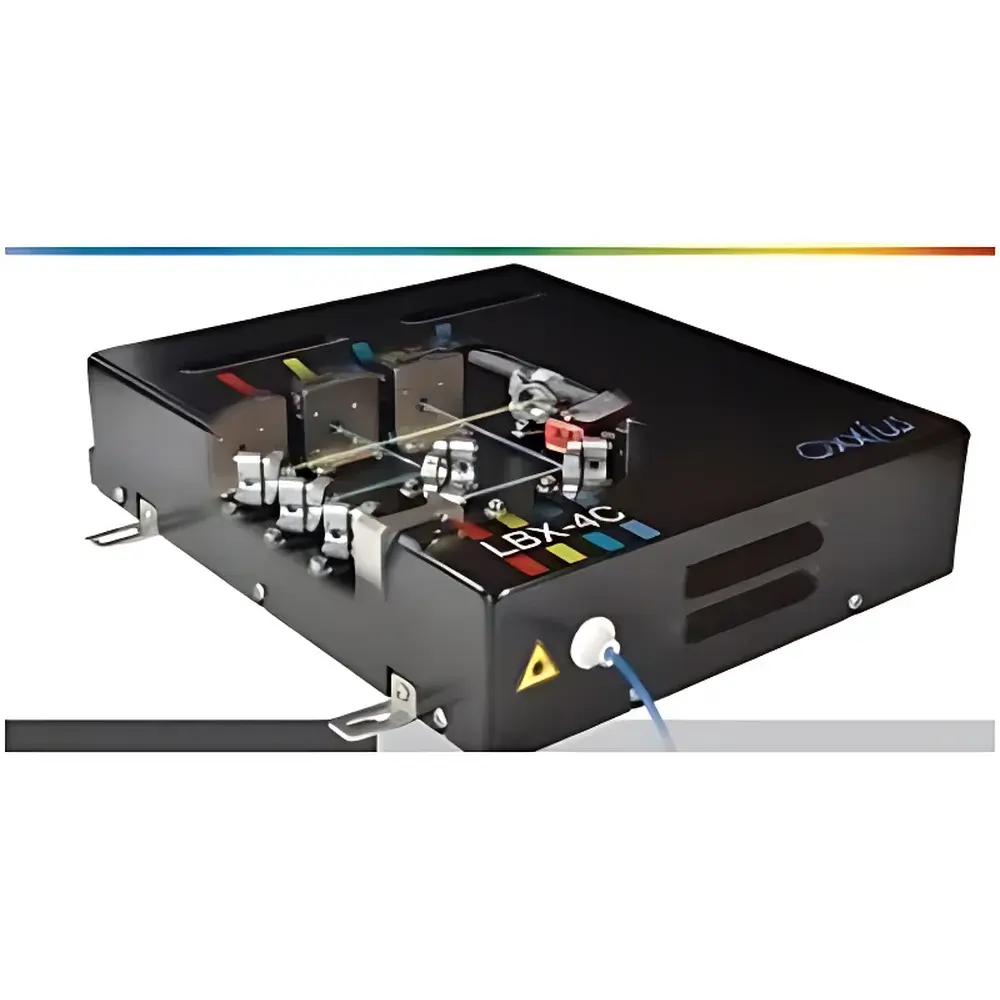
Oxxius LBX-4C Compact Multi-Wavelength Beam-Combined Laser System
| Origin | France |
|---|---|
| Manufacturer Type | Authorized Distributor |
| Origin Category | Imported |
| Model | LBX-4C |
| Pricing | Available Upon Request |
Overview
The Oxxius LBX-4C is a high-integration, fiber-coupled multi-wavelength laser engine engineered for demanding optical instrumentation applications requiring precise, independent control of multiple excitation wavelengths. Based on proprietary beam-combining optics and thermally stabilized diode laser modules, the LBX-4C employs free-space dichroic merging followed by active alignment into a single-mode (SM) or polarization-maintaining (PM) fiber output. This architecture ensures minimal spectral crosstalk (< −30 dB), high spatial mode fidelity (M² < 1.1), and long-term pointing stability—critical for confocal microscopy, super-resolution imaging (e.g., STED, SIM), and quantitative fluorescence assays where wavelength-specific photon flux must be reproducible across hours or days. Designed and assembled in France, the system complies with IEC 60825-1:2014 for Class 3B/4 laser safety and meets CE marking requirements for EMC (EN 55011) and low-voltage directives.
Key Features
- Configurable wavelength integration: Supports 2 to 8 discrete laser lines from a library of 14 standard wavelengths (375–780 nm), including 405, 445, 473, 488, 515, 532, 553, 561, 594, 638, 642, 660, 705, and 730 nm.
- Independent channel control: Each wavelength operates with fully decoupled analog (0–5 V) and TTL (0/5 V) modulation inputs, enabling synchronized or asynchronous intensity ramping with rise/fall times < 1 µs.
- Fiber delivery options: Standard FC/APC-terminated PM or SM fiber (1.5 m length); optional custom fiber types (e.g., HI1060, PM980) and connector variants (SMA905, QD) available upon request.
- Intelligent system management: Embedded microcontroller enables real-time thermal monitoring, interlock status reporting, and remote firmware diagnostics via USB-C or RS-232 interfaces.
- Robust mechanical design: Aluminum alloy chassis with passive thermal management; operational temperature range 15–35 °C; humidity tolerance 20–80% RH non-condensing.
- Low-noise performance: Intensity noise < 0.5% RMS (10 Hz–10 MHz) for all channels; power stability ±0.5% (free-space) / ±2% (fiber-coupled) over 8 hours at constant ambient conditions.
Sample Compatibility & Compliance
The LBX-4C is compatible with standard microscope filter sets (e.g., Semrock, Chroma) and commercial OEM scanning platforms (e.g., Nikon A1R, Zeiss LSM 900, Leica SP8). Its output beam characteristics—including collimated free-space profiles (0.7–0.8 mm Ø, ellipticity 100:1 extinction ratio)—ensure seamless integration into TIRF, FRAP, SPIM, and flow cytometry optical trains. The system supports GLP/GMP-aligned workflows through optional audit-trail logging (via Oxxius LaseSoft™ v3.x), compliant with FDA 21 CFR Part 11 requirements when deployed with validated host software environments. All laser modules conform to ISO 11554 (laser beam parameter measurement) and are certified per EN 60825-1:2014 Annex D for accessible emission limits.
Software & Data Management
Control is implemented via Oxxius LaseSoft™—a cross-platform application (Windows/macOS/Linux) supporting USB HID and virtual COM port protocols. The software provides GUI-based channel enable/disable, power setpoint adjustment (0–100% in 0.1% increments), modulation mode selection (CW, analog, TTL, or external sync), and real-time power readback using integrated photodiode monitors. For automated workflows, a documented ASCII command protocol enables integration with LabVIEW, Python (PySerial), MATLAB, or EPICS-based control systems. Firmware updates and diagnostic logs are retrievable remotely; error codes map directly to maintenance procedures defined in the service manual (Revision C, 2023).
Applications
- Multi-color confocal and widefield fluorescence microscopy, including spectral unmixing and lifetime-resolved imaging (FLIM).
- Super-resolution modalities such as STORM, PALM, and structured illumination microscopy (SIM), where precise temporal gating of excitation pulses is required.
- Flow cytometry systems requiring simultaneous excitation of tandem dyes (e.g., PE-Cy5, APC-Cy7) with minimal spillover.
- Optogenetics stimulation platforms integrating rapid wavelength switching for multi-opsin activation (ChR2, Chrimson, NpHR).
- Industrial metrology and semiconductor inspection tools utilizing multi-spectral defect classification.
FAQ
Can the LBX-4C be upgraded with additional wavelengths after purchase?
Yes—Oxxius offers field-upgradeable configurations; existing units may be returned for module replacement and recalibration under service agreement.
Is PM fiber coupling available for all wavelengths?
Yes; polarization-maintaining coupling is standard for 405, 488, 561, and 638 nm channels, and optional for other wavelengths depending on laser module availability.
What is the maximum total combined power achievable in single-mode fiber?
Up to 1.2 W aggregate power is technically feasible; however, practical limits depend on thermal load management and are specified per configuration in the delivered system datasheet.
Does the system support synchronization with external hardware triggers?
Yes—TTL input accepts 5 V CMOS/LVTTL signals with programmable delay (0–100 ms) and pulse width (1 µs–1 s) per channel via LaseSoft™ or ASCII commands.
Are calibration certificates traceable to national standards included?
NIST-traceable power calibration certificates (ISO/IEC 17025 accredited) are available as an optional add-on at time of order.





