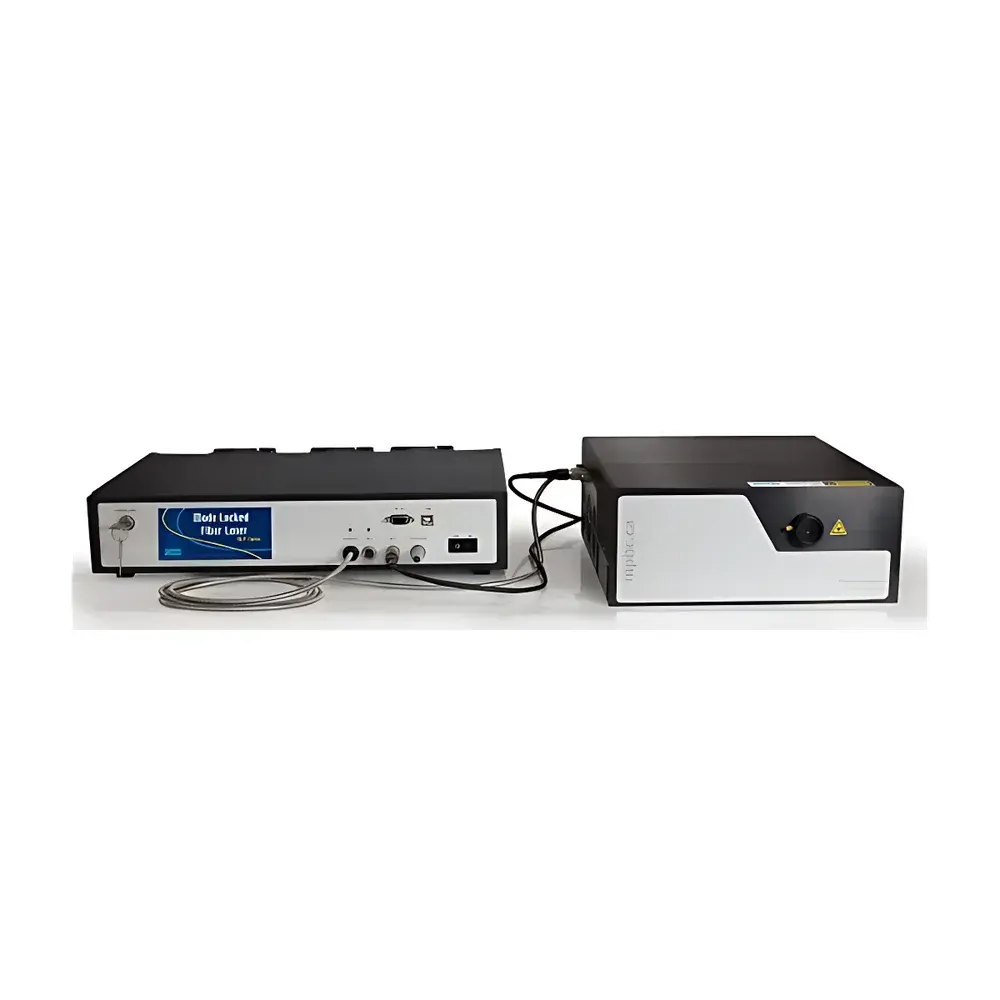
MPB AFML-Series and MLFL-Series Femtosecond Mode-Locked Fiber Lasers
| Brand | MPB |
|---|---|
| Origin | Canada |
| Model | AFML-1030-femto / MLFL-900-femto / MLFL-1190-femto |
| Central Wavelength | 900 nm, 1030 nm, 1190 nm |
| Pulse Duration | 100–800 fs |
| Repetition Rate | 25 MHz or 80 MHz |
| Average Output Power | ≥1 W (MLFL) / 3–10 mW (AFML) |
| Spectral Bandwidth | ~10 nm |
| Beam Diameter | 1 mm |
| Polarization | Linear, >99% |
| Beam Quality | Diffraction-limited (M² < 1.1) |
| Package Dimensions | Pump Module 440 × 343 × 92 mm |
| Design | All-fiber, alignment-free, maintenance-free |
Overview
The MPB AFML-Series and MLFL-Series femtosecond mode-locked fiber lasers are engineered for precision ultrafast photonics applications requiring high stability, exceptional beam quality, and long-term operational reliability. These all-fiber oscillators operate on the principle of passive mode-locking via nonlinear polarization evolution (NPE) or semiconductor saturable absorber mirrors (SESAMs), generating transform-limited or near-transform-limited pulses without bulk optics or free-space alignment. Unlike Ti:sapphire-based systems, these lasers eliminate the need for water cooling, complex cavity alignment, and stringent environmental controls—making them ideal for integration into OEM instruments, metrology platforms, and industrial-grade ultrafast systems. The MLFL variants deliver 1 W average power at 900 nm and 1190 nm with 80 MHz repetition rate and sub-200 fs pulse duration, while the AFML-Series provides a robust, low-noise seed source at 1030 nm (25 MHz, 600–800 fs, 3–10 mW), optimized for amplification stages in chirped-pulse amplification (CPA) architectures.
Key Features
- All-fiber monolithic architecture: No free-space optics, no realignment required over lifetime—ensures long-term pointing stability and mechanical robustness.
- Transform-limited pulse generation: Measured autocorrelation traces confirm Gaussian temporal profiles (FWHM ≈ 99 fs for MLFL-900), enabling high-fidelity time-resolved measurements.
- Linear polarization output with >99% extinction ratio, maintained through polarization-maintaining (PM) fiber delivery—critical for interferometric and nonlinear optical applications.
- Compact 2RU-compatible footprint: Integrated pump module and laser head enable rack-mount deployment in cleanroom or laboratory environments compliant with ISO 14644 Class 5+ standards.
- Low amplitude noise (<0.3% RMS, 10 Hz–10 MHz) and timing jitter <30 fs (integrated from 1 kHz to 10 MHz), supporting phase-sensitive applications such as optical frequency comb stabilization and asynchronous optical sampling (ASOPS).
- GUI-based control interface with USB and RS-232 connectivity supports remote monitoring of output power, temperature, and lock status—compatible with LabVIEW™ and Python-based automation frameworks.
Sample Compatibility & Compliance
These lasers are designed for integration into systems requiring traceable, repeatable ultrafast excitation sources. They comply with IEC 60825-1:2014 (Class 4 laser product safety requirements) and meet CE marking directives for electromagnetic compatibility (EMC Directive 2014/30/EU) and low-voltage operation (LVD Directive 2014/35/EU). The all-fiber construction ensures immunity to vibration and thermal drift—validated per MIL-STD-810G procedures for shock and thermal cycling. For regulated environments (e.g., GLP/GMP-compliant biophotonics labs), optional audit-trail-enabled firmware supports 21 CFR Part 11-compliant user access logs and parameter change history. No hazardous substances are used in manufacturing; RoHS 3 and REACH compliance is certified.
Software & Data Management
The embedded firmware supports real-time telemetry streaming via ASCII-over-serial or USB CDC protocols. The included Windows/Linux-compatible GUI provides calibrated power readout, pulse train visualization (via integrated photodiode monitor), and configurable interlock thresholds. Export formats include CSV and HDF5 for direct ingestion into MATLAB®, Python (NumPy/Pandas), or LabVIEW™ data acquisition workflows. For system integrators, a documented C/C++ SDK and Python bindings enable full control—including repetition rate fine-tuning (±100 ppm), output blanking, and thermal setpoint adjustment—without interrupting laser lock. Firmware updates are performed via signed binary packages to ensure integrity and version traceability.
Applications
- Optical Metrology: Used as coherent light sources in heterodyne laser interferometers for sub-nanometer displacement measurement and absolute distance metrology (per ISO 230-6 and VDI/VDE 2634).
- Multiphoton Microscopy: Enables deep-tissue imaging with reduced phototoxicity at 900 nm and 1190 nm—wavelengths selected for optimal scattering-to-absorption ratio in biological specimens.
- Terahertz Time-Domain Spectroscopy (THz-TDS): Serves as pump-probe excitation source for photoconductive antenna arrays, supporting bandwidths >5 THz with high signal-to-noise ratio.
- Ultrafast Spectroscopy: Provides synchronized pulse trains for transient absorption, fluorescence upconversion, and coherent anti-Stokes Raman scattering (CARS) experiments.
- OEM Seed Sources: Designed for injection seeding of Yb-doped fiber amplifiers and thin-disk lasers—enabling scalable high-energy CPA systems meeting ISO 11146 beam propagation standards.
- Frequency Comb Referencing: When coupled with octave-spanning supercontinuum generation and f–2f interferometry, supports optical clock development and precision spectroscopy traceable to SI second.
FAQ
What is the typical pulse-to-pulse energy stability over 8 hours?
Measured RMS fluctuation is ≤0.5% under constant ambient conditions (23 ± 0.5°C, humidity 40–60% RH), verified per ANSI Z136.1 Annex D test protocol.
Can the repetition rate be externally modulated or tuned?
The MLFL series operates at fixed 80 MHz; the AFML series supports adjustable repetition rate between 20–30 MHz via internal cavity length tuning—no external RF driver required.
Is single-shot pulse characterization supported out-of-the-box?
No integrated autocorrelator is included, but the 1 mm collimated output is fully compatible with commercial FROG or SPIDER devices (e.g., Mesa Photonics, APE Berlin) via standard SMF-28 or PM980 fiber patch cables.
What cooling method is used?
Conductive cooling only—no fans or liquid chillers required. Thermal management meets EN 60950-1 thermal class A specifications for continuous operation at ambient temperatures up to 35°C.
Are custom wavelengths available within the Yb- and Er-doped fiber gain bands?
Yes—MPB offers engineering support for wavelength-specific variants (e.g., 1064 nm, 1550 nm) under NRE agreement, subject to cavity design validation and ITAR-controlled export licensing where applicable.