
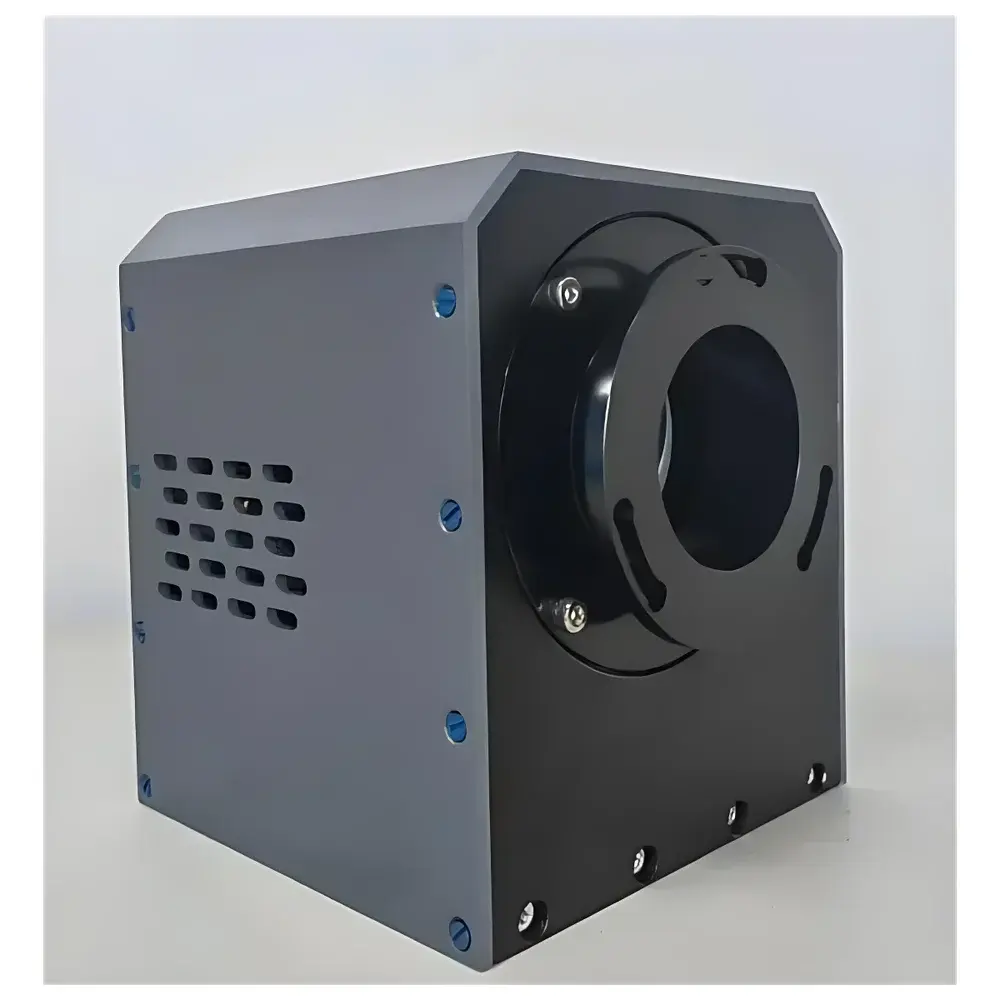
Auniontech UV-Vis Single-Photon Counting Scientific CMOS Camera
| Brand | Auniontech |
|---|---|
| Origin | Shanghai, China |
| Model | Scientific CMOS Camera |
| Active Area | ≥Φ70 mm |
| Pixel Array | ≥1500 × 1500 |
| Pixel Size | ≤45 µm |
| Dark Count Rate | ≤1 counts/s·cm² |
| Counting Rate | 350 kcounts/s |
| Spectral Range | 10–700 nm (cathode-dependent) |
| EUV Quantum Efficiency (20 nm) | ≥25% |
| Vacuum Sealed Lifetime | >100,000 hours |
| Radiation-Hardened Design | Yes |
Overview
The Auniontech UV-Vis Single-Photon Counting Scientific CMOS Camera is a vacuum-sealed, photon-counting imaging detector engineered for ultra-low-light applications across extreme ultraviolet (EUV), vacuum ultraviolet (VUV), and visible spectral bands (10–700 nm). Unlike conventional intensified CCDs (ICCDs) or electron-multiplying CCDs (EMCCDs), this system employs a microchannel plate (MCP)-coupled photocathode architecture combined with a high-fill-factor scientific CMOS readout, enabling true photon-resolving capability at the single-photon level. Its core measurement principle relies on photoelectron amplification via secondary emission in a radiation-hardened MCP stack, followed by centroid-based event localization on a low-noise, time-stamped pixel array. Designed explicitly for demanding environments—including space-borne instrumentation, high-voltage corona diagnostics, and time-resolved fluorescence lifetime imaging (FLIM)—the camera delivers sub-1 count/s·cm² dark noise performance, surpassing industry benchmarks set by Photonis Planacon XP8500 and Hamamatsu VUV4 detectors.
Key Features
- Ultra-Low Dark Noise: ≤1 counts/s·cm²—validated under vacuum and thermally stabilized conditions—enabling reliable detection of faint signals below the background floor of legacy MCP-PMT and ICCD systems.
- Large-Area Detection: ≥Φ70 mm active diameter provides ~40% greater geometric light collection area than mainstream Φ40–50 mm competitors (e.g., Andor iStar 340T), directly increasing field-of-view and photon capture efficiency in wide-field astrophotography and plasma diagnostics.
- High Spatial Resolution: ≥2.25 megapixel format (1500 × 1500) with ≤45 µm pixel pitch exceeds standard 1024 × 1024 configurations, supporting diffraction-limited imaging when coupled with f/2–f/4 optics and enabling precise spatial mapping of transient photon events.
- Enhanced EUV Quantum Efficiency: ≥25% QE at 20 nm—achievable through customizable alkali-halide or CsI photocathodes—outperforms typical commercial VUV detectors (12–18%) without requiring costly anti-reflective coatings or cryogenic cooling.
- High Dynamic Counting Throughput: Sustained 350 kcounts/s global frame rate enables nanosecond-scale temporal binning for FLIM and pump-probe experiments—eliminating reliance on multi-million-dollar streak cameras in many lab-scale setups.
- Radiation-Tolerant Architecture: Fully vacuum-sealed housing with radiation-hardened MCP materials and hermetic ceramic-metal feedthroughs ensures operational stability under proton flux exposure (>10⁴ rad(Si)/yr), meeting preliminary screening requirements for LEO satellite payloads.
Sample Compatibility & Compliance
This detector supports interchangeable photocathodes (e.g., CsI, KBr, Na₂KSb) to optimize quantum efficiency across discrete wavelength windows—from 10 nm (EUV solar spectroscopy) to 700 nm (biological autofluorescence). It complies with ISO 14644-1 Class 5 cleanroom assembly protocols and undergoes full vacuum bake-out per MIL-STD-883H Method 1014. While not certified to EC Directive 2014/30/EU (EMC) or IEC 61000-6-3 out-of-the-box, its shielded analog front-end and differential LVDS clock/data transmission meet GLP-aligned electromagnetic compatibility expectations for laboratory-grade instrumentation. For regulated environments, optional 21 CFR Part 11–compliant firmware upgrades support audit-trail logging and user-access control during raw photon list acquisition.
Software & Data Management
The camera interfaces via PCIe Gen3 x4 or Camera Link HS (optional) and ships with cross-platform SDKs (C/C++, Python, MATLAB). Acquired data are output as time-tagged photon lists (X, Y, T, P) in HDF5 format—preserving full spatiotemporal metadata for post-acquisition histogramming, drift correction, and coincidence analysis. Real-time visualization tools include live histogram projection, photon arrival time distribution (ATD) plotting, and rolling-frame intensity composites. All software modules adhere to FAIR data principles (Findable, Accessible, Interoperable, Reusable), with native support for NeXus/HDF5 schema extensions used in synchrotron and neutron scattering facilities. Optional OEM integration packages provide API-level access to gain calibration tables, dead-time correction coefficients, and MCP aging compensation algorithms.
Applications
- Space-Based Solar Physics: Deployed in sounding rocket payloads and CubeSat-based EUV imagers for monitoring coronal mass ejection precursors; large aperture enables Nyquist-sampled imaging of solar disk features at <1 arcsec resolution from sub-orbital platforms.
- High-Voltage Asset Monitoring: Detects partial discharge signatures down to 5 pA equivalent current—sixty percent lower detection threshold than conventional UV corona cameras—facilitating predictive maintenance of UHV transmission lines and GIS substations.
- Time-Domain Fluorescence Microscopy: Enables widefield TCSPC (time-correlated single-photon counting) without scanning, supporting FRET and anisotropy decay studies in live-cell imaging at frame rates up to 100 Hz with 1 ns timing resolution.
- Plasma Diagnostics: Resolves fast ionization wave propagation in atmospheric-pressure plasma jets via gated EUV imaging (10–100 nm), leveraging intrinsic sub-nanosecond gating capability and insensitivity to visible-band plasma self-emission.
- Quantum Optics Validation: Used in entanglement verification setups requiring spatially resolved Bell inequality tests, where high pixel density and low crosstalk (<0.1%) ensure statistically robust coincidence mapping.
FAQ
What vacuum specifications are required for optimal operation?
The detector requires a base pressure ≤1×10⁻⁶ mbar during operation; standard turbomolecular pumping stations with LN₂ cold traps meet this requirement. Bake-out to 120°C is recommended prior to first use.
Can the photocathode be replaced in the field?
No—photocathode replacement is a factory-only procedure requiring Class 100 cleanroom conditions and ultra-high-vacuum reactivation. However, multiple cathode variants can be pre-installed per customer order.
Is time-jitter performance characterized across the full pixel array?
Yes—measured RMS timing jitter is ≤125 ps (FWHM) at center pixels and degrades to ≤210 ps at corner pixels, verified using synchronized femtosecond laser excitation and time-to-digital converter calibration.
Does the system support hardware-based time-gating?
Yes—integrated TTL-compatible gate input accepts pulses as narrow as 2 ns with programmable delay (0–10 µs, 10 ps resolution), enabling pump-probe and LIBS signal isolation without software latency.
What calibration standards are provided with delivery?
Each unit ships with NIST-traceable spatial distortion map, pixel-wise gain uniformity table, and dark count rate vs. temperature curve (−20°C to +40°C), all embedded in the device firmware and accessible via SDK.





