
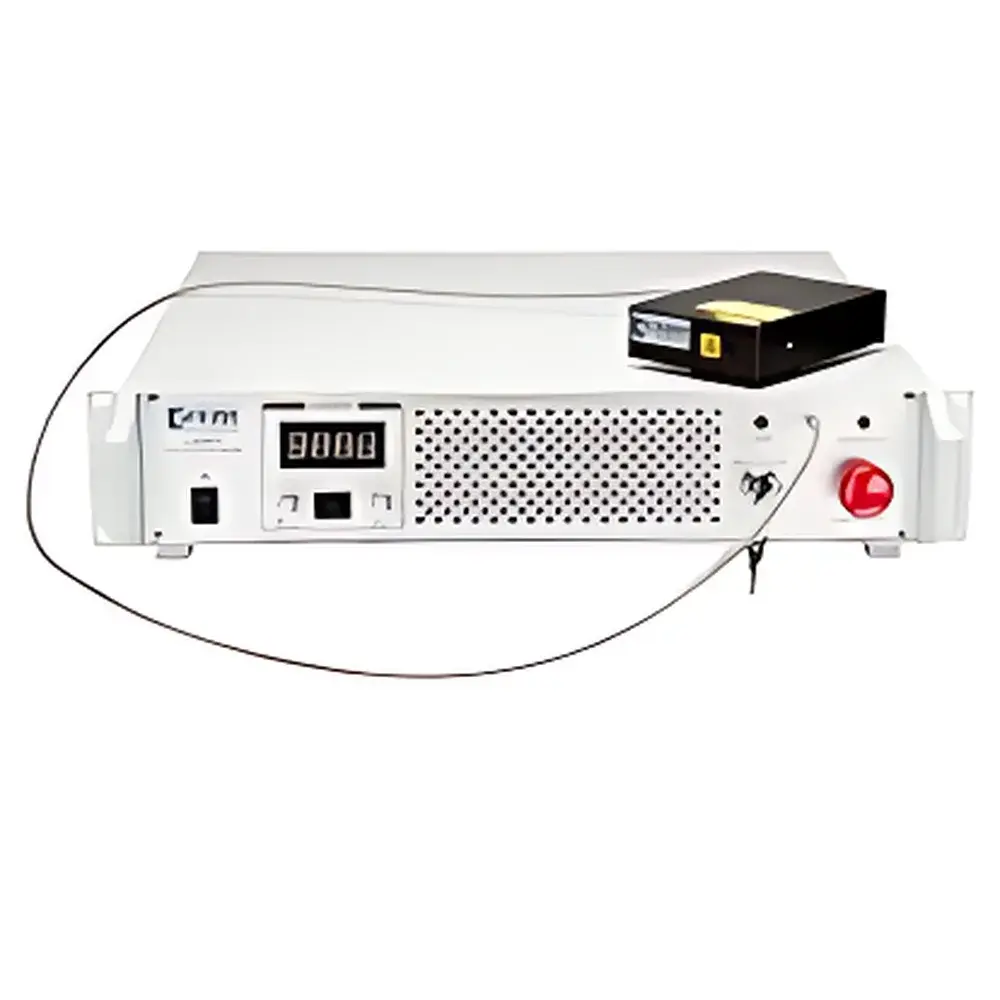
Calmar Laser CFL-05RFF0 High-Power Dual-Wavelength Femtosecond Fiber Laser (780 nm / 1550 nm)
| Brand | Calmar Laser |
|---|---|
| Model | CFL-05RFF0 |
| Wavelengths | 780 nm and 1550 nm (manually switchable) |
| Average Power | up to 0.8 W @ 780 nm, up to 2.5 W @ 1550 nm |
| Pulse Width | < 80 fs @ 780 nm, < 100 fs @ 1550 nm |
| Repetition Rate | 10–80 MHz (fixed per unit) |
| Beam Quality (M²) | < 1.2 @ 780 nm, < 1.1 @ 1550 nm |
| Polarization Extinction Ratio | > 25 dB @ 780 nm, > 18 dB @ 1550 nm |
| Power Stability | < 1% RMS over operating temperature range |
| RF Sync Output | 0.5 V TTL-compatible, SMA connector |
| Cooling | Air-cooled (low-noise fan) |
| Warm-up Time | ≤ 10 min |
| Laser Head Dimensions | 9.0 × 13.0 × 3.0 cm |
| Controller | 2U 19″ rackmount (44 × 42 × 9 cm) |
| Input Power | 85–264 VAC, 47–63 Hz, 200 VA max |
| Output Termination | Free-space collimated beam |
| Fiber Coupling Option | Available upon request |
Overview
The Calmar Laser CFL-05RFF0 is a turnkey, dual-wavelength femtosecond fiber laser engineered for industrial integration and demanding scientific applications requiring high temporal coherence, exceptional amplitude stability, and long-term operational robustness. Based on passively mode-locked erbium- and ytterbium-doped fiber oscillator-amplifier architecture, the system delivers sub-80-fs pulses at 780 nm and sub-100-fs pulses at 1550 nm—two spectrally distinct yet mutually exclusive output channels selected manually via front-panel interface. Unlike bulk-solid-state Ti:Sapphire lasers, the CFL-05RFF0 achieves comparable average power in a laser head volume reduced by a factor of ~300, enabling seamless integration into space-constrained platforms such as multiphoton microscopes, THz generation setups, and optical metrology stations. Its all-fiber oscillator core eliminates alignment-sensitive free-space cavities, while polarization-maintaining (PM) fiber delivery ensures consistent beam pointing and modal fidelity across thermal and mechanical perturbations. The system operates without water cooling and requires no periodic optical realignment or gain medium replacement—design features validated under continuous 24/7 operation in GLP-compliant laboratories and ISO Class 7 cleanroom environments.
Key Features
- Manually switchable dual-wavelength operation: 780 nm (up to 0.8 W) and 1550 nm (up to 2.5 W), each with independent pulse parameter optimization
- Pulse duration < 80 fs (780 nm) and < 100 fs (1550 nm), measured via autocorrelation with deconvolution factor 1.08
- High pulse contrast ratio (>10⁴:1) enabled by nonlinear pulse shaping and dispersion management within the PM fiber chain
- Timing jitter < 60 fs RMS (integrated from 10 kHz to 10 MHz), verified using balanced optical cross-correlator trace analysis
- Beam quality M² < 1.2 (780 nm) and 90%, diameter 1.0 mm (1/e²)
- RF synchronization output (0.5 V TTL, SMA) referenced to the fundamental repetition rate (10–80 MHz, factory-set)
- Front-panel control interface with real-time status feedback, including power readout, temperature monitoring, and fault diagnostics
- Air-cooled architecture with low-noise fan (< 45 dBA at 1 m); no external chiller or compressed air required
- Controller housed in 2U 19″ rack-mount chassis; laser head connected via armored single-mode fiber (1–5 m length, customizable)
Sample Compatibility & Compliance
The CFL-05RFF0 is designed for direct coupling into commercial and custom-built optical systems—including upright/inverted multiphoton microscopes, time-resolved spectroscopy platforms, and THz electro-optic sampling apparatus—via its collimated free-space output. Optional fiber-pigtailed configurations support integration with SMF-28 or PM980 fiber interfaces compliant with IEC 61300-2-4 (fiber optic connector durability) and Telcordia GR-1312-CORE (reliability under thermal cycling). All electrical subsystems meet CE marking requirements per EN 61000-6-3 (EMI emission) and EN 61000-6-2 (immunity). Firmware supports audit-trail logging for GxP-regulated workflows, with timestamped event records (power-on, wavelength switch, fault reset) stored in non-volatile memory. While not pre-certified for FDA 21 CFR Part 11, the system’s deterministic behavior, deterministic boot sequence, and hardware-enforced write protection enable straightforward validation for regulated biophotonics applications.
Software & Data Management
The CFL-05RFF0 operates autonomously without host PC dependency; however, optional RS-232 and USB-C serial interfaces allow remote monitoring and configuration via ASCII command protocol (documented in SDK v3.2). Logged parameters—including instantaneous output power, heatsink temperature, pump diode current, and sync signal phase deviation—are accessible in real time and exportable as CSV. Data retention spans ≥10⁶ operational cycles, with cyclic redundancy check (CRC-32) applied to all stored entries. For laboratory information management systems (LIMS) integration, the controller supports Modbus RTU over RS-485 (isolated port), enabling direct ingestion of laser status into centralized equipment tracking databases. No proprietary runtime or driver installation is required; all communication layers are OS-agnostic and compatible with Python, LabVIEW, MATLAB, and EPICS IOC environments.
Applications
- Multiphoton microscopy: Simultaneous two-photon excitation of GFP/YFP (780 nm) and deep-tissue imaging with reduced scattering and photodamage (1550 nm), leveraging tissue transparency window in the short-wave infrared (SWIR)
- Optical frequency metrology: Seed source for octave-spanning supercontinuum generation in highly nonlinear fibers (HNLF), supporting f–2f interferometry and optical clock stabilization
- Terahertz time-domain spectroscopy (THz-TDS): Pump-probe excitation of photoconductive antennas or nonlinear crystals (e.g., ZnTe, GaP), benefiting from high peak power and low timing jitter
- Ultrafast material processing: Precision ablation of transparent dielectrics (e.g., fused silica, sapphire) and polymer thin films, where wavelength-selective absorption enables process control
- Quantum optics experiments: Generation of heralded single photons via spontaneous parametric down-conversion (SPDC) in periodically poled lithium niobate (PPLN), requiring stable repetition rate and narrow spectral bandwidth
FAQ
Is the 780 nm and 1550 nm output truly simultaneous?
No—output is mutually exclusive. Users select one wavelength via front-panel toggle; internal optical routing prevents concurrent lasing.
Can the repetition rate be tuned in real time?
No—the repetition rate is fixed at time of manufacture (10, 20, 40, or 80 MHz) and cannot be adjusted post-delivery.
What is the maximum permissible back-reflection into the output port?
< –30 dB (0.1% reflected power) to maintain passive mode-locking stability; an integrated isolator is recommended for high-reflectivity target applications.
Does the system support external cavity dispersion compensation?
Yes—collimated output includes adjustable grating-based compressor mounts (optional accessory kit) for pulse recompression after dispersive media.
Is OEM integration support available?
Yes—Calmar provides mechanical drawings (STEP), electrical schematics, thermal derating curves, and EMI test reports under NDA for embedded system developers.



