
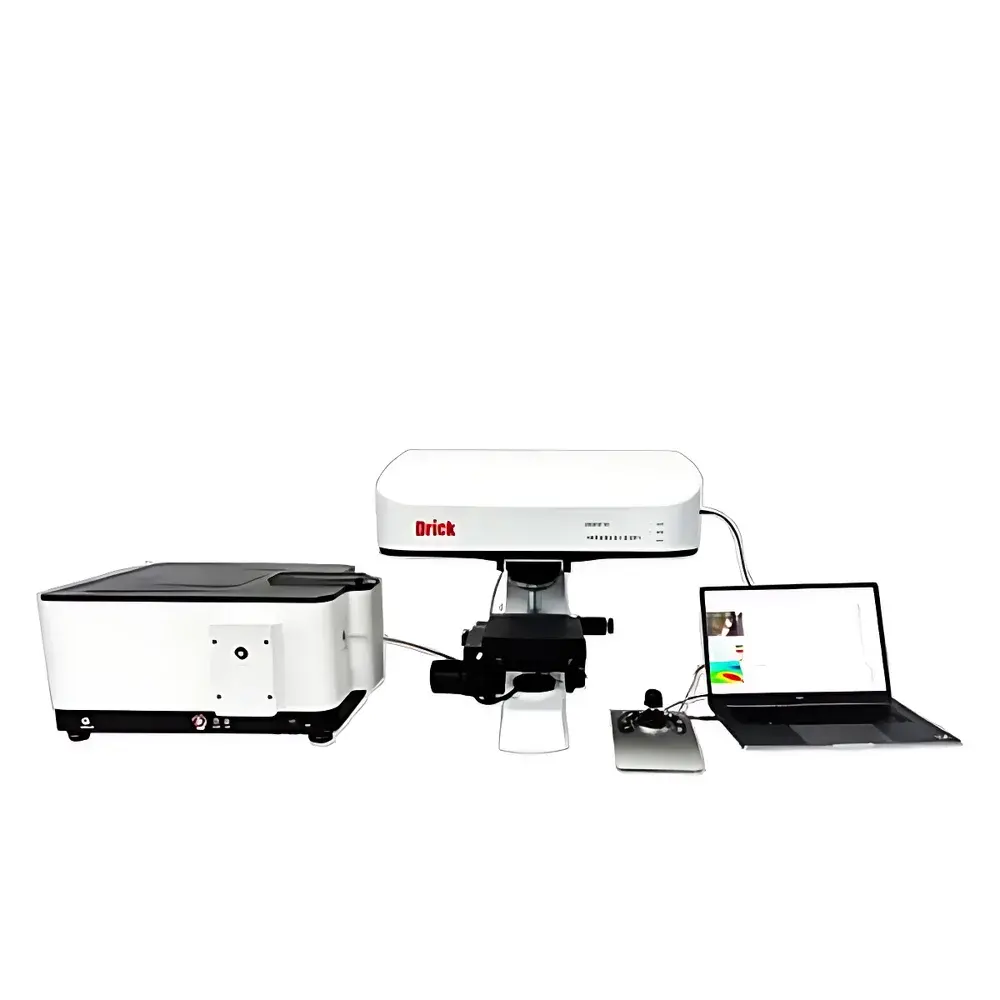
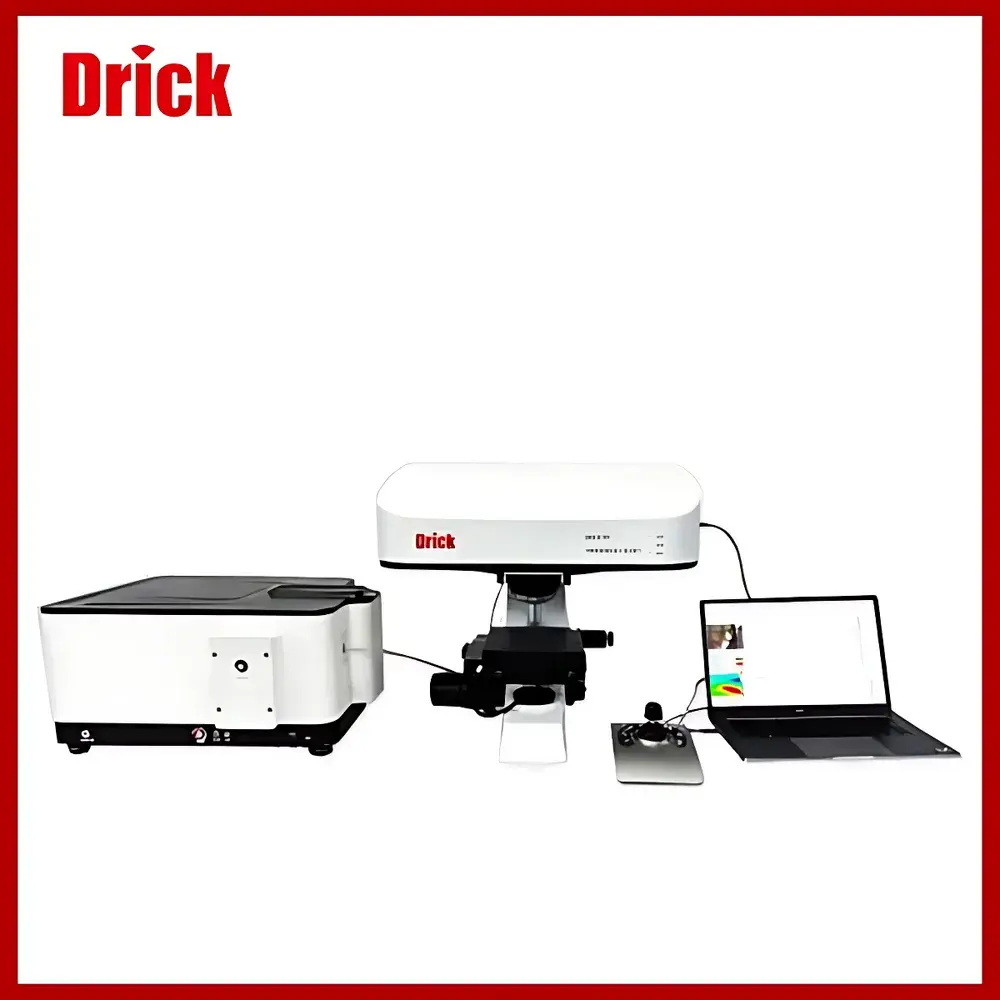
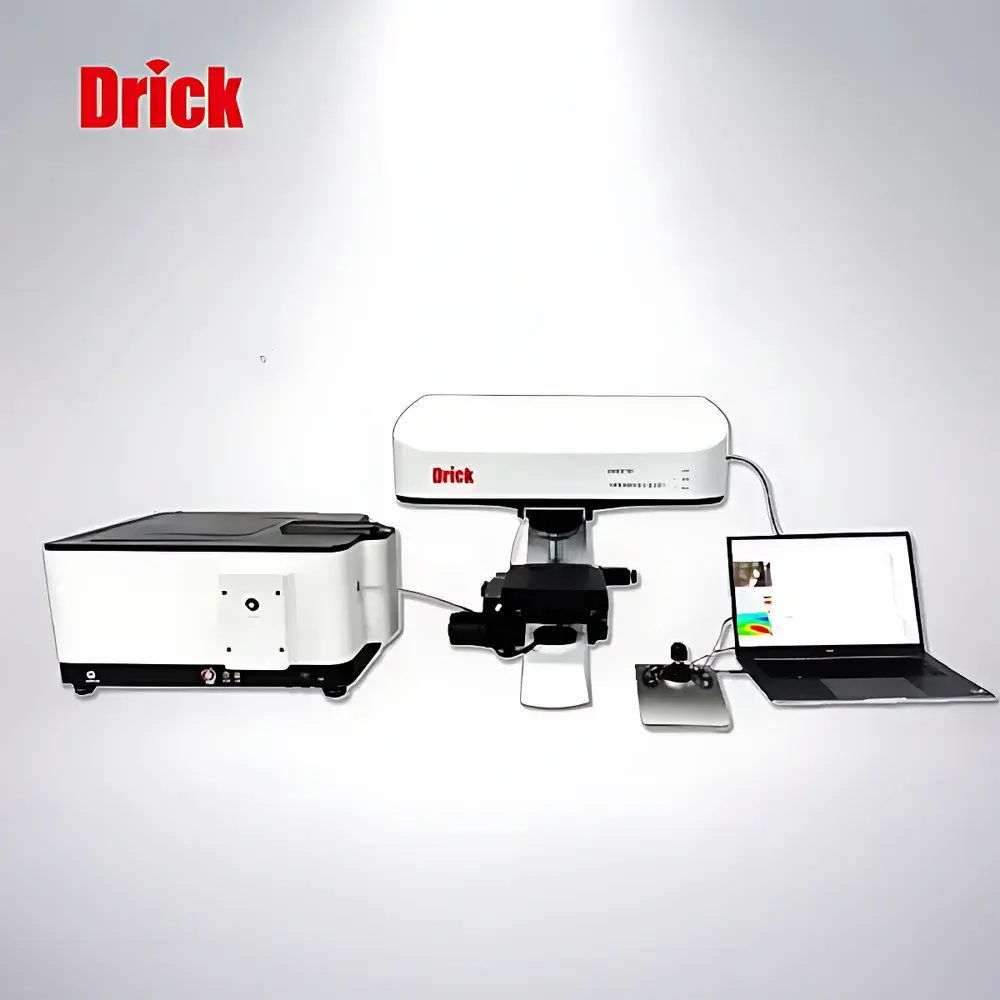
Drick DRK8700 Modular Confocal Micro-Raman Spectroscopic Imaging System
| Brand | Drick |
|---|---|
| Origin | Shandong, China |
| Manufacturer Type | OEM Manufacturer |
| Instrument Type | Modular Confocal Micro-Raman Spectrometer |
| Model Series | DRK8700 |
| Excitation Wavelengths | 532 nm, 638 nm, 785 nm, 1064 nm (up to 3 simultaneously integrated) |
| Spectrometer Focal Length Options | 210 mm, 350 mm, 510 mm, 810 mm |
| Spectral Resolution (min) | 0.5 cm⁻¹ (at FL810, narrow slit) |
| Spectral Range (configurable) | 150–10,000 cm⁻¹ (dependent on excitation wavelength) |
| Detector Options | Deep-cooled CCD (−70 °C, 2048×256 px), Scientific-grade CCD (−30 °C), InGaAs array (−70 °C, 512×1 or 1024×1 px) |
| Spatial Resolution (XY) | <2 µm |
| Axial (Z) Resolution | <5 µm |
| Confocal Mechanism | Motorized 6-position adjustable pinhole |
| Microscope Camera | 5 MP industrial CMOS |
| Objective Lenses | Standard 4×, 10×, 20× |
| XYZ Stage | Motorized 2D stage (50×50 mm or 100×100 mm travel), 0.1 µm resolution, ±1 µm positioning accuracy |
| Auto-focus Precision | ≤±0.2 µm |
| Integration Time | Up to 4680 s (1.3 h) with DRK8700-LT variant |
| Laser Power (max) | 532 nm: 100 mW |
| 638 nm | 80 mW |
| 785 nm | 350 mW |
| 1064 nm | 500 mW |
| Interface | USB 3.0 |
Overview
The Drick DRK8700 Modular Confocal Micro-Raman Spectroscopic Imaging System is an engineered platform for high-fidelity spatially resolved vibrational spectroscopy. It integrates a research-grade inverted microscope with a modular Czerny–Turner spectrograph, deep-cooled detection, and precision confocal optics—enabling true diffraction-limited Raman mapping with sub-micron lateral localization. The system operates on the principle of inelastic light scattering (Raman effect), where monochromatic laser excitation induces molecular vibrational transitions; the resulting Stokes/anti-Stokes shifts are dispersed by a motorized rotating grating spectrometer and recorded by a thermoelectrically cooled detector. Its modular architecture decouples the spectrometer head from the microscope base, permitting standalone spectral acquisition or full micro-spectroscopic imaging workflows. Designed for quantitative materials characterization, the DRK8700 supports rigorous spectral calibration traceable to NIST-traceable emission lines (e.g., Hg–Ar lamp at 614.31 nm and 922.45 nm), fulfilling requirements for method validation under ISO/IEC 17025 and ASTM E1840-22.
Key Features
- True confocal optical design with motorized 6-position pinhole turret and continuous pinhole diameter adjustment—ensuring optimal depth discrimination and rejection of out-of-focus signal.
- Modular spectrograph architecture with interchangeable focal lengths (210 mm, 350 mm, 510 mm, 810 mm) and automated multi-grating selection—enabling dynamic trade-off between spectral range (150–10,000 cm⁻¹) and resolution (down to 0.5 cm⁻¹).
- Deep-cooled scientific detectors: −70 °C CCD (2048×256 pixels) for visible/NIR excitation; −70 °C InGaAs arrays (512×1 or 1024×1) for extended NIR coverage up to 3500 cm⁻¹ with 1064 nm excitation.
- Multi-wavelength excitation capability: Up to three lasers (532 nm, 638 nm, 785 nm, 1064 nm) can be pre-aligned and software-switched via proprietary optical path routing—eliminating manual realignment and minimizing photodamage risk across heterogeneous samples.
- Automated XYZ stage with 100×100 mm travel range, 0.1 µm step resolution, and seamless image stitching algorithm—supporting large-area chemical mapping without user intervention.
- Real-time co-registration of optical morphology and spectral data: A 5 MP industrial camera captures diffraction-limited focus images synchronized with Raman acquisition; laser spot size remains <1 µm under 100× objective.
- USB 3.0 interface ensures high-throughput spectral streaming (>100 spectra/s at 1024 px resolution) and deterministic latency for closed-loop autofocus and scanning control.
Sample Compatibility & Compliance
The DRK8700 accommodates solid, powder, thin-film, and semi-transparent biological specimens—including tissue sections, polymer blends, semiconductor wafers, mineral grains, and forensic trace evidence. Its non-destructive, label-free analysis complies with ASTM E2529-20 (Standard Guide for Raman Microspectroscopy), ISO 21348 (Space environment—Process for determining solar irradiance), and supports GLP/GMP-aligned workflows through audit-trail-enabled software logging. Optional low-wave-number configuration (starting at 5 cm⁻¹) enables terahertz-range phonon mode analysis in crystalline lattices and soft matter systems. All optical paths meet IEC 61000-6-3 EMC emission standards and Class 3B laser safety requirements per IEC 60825-1:2014.
Software & Data Management
The native DRK-SpecSuite v4.x software provides full instrument orchestration—including automatic alignment routines, spectral calibration (polynomial fit to reference peaks), cosmic ray removal, baseline correction (asymmetric least squares), and multivariate analysis (PCA, cluster mapping). Raw spectral data are stored in HDF5 format with embedded metadata (excitation wavelength, grating position, integration time, stage coordinates, detector temperature), ensuring FAIR (Findable, Accessible, Interoperable, Reusable) compliance. Export options include ASCII, JCAMP-DX, and mzML-compatible formats for integration with third-party chemometrics platforms (e.g., MATLAB, Python scikit-learn, Unscrambler X). Audit trail logs record all parameter changes, user actions, and timestamped calibration events—meeting FDA 21 CFR Part 11 requirements when configured with electronic signature modules.
Applications
- Nanomaterial characterization: Strain mapping in 2D transition metal dichalcogenides (e.g., MoS₂ layer thickness via E²g/A₁g peak separation); defect density quantification in graphene via D/G intensity ratios.
- Pharmaceutical solid-state analysis: Polymorph identification in active pharmaceutical ingredients (APIs), crystallinity assessment in amorphous dispersions, and excipient compatibility screening.
- Forensic trace evidence: Non-invasive identification of pigments, dyes, explosives residues, and illicit drug adulterants directly on tape lifts or fiber substrates.
- Geological and gemological analysis: In situ mineral phase discrimination (e.g., quartz vs. cristobalite), fluid inclusion characterization, and synthetic diamond detection via stress-induced peak shifts.
- Biomedical research: Label-free histopathology of unstained tissue sections (e.g., collagen/elastin distribution in arterial walls), lipid droplet composition in adipocytes, and amyloid β aggregation kinetics.
- Environmental monitoring: Microplastic polymer typing in water filtration membranes; heavy metal speciation in biofilm matrices using surface-enhanced Raman scattering (SERS) substrates.
FAQ
What excitation wavelengths are supported, and can multiple lasers operate simultaneously?
The DRK8700 supports 532 nm, 638 nm, 785 nm, and 1064 nm lasers. Up to three wavelengths may be pre-installed and switched in software—no hardware reconfiguration is required.
Is the system compliant with regulatory data integrity standards?
Yes. With optional audit trail and electronic signature modules, DRK-SpecSuite meets FDA 21 CFR Part 11 and EU Annex 11 requirements for analytical instrument qualification in regulated environments.
How is spectral resolution validated?
Resolution is verified per GB/T 29854–2013 (Chinese National Standard equivalent to ASTM E1840) using Hg–Ar lamp emission lines at 614.31 nm and 922.45 nm. Measured full width at half maximum (FWHM) values are reported in the Certificate of Conformance.
Can the system perform long-integration measurements for low-signal samples?
The DRK8700-LT variant supports integration times up to 4680 seconds (1.3 hours) with −30 °C cooling, while the standard −70 °C CCD enables high-SNR acquisition at shorter exposures (1–60 s) for routine mapping.
What level of automation is available for Raman imaging?
Full automation includes motorized XYZ stage navigation, software-controlled pinhole and grating selection, real-time autofocus (≤10 s per field), and batch script execution for unattended multi-location mapping across heterogeneous sample areas.






