
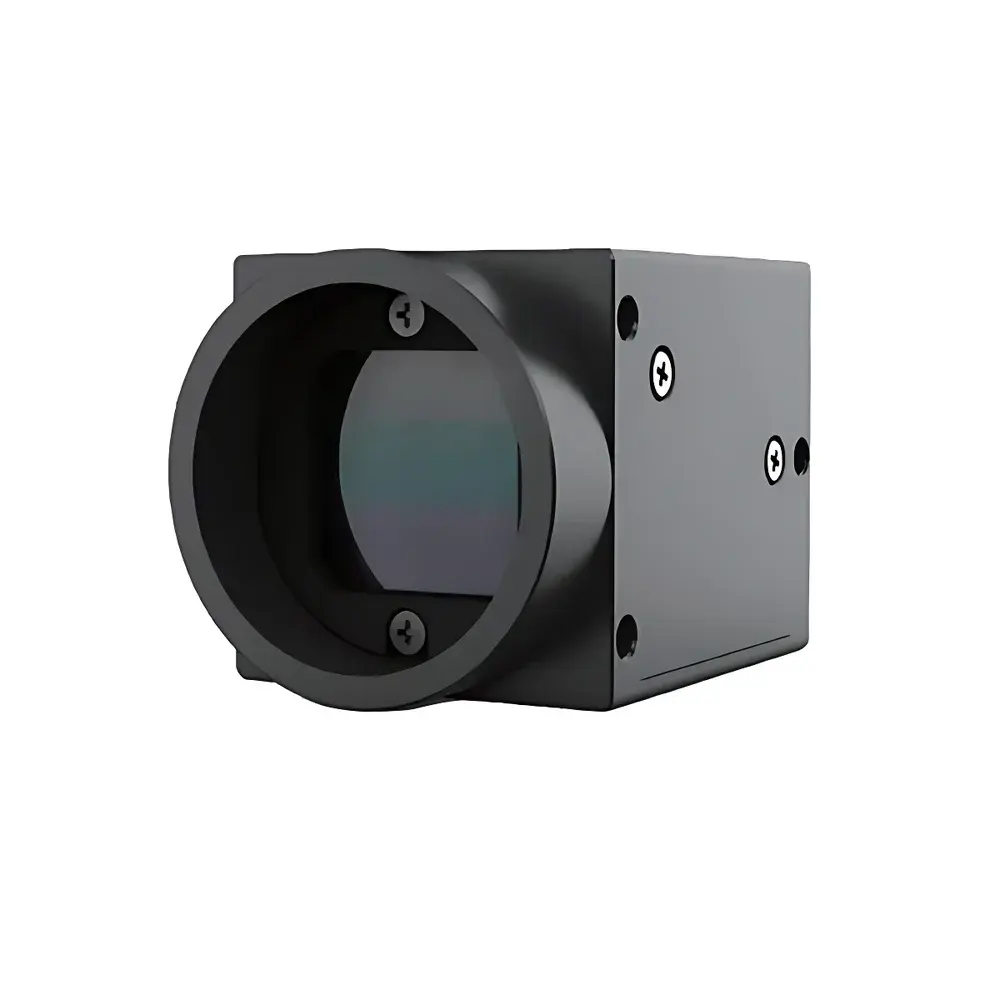
Auniontech JHS Thin-Film Filter-Based Miniature Hyperspectral Imaging Camera
| Brand | Auniontech |
|---|---|
| Origin | Shanghai, China |
| Manufacturer Type | Authorized Distributor |
| Regional Category | Domestic (PRC) |
| Model Series | JHS-SN16 & JHS-LS16/32 |
| Operating Principle | Push-broom & Snapshot (Mosaic) |
| Spectral Range | 500–950 nm |
| Spectral Resolution (FWHM) | 4–10 nm (typ.) |
| Spatial Format | Mosaic (64×4 or 104×4), Linear Scan (16/32 bands) |
| Sensor | Monolithic Fabry–Pérot CMOS Image Sensor |
| Pixel Size | 4.2 µm × 4.2 µm |
| Sensor Format | 1/1.3″ |
| Bit Depth | 8/12-bit selectable |
| Max Frame Rate | 52.25 fps @ 1752×2336 (8-bit) |
| Interface | USB3 Vision 1.0 / GenICam compliant |
| Lens Mount | C-mount |
| Power | 5 V DC (USB bus-powered) |
| Power Consumption | <3 W |
| Dimensions | 29 × 39.5 × 32.7 mm (excl. lens mount & housing) |
| Weight | <100 g |
| Operating Temp. | 0–50 °C |
| Humidity | 20–80% RH (non-condensing) |
| OS Support | Windows XP/7/8/10 (32/64-bit), Linux, ARM Linux, Android (custom drivers available) |
| SDK | C/C++, C#, VB.NET, Python, Java, LabVIEW, HALCON, DirectShow, TWAIN, OCX |
Overview
The Auniontech JHS Thin-Film Filter-Based Miniature Hyperspectral Imaging Camera is an integrated snapshot and push-broom hyperspectral imager engineered for field-deployable, non-destructive spectral analysis. Unlike conventional grating- or prism-based systems, the JHS series employs a monolithic Fabry–Pérot (FP) cavity pixel-level filter architecture fabricated directly onto a CMOS image sensor via thin-film deposition. This enables true on-chip spectral discrimination—eliminating external dispersive optics, moving parts, and optical alignment dependencies. The result is a robust, maintenance-free imaging spectrometer with inherent spatial-spectral co-registration and high temporal stability. Designed for real-time operation in resource-constrained environments, it delivers “image + spectrum” data cubes without post-acquisition registration or interpolation artifacts. Its compact form factor (under 100 g, <3 W power draw) and USB3 Vision compliance make it suitable for integration into UAV-mounted payloads, handheld inspection tools, embedded industrial vision systems, and portable laboratory platforms.
Key Features
- Monolithic FP-cavity CMOS sensor: Single-die integration of spectral filtering, photodetection, and readout circuitry ensures pixel-level spectral fidelity and eliminates inter-channel misregistration.
- Dual acquisition architectures: Selectable mosaic snapshot mode (for instantaneous full-frame spectral capture) or linear push-broom mode (for high-spatial-resolution line-scanned data cubes).
- Configurable spectral bands: Four standard variants cover 500–660 nm and 700–950 nm ranges, with FWHM from 4 nm to 10 nm; mosaic layouts support 64×4 or 104×4 spectral pixel arrays; linear scan variants provide 16 or 32 discrete bands with stepwise spectral sampling.
- Industrial-grade interface stack: Fully compliant with USB3 Vision 1.0 and GenICam standards—enabling plug-and-play integration with machine vision software suites (e.g., HALCON, OpenCV, LabVIEW) and supporting trigger synchronization (hard/soft/continuous), ROI definition, and real-time ISP acceleration.
- On-sensor image processing: Embedded features include programmable LUTs, 3D noise reduction, black level correction, white balance calibration, dead pixel mapping, gamma/contrast/saturation control, and user-defined ROI extraction—all configurable via SDK without host CPU overhead.
Sample Compatibility & Compliance
The JHS camera operates contactlessly across reflective and emissive sample modalities, supporting solid, semi-solid, and particulate surfaces typical in agricultural, pharmaceutical, forensic, and environmental applications. Its visible-to-near-infrared (VNIR) spectral response (500–950 nm) aligns with key absorption features of chlorophyll, water, cellulose, melanin, and common organic adulterants. Hardware design adheres to IEC 60950-1 safety requirements for low-voltage DC operation and meets EMC Class B emission limits per CISPR 32. While not certified for medical device use under ISO 13485 or FDA 21 CFR Part 820, the system supports GLP/GMP-aligned data integrity practices when deployed with audit-trail-enabled software frameworks. All firmware and driver binaries are digitally signed, and SDK logging functions enable traceable acquisition metadata (timestamp, exposure, gain, ROI coordinates, spectral band assignment).
Software & Data Management
Auniontech provides a comprehensive cross-platform SDK supporting C/C++, Python, C#, LabVIEW, HALCON, and MATLAB. The SDK includes GenICam-compliant device discovery, parameter enumeration, streaming control, and raw data parsing utilities. Spectral cube export formats include ENVI .hdr/.bin, HDF5, and TIFF stacks with embedded wavelength metadata. Optional database integration modules allow users to associate acquired spectra with reference libraries (e.g., NIST SRD, USGS spectral library subsets) for supervised classification or anomaly detection. All calibration files (radiometric, spectral, spatial) are stored in vendor-neutral JSON schemas, enabling reproducible preprocessing pipelines. Firmware updates are delivered via signed binary packages with SHA-256 checksum verification.
Applications
- Defense & Security: Camouflage detection via spectral signature divergence in NIR reflectance; counterfeit document/material identification using pigment-specific absorption edges.
- Agriculture & Food Safety: Non-invasive assessment of fruit ripeness (chlorophyll/carotenoid ratios), leaf nitrogen status, pesticide residue screening (organophosphate vibrational overtones), and grain moisture mapping.
- Pharmaceutical QC: Tablet coating uniformity analysis, excipient differentiation, and counterfeit drug detection through spectral fingerprint matching against validated reference spectra.
- Environmental Monitoring: Surface water turbidity estimation, algal bloom species discrimination, and soil organic carbon quantification via VNIR continuum removal and derivative spectroscopy.
- Forensics & Cultural Heritage: Ink differentiation on questioned documents, pigment identification in historical paintings, and char residue characterization in fire investigation.
FAQ
What spectral calibration accuracy is achievable with the JHS series?
Factory spectral calibration is traceable to NIST-traceable tungsten-halogen and deuterium lamp sources, with wavelength uncertainty ≤ ±0.5 nm across the specified range. Users may perform field recalibration using optional LED-based spectral reference targets.
Is radiometric calibration supported?
Yes—each unit ships with a factory-measured radiometric response curve (DN vs. irradiance). Optional NIST-traceable integrating sphere calibration services are available upon request.
Can the camera operate in synchronized multi-camera configurations?
Yes—hardware trigger input/output lines support precise frame synchronization across multiple JHS units or with external sensors (e.g., RGB cameras, LiDAR), enabling fused multimodal data acquisition.
Are custom spectral band configurations available?
Auniontech offers OEM spectral filter design services for tailored band placement, FWHM, and transmission profiles—subject to minimum order quantities and lead time validation.
Does the SDK support real-time spectral unmixing or classification algorithms?
The base SDK provides raw cube access and preprocessing primitives. Real-time unmixing (e.g., constrained least squares) and classification (e.g., SVM, PLS-DA) require integration with third-party or user-developed inference engines; example implementations are provided in Python and C++ reference code repositories.





