
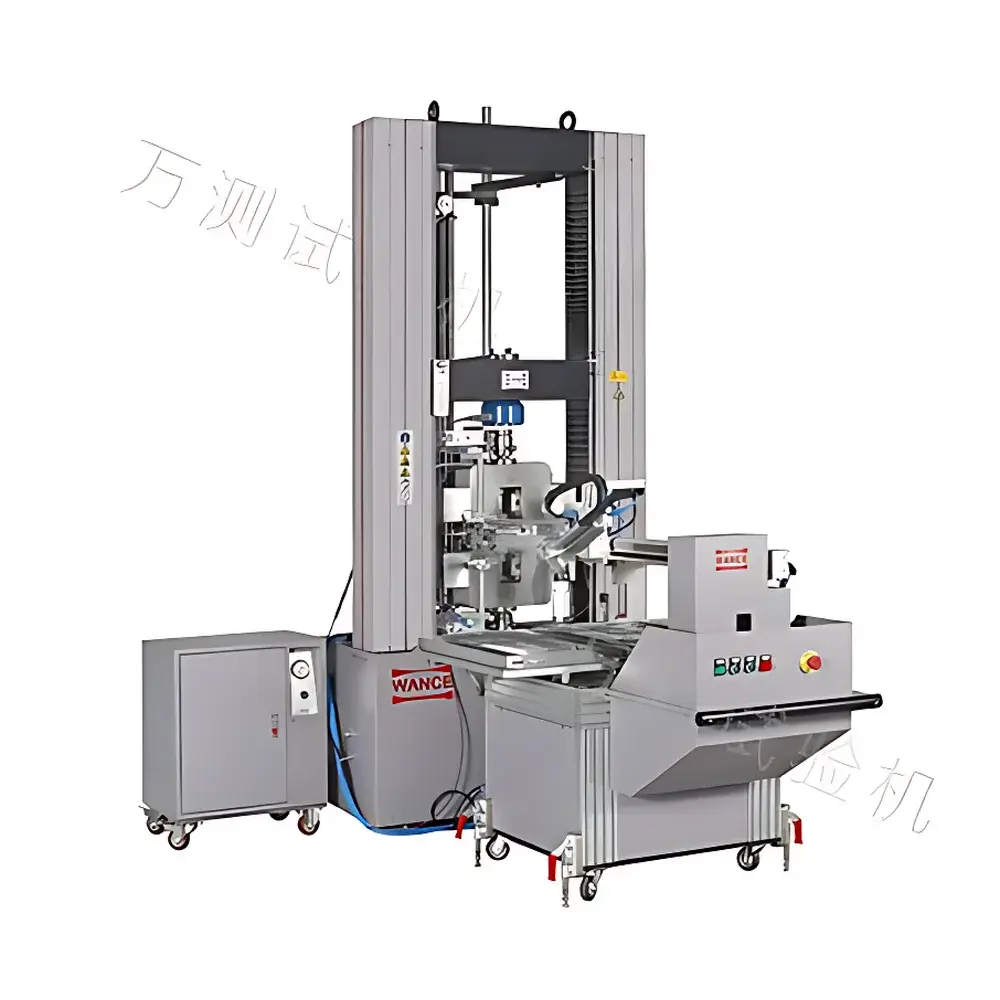
WANCE ETM105D-A 100 kN Microcomputer-Controlled Fully Automated Tensile Testing Machine
| Brand | WANCE |
|---|---|
| Origin | Guangdong, China |
| Model | ETM105D-A |
| Maximum Test Force | 100 kN |
| Force Measurement Range | ±1/500000 FS |
| Force Accuracy | ±0.5% |
| Crosshead Travel | 1150 mm |
| Displacement Resolution | 0.025 µm |
Overview
The WANCE ETM105D-A is a high-precision, fully automated tensile testing system engineered for high-throughput mechanical characterization of metallic sheet materials in industrial and research environments. Built upon a microcomputer-controlled electro-mechanical architecture with AC servo actuation, the system implements standardized uniaxial tensile testing per ASTM E8/E21, ISO 6892-1, and GB/T 228.1. Its core measurement principle relies on closed-loop force and displacement feedback at 1000 Hz sampling frequency, enabling accurate determination of yield strength (Rp0.2), ultimate tensile strength (Rm), total elongation (Agt), uniform elongation (Ag), and anisotropic plasticity parameters—namely the strain hardening exponent (n-value) and plastic strain ratio (r-value). Designed specifically for batch processing of thin-gauge metal strips (0.1–6 mm thickness), the ETM105D-A integrates synchronized hardware subsystems—including hydraulic wedgeless dual-face clamping, motorized specimen handling, real-time cross-sectional geometry measurement, and biaxial extensometry—to eliminate manual intervention while maintaining metrological traceability to national standards.
Key Features
- Fully automated workflow: Integrated robotic sample loading/unloading, auto-calibrated cross-section measurement (width: 10–50 mm; thickness: 0–20 mm), and programmable test sequencing reduce operator dependency and improve inter-laboratory reproducibility.
- High-fidelity force control: 100 kN load cell with ±0.5% accuracy across 0.4–100% FS range and resolution down to ±1/500000 FS ensures reliable detection of subtle yield transitions and low-force deformation regimes.
- Dual-axis extensometry system: Longitudinal extensometer (gauge length 15–205 mm, resolution ≤0.5 µm, Class 0.5 accuracy) coupled with transverse extensometer (gauge length 12–25 mm, resolution 0.05 µm) enables simultaneous true stress–true strain calculation and r-value derivation per ASTM E517.
- Hydraulic wedgeless clamping: Dual-face push-type grips deliver uniform 150 kN clamping force over 60 × 65 mm contact area, minimizing edge slippage and ensuring alignment tolerance ≤0.2 mm—critical for planar isotropy assessment.
- Precision motion control: Crosshead speed adjustable from 0.001 to 500 mm/min with closed-loop displacement feedback (±0.5% error, 0.025 µm resolution) supports quasi-static to high-strain-rate protocols under constant load or constant displacement modes.
Sample Compatibility & Compliance
The ETM105D-A accommodates flat metallic specimens conforming to ISO 6892-1 Type 1B, ASTM E345, and GB/T 228.1 standard geometries: thickness 0.1–6 mm; parallel width 12.5/20/25 mm; gauge length 50–100 mm; total length 250–300 mm. It supports both sheet and rod samples (Φ2–Φ40 mm), with automatic recognition of cross-sectional dimensions prior to test initiation. All measurement subsystems comply with ISO 9513 (extensometer calibration), ISO 7500-1 (load cell verification), and JJG 475 (Chinese national verification regulation). The system architecture supports GLP/GMP-aligned audit trails and is compatible with FDA 21 CFR Part 11 requirements when configured with electronic signature-enabled software modules.
Software & Data Management
The proprietary WANCE TestMaster™ software provides a validated, Windows-based interface for test method definition, real-time data visualization, post-test analysis, and report generation. It supports customizable templates aligned with ISO/IEC 17025 reporting structures, including automatic calculation of n- and r-values using polynomial curve fitting of true stress–strain data. Raw data are stored in binary format with embedded metadata (operator ID, timestamp, environmental conditions, calibration status), exportable to CSV, XML, or PDF. Audit logs record all user actions—including parameter modifications, calibration events, and result overrides—with time-stamped digital signatures. Integration with LIMS via OPC UA or RESTful API enables seamless data flow into enterprise quality management systems.
Applications
This system serves as a primary mechanical testing platform in steel mills for incoming/outgoing quality assurance of cold-rolled and hot-dip galvanized sheet products. It is widely deployed in third-party certification labs conducting CNAS-accredited tests for automotive OEMs (e.g., GMW14123, Ford WSS-M1A366-A2), aerospace suppliers validating AMS 2355 compliance, and academic metallurgy departments investigating texture–property relationships in advanced high-strength steels (AHSS). Its throughput of up to 22 specimens per hour makes it suitable for production-line statistical process control (SPC), fatigue pre-screening, and material database development for digital twin modeling.
FAQ
What standards does the ETM105D-A support for n-value and r-value determination?
It complies with ASTM E646 (n-value) and ASTM E517 (r-value), with automated calculations based on true stress–true strain curves derived from longitudinal and transverse extensometer data.
Can the system handle non-standard specimen geometries?
Yes—the software allows user-defined specimen profiles, and the cross-section measurement module adapts to custom width/thickness ranges within its physical limits (10–50 mm width, 0.1–20 mm thickness).
Is remote diagnostics and calibration support available?
WANCE provides secure remote access for firmware updates, diagnostic logging, and guided calibration procedures via encrypted VNC sessions, subject to customer IT policy approval.
What is the maintenance interval for hydraulic components?
The hydraulic clamping station requires oil filtration and pressure verification every 12 months or 2000 operational hours, whichever occurs first; full system recalibration is recommended biannually per ISO/IEC 17025 guidelines.
Does the system meet electromagnetic compatibility (EMC) requirements for laboratory use?
Yes—it conforms to IEC 61326-1:2013 for EMC immunity and emissions, certified for CE marking and RoHS compliance in industrial environments.



