
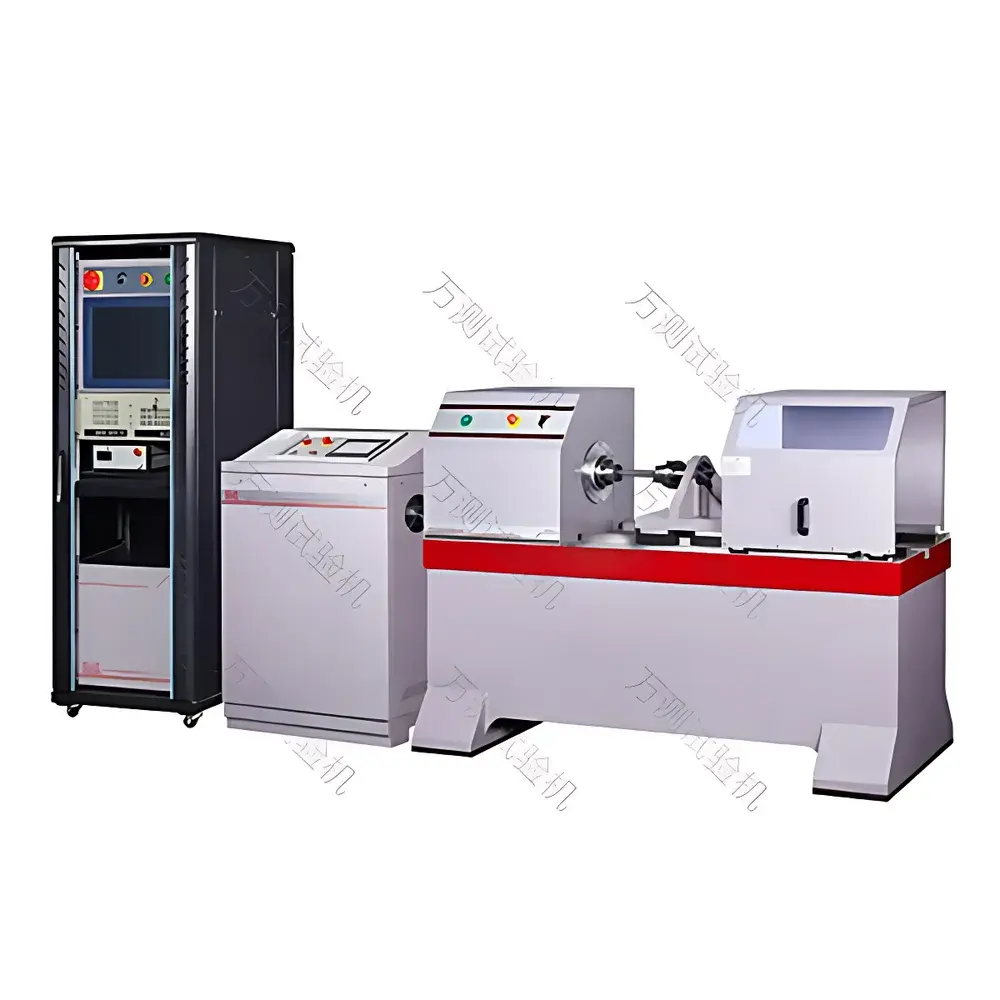
WANCE HDT-S Series Electro-Hydraulic Servo Torsional Fatigue Testing Machine
| Brand | WANCE |
|---|---|
| Origin | Guangdong, China |
| Model | HDT-S |
| Instrument Type | Electro-Hydraulic Servo Fatigue Testing Machine |
| Maximum Test Torque (Static) | 20,000 N·m |
| Maximum Dynamic Torque | ±20,000 N·m |
| Torque Measurement Accuracy | Better than ±0.5% of indicated value |
| Angular Measurement Accuracy | Better than ±0.5% of indicated value |
| Angular Resolution | 0.01° |
| Dynamic Test Frequency Range | 0.01–50 Hz |
| Test Waveforms | Sine, Square, Triangle, Trapezoidal, Ramp, Random |
| Maximum Swing Angle | ±50° (100° total range) |
| Control Modes | Torque闭环, Angle闭环, with seamless switching |
| Software Platform | Windows-based, Chinese-language interface, full computer control of test sequence |
Overview
The WANCE HDT-S Series Electro-Hydraulic Servo Torsional Fatigue Testing Machine is a high-capacity, precision-engineered system designed for controlled cyclic torsional loading of shaft-like specimens under static and dynamic conditions. It operates on the principle of electro-hydraulic servo actuation, where a high-bandwidth hydraulic torque actuator—driven by a digitally regulated servo valve—is coupled with real-time closed-loop feedback from high-fidelity torque transducers and angular encoders. This architecture enables accurate reproduction of complex torsional waveforms (including sine, square, triangle, trapezoidal, ramp, and user-defined random profiles) across a broad frequency spectrum (0.01–50 Hz), making it suitable for both low-cycle fatigue (LCF) and high-cycle fatigue (HCF) characterization of structural components. The system is primarily deployed in R&D laboratories, quality assurance departments, and third-party testing facilities to evaluate torsional durability, crack initiation thresholds, and life prediction models for rotating mechanical elements—particularly automotive drive shafts, aerospace couplings, powertrain components, and biomedical implants.
Key Features
- High-torque electro-hydraulic servo actuation with peak static capacity up to 20,000 N·m and symmetric dynamic capability of ±20,000 N·m
- Dual closed-loop control architecture supporting simultaneous or independent torque- and angle-controlled testing, with disturbance-free mode switching during active test sequences
- High-resolution angular measurement system (0.01° resolution) and calibrated torque sensing with accuracy better than ±0.5% of full scale
- Wide operational frequency bandwidth (0.01–50 Hz), enabling simulation of both quasi-static torsional stiffness evaluation and high-frequency vibratory fatigue conditions
- Modular integration capability for environmental chambers—including high-temperature (up to 600 °C), low-temperature (down to –70 °C), and salt-spray configurations—to support accelerated corrosion-fatigue studies
- Rigid four-column load frame with optimized torsional rigidity and minimized parasitic bending moments, ensuring pure torsional stress states per ASTM E2207 and ISO 1143 standards
Sample Compatibility & Compliance
The HDT-S accommodates cylindrical and prismatic shaft specimens ranging from Ø10 mm to Ø300 mm in diameter, with lengths up to 2,500 mm. It supports standardized test geometries per GB/T 12443–2007 (Metallic Materials — Torsional Fatigue Testing Method) and aligns with international equivalents including ASTM E2207 (Standard Practice for Torsional Fatigue Testing of Metallic Materials) and ISO 1143 (Rotating Beam and Torsion Fatigue Testing). Its mechanical design conforms to GB/T 2611–2007 (General Technical Requirements for Testing Machines) and incorporates safety interlocks, emergency stop circuits, and overload protection compliant with IEC 61800-5-2. While the base configuration operates at ambient temperature, optional environmental enclosures allow full compliance with ISO 9001-certified testing workflows and GLP/GMP audit requirements when paired with validated calibration records and traceable metrology.
Software & Data Management
The system runs on a Windows-based proprietary control and acquisition platform, featuring a localized Chinese graphical user interface without reliance on external runtime environments. All test parameters—including waveform type, amplitude, frequency, hold time, cycle count, and termination criteria—are programmable via intuitive dialog boxes and script-based batch sequencing. Real-time data acquisition captures torque, twist angle, rotational speed, and actuator pressure at up to 10 kHz sampling rate, stored in ASCII-compatible .csv and binary .tdms formats. Built-in statistical post-processing includes hysteresis loop analysis, S–N curve generation, phase lag calculation, and cumulative damage summation (e.g., Miner’s rule). Audit trail functionality logs operator actions, parameter changes, and calibration events—supporting alignment with FDA 21 CFR Part 11 principles when configured with electronic signatures and access controls.
Applications
- Automotive: Fatigue life validation of propeller shafts, CV joints, steering columns, and turbocharger rotors under combined torsional and thermal cycling
- Aerospace: Qualification testing of turbine blade root attachments, gearbox input/output shafts, and composite drive train couplings per MIL-STD-1540 and SAE AIR4925
- Energy: Structural integrity assessment of wind turbine main shafts and generator coupling systems subjected to variable-speed torsional loads
- Biomedical: Cyclic torsional evaluation of orthopedic fixation devices (e.g., intramedullary nails) and spinal implant interfaces under physiological torque ranges
- Academic Research: Fundamental investigation of torsional crack propagation mechanisms in metallic alloys, fiber-reinforced polymers, and additively manufactured lattice structures
FAQ
What types of materials and components can be tested on the HDT-S?
The system is validated for metals (steel, aluminum, titanium alloys), engineering thermoplastics (PA66-GF30, PEEK), fiber-reinforced composites (carbon/epoxy, glass/polyester), and hybrid assemblies such as bonded metal-composite drive shafts.
Is the HDT-S compatible with external environmental chambers?
Yes—standardized flange interfaces and signal feedthrough provisions enable seamless integration with commercially available high-temperature, cryogenic, and corrosion chambers, subject to chamber manufacturer specifications and thermal expansion compensation protocols.
Does the software support automated reporting and export to LIMS?
Test reports are generated in PDF and Excel formats with configurable templates; raw data exports (.csv, .tdms) are fully compatible with laboratory information management systems (LIMS) via standard ODBC or REST API gateways when deployed on enterprise networks.
What calibration and traceability documentation is provided?
Each unit ships with a factory calibration certificate traceable to CNAS-accredited national standards (GB/T 5027, JJG 1053), including torque transducer linearity verification, encoder angular repeatability, and dynamic response characterization at multiple frequencies.
Can the HDT-S perform combined axial-torsional loading?
The base HDT-S model is torsion-only; however, WANCE offers the HDT-AXT variant—a biaxial electro-hydraulic platform capable of synchronized axial force and torsional moment application for multiaxial fatigue research.



