
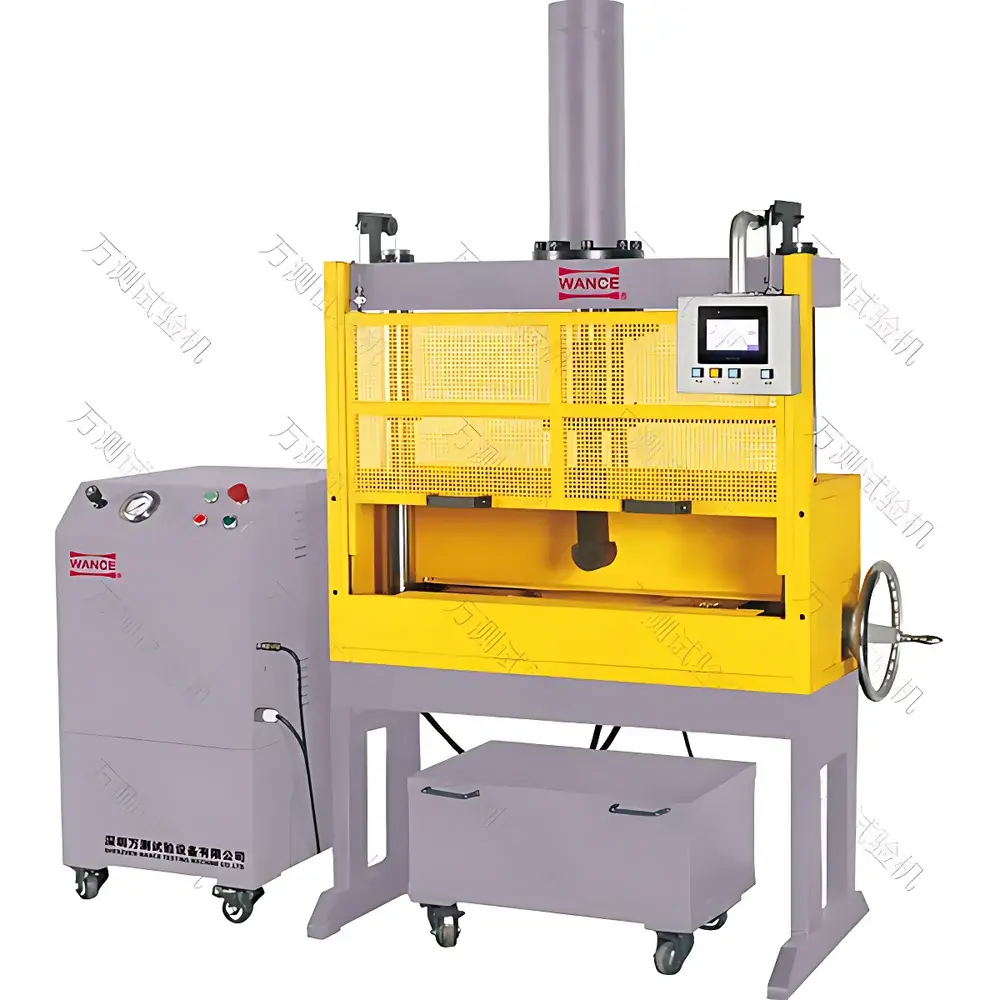
WANCE HBT165C Microcomputer-Controlled Steel Bar Bending Testing Machine
| Brand | WANCE |
|---|---|
| Model | HBT165C |
| Type | Vertical Hydraulic Bending Tester |
| Max Test Force (Main Cylinder) | 160 kN |
| Max Forming Force (Auxiliary Cylinder) | 60 kN |
| Main Cylinder Stroke | 300 mm |
| Auxiliary Cylinder Stroke | 30 mm |
| Roller Spacing Adjustment Range | 10–340 mm (stepless) |
| Bending Head Diameter Options | 6–200 mm (standard set covers Φ6–Φ200 per GB/T 1499.2–2007) |
| Specimen Capacity | Round bars Φ6–Φ40 mm |
| Max Bending Angle | 180° |
| Test Speed Control Range | 0.5–4 mm/s (infinitely adjustable, compliant with 1 ± 0.2 mm/s per GB/T 232–2010 Clause 7.3) |
| Power Supply | 380 V, 50 Hz, 2.2 kW |
| Dimensions (L×W×H) | 1450 × 680 × 1050 mm |
| Weight | 600 kg |
| Compliance | GB/T 232–2010, GB 1499.1–2007, GB 1499.2–2007 |
Overview
The WANCE HBT165C Microcomputer-Controlled Steel Bar Bending Testing Machine is a vertically oriented, dual-cylinder hydraulic system engineered for precise and repeatable bending tests on metallic construction materials—including hot-rolled plain and ribbed steel bars, round rods, and flat plates—according to internationally referenced mechanical testing standards. It operates on a two-stage bending principle: the main cylinder initiates plastic deformation by bending the specimen to approximately 170°, after which the auxiliary cylinder completes the final angular displacement to exactly 180°, ensuring full compliance with the endpoint definition in GB/T 232–2010. This sequential actuation eliminates manual repositioning, reduces operator intervention, and guarantees consistent load application across test cycles. The machine integrates real-time displacement sensing via high-linearity LVDTs, enabling direct calculation and digital display of bending angle (°), piston displacement (mm), and instantaneous test speed (mm/s). Its architecture supports both arbitration-grade testing and routine QC verification in reinforced concrete material laboratories, precast facilities, and third-party certification bodies.
Key Features
- Dual-cylinder hydraulic actuation: Main cylinder (160 kN) for primary bending; auxiliary cylinder (60 kN) for precision final-angle completion to 180°
- Stepless, handwheel-driven roller spacing adjustment (10–340 mm) with automatic self-locking mechanism—no wrench required
- Modular bending head system with standardized diameters (6–200 mm) fully aligned with GB/T 1499.2–2007 requirements for HRB(F)335 and HRB(F)400 grades
- Real-time digital feedback: LCD panel displays bending angle, piston displacement, and test speed with resolution ≤0.1 mm and ±0.5° angular accuracy
- Infinitely variable speed control (0.5–4 mm/s) calibrated to meet the (1 ± 0.2) mm/s tolerance specified in GB/T 232–2010 Clause 7.3
- Ergonomic vertical layout (operating height ~800 mm) with front-mounted control console and integrated safety guard enclosure
- Single-operator workflow: All functions executed via momentary push-button controls; no secondary setup or tooling adjustments needed between specimens
Sample Compatibility & Compliance
The HBT165C accommodates a broad spectrum of structural steel specimens: round bars from Φ6 mm to Φ40 mm, rectangular plates up to 40 mm thick × 50 mm wide, and multi-sided cross-sections within dimensional constraints. Its bending geometry adheres strictly to the support span-to-diameter (a/d) and mandrel diameter (D) ratios defined in GB/T 232–2010, ensuring geometric fidelity during plastic deformation. The system satisfies mandatory testing protocols for reinforcing steel under GB 1499.1–2007 (hot-rolled plain bars) and GB 1499.2–2007 (hot-rolled ribbed bars), including verification of ductility, surface crack formation, and core integrity post-bending. While not certified to ISO 7438 or ASTM E290 by default, its mechanical design and measurement traceability pathway support calibration alignment with those standards when configured with NIST-traceable load cells and angular encoders.
Software & Data Management
The embedded microcomputer controller provides local data acquisition without external PC dependency. All test parameters—including start/stop timestamps, peak force values, bending angle progression, and velocity profiles—are logged internally and exportable via USB interface in CSV format. The firmware implements audit-ready data integrity features: timestamped event logging, non-erasable test records, and user-access level control (operator vs. administrator). Though not Part 11 compliant out-of-the-box, the system architecture allows integration with LIMS platforms via RS-232 or Modbus RTU for centralized reporting in GLP/GMP environments. Optional software upgrades enable automated report generation conforming to GB/T 232–2010 Annex A templates, including pass/fail evaluation against maximum allowable crack width and visible fracture criteria.
Applications
- Quality assurance testing of reinforcing steel supplied to civil infrastructure projects (bridges, high-rises, dams)
- Factory acceptance testing (FAT) at rolling mills and rebar fabrication plants
- Third-party conformity assessment per Chinese national standards and CCC certification requirements
- R&D validation of new alloy formulations or thermomechanical processing routes for improved bendability
- Educational use in materials science laboratories for hands-on demonstration of plastic hinge formation and strain localization
- Periodic verification of production line consistency in prefabricated component manufacturing
FAQ
Does the HBT165C comply with ASTM E290 or ISO 7438?
It is primarily designed and validated for GB/T 232–2010 and related Chinese steel standards. With appropriate calibration and documentation, it may be adapted for ASTM E290 or ISO 7438 testing, but formal certification requires third-party verification.
Can the bending speed be maintained at exactly 1.0 mm/s throughout the entire stroke?
Yes—the infinitely adjustable hydraulic flow control enables stable velocity maintenance within ±0.2 mm/s tolerance over the full 300 mm main cylinder stroke, as verified per GB/T 232–2010 Clause 7.3.
Is the 180° bending angle measured optically or calculated from displacement?
Angle is calculated in real time using calibrated linear displacement data and fixed kinematic geometry; no optical encoder is installed, but angular resolution remains ≤0.5° across the full range.
What maintenance intervals are recommended for the hydraulic system?
Hydraulic oil replacement every 2,000 operating hours or biannually (whichever occurs first); filter element replacement every 1,000 hours; annual calibration of load cells and displacement sensors is advised for metrological continuity.
Are custom bending heads available beyond the standard 25-diameter set?
Yes—WANCE offers OEM-designed bending mandrels for non-standard geometries or proprietary reinforcement profiles upon submission of dimensional specifications and loading requirements.
Related Products



