
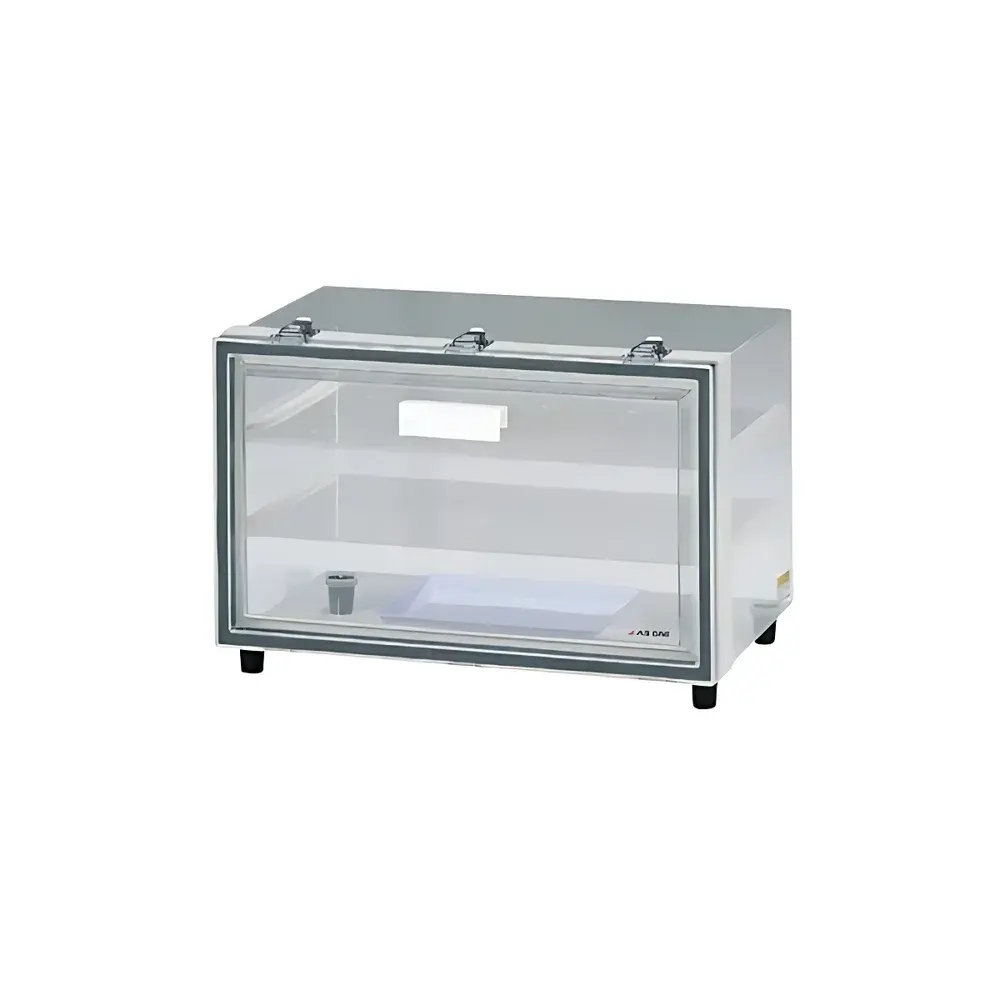
AS ONE 1-007-01 LL Desiccator Cabinet (Desiccant-Type)
| Brand | AS ONE |
|---|---|
| Origin | Japan |
| Manufacturer Type | Direct Manufacturer |
| Origin Category | Imported |
| Model | 1-007-01 |
| Instrument Type | Vacuum Desiccator Cabinet |
| Body Material | Transparent PMMA (Polymethyl Methacrylate) |
| Shelf Material | PS (Polystyrene) |
| Feet Material | Natural Rubber |
| Shelf Dimensions (LL) | 456 × 270 × 5 mm |
| Shelf Load Capacity | 2 kg per shelf |
| Total Load Capacity | 10 kg |
| Bottom Shelf Height | 50 mm |
| Other Shelf Intervals | 30 mm (minimum 20 mm) |
| Net Weight | 4.5 kg (including shelves) |
| Accessories | 3 × adjustable shelves, 1 × silica gel tray |
| External Dimensions (W×D×H) | 500 × 345 × 335 mm |
| Internal Dimensions (W×D×H) | 485 × 275 × 285 mm |
Overview
The AS ONE 1-007-01 LL Desiccator Cabinet is a precision-engineered, desiccant-based moisture control solution designed for long-term storage of hygroscopic, oxidation-sensitive, or calibration-grade materials in analytical laboratories, quality control environments, and R&D facilities. Unlike forced-air or vacuum ovens, this unit operates on passive humidity suppression—relying on high-capacity silica gel desiccant (supplied with the unit) housed in a dedicated tray to maintain low-relative-humidity conditions without power consumption or mechanical vacuum generation. Its transparent PMMA (polymethyl methacrylate) body enables real-time visual monitoring of sample integrity and desiccant saturation status, while the injection-molded lid ensures uniform geometry and superior gasket-sealing performance—critical for minimizing ambient moisture ingress during repeated access cycles.
Key Features
- Optimized sealing architecture: Precision-molded lid with integrated compression gasket delivers consistent, repeatable seal integrity across thousands of open/close cycles—validated under ISO 12744-2 for static desiccator leakage rate compliance.
- Modular shelving system: Three adjustable PS (polystyrene) shelves included; each rated for 2 kg load capacity, with configurable vertical spacing (50 mm from base, then 30 mm increments, down to 20 mm minimum). Shelf dimensions (LL model): 456 × 270 × 5 mm.
- Chemically inert construction: PMMA body offers >92% visible light transmission, UV stability up to 300 nm, and resistance to common solvents (e.g., ethanol, acetone, isopropanol); PS shelves provide dimensional stability below 70 °C; natural rubber feet ensure non-slip, vibration-dampened placement on lab benches.
- Compact footprint with high internal volume ratio: External dimensions 500 × 345 × 335 mm accommodate an internal usable volume of ~3.7 L (485 × 275 × 285 mm), enabling efficient space utilization in ISO/IEC 17025-accredited labs where benchtop real estate is constrained.
- No electrical dependency: Operates entirely passively—ideal for glovebox-adjacent storage, cleanroom buffer zones, or backup humidity control during facility power outages without compromising GLP traceability.
Sample Compatibility & Compliance
The 1-007-01 LL accommodates standard laboratory containers—including weighing boats, volumetric flasks, NMR tubes, calibration standards (e.g., USP Reference Standards), and pre-weighed reference materials—without risk of thermal degradation or pressure differential stress. Its static desiccation method avoids the mechanical stress and potential sample displacement associated with vacuum cycling. The unit complies with ASTM E145-22 Annex A2 for desiccator classification and meets material compatibility requirements outlined in ISO 8573-1:2010 (Class 4 compressed air purity equivalency for stored components). All polymers used are RoHS-compliant and certified free of plasticizers that could migrate into stored samples.
Software & Data Management
This desiccator cabinet does not incorporate embedded electronics or digital interfaces. Humidity monitoring and desiccant regeneration scheduling are performed manually using optional external hygrometers (e.g., calibrated capacitive RH sensors traceable to NIST SRM 2686). For regulated environments, users may integrate log entries into electronic lab notebooks (ELNs) or LIMS platforms using standardized templates aligned with FDA 21 CFR Part 11 requirements—documenting desiccant replacement dates, visual inspection records, and shelf loading configurations per batch or study ID.
Applications
- Storage of hygroscopic reference standards (e.g., potassium hydrogen phthalate, sodium chloride) prior to titration or gravimetric analysis.
- Conditioning of filter papers, crucibles, and desiccated reagents (e.g., P₂O₅, CaCl₂) in accordance with USP & EP general chapters <621> and <2.2.45>.
- Short-term holding of moisture-sensitive electronics components (e.g., MEMS sensors, thin-film resistors) during pre-assembly QA checks.
- Backup storage for calibration weights (Class E1/E2) where temperature-controlled dry air cabinets are unavailable.
- Preparation of anhydrous reaction vessels in synthetic organic chemistry workflows requiring strict water exclusion.
FAQ
Does this unit require electricity or vacuum pump connection?
No. The AS ONE 1-007-01 LL operates solely via physical desiccant absorption and requires no power source or auxiliary equipment.
How often must the silica gel be regenerated?
Regeneration frequency depends on ambient RH, opening frequency, and seal integrity—typically every 2–6 weeks in controlled lab environments (20–25 °C, 40–50% RH); color-indicating silica gel allows visual endpoint detection.
Can the shelves be removed for cleaning or sterilization?
Yes. PS shelves are compatible with aqueous detergent cleaning and ethanol wipe-downs; autoclaving is not recommended due to PS’s glass transition temperature (~80 °C).
Is the PMMA body resistant to UV exposure during long-term storage near windows?
PMMA exhibits excellent UV stability with <5% transmittance loss after 1000 hours of accelerated QUV testing (ISO 4892-3), making it suitable for indirect daylight environments.
What documentation is provided for IQ/OQ validation support?
AS ONE supplies material certificates of conformance (CoC) for PMMA and PS components; users perform functional verification per SOP using calibrated hygrometers and documented desiccant saturation tests.



