
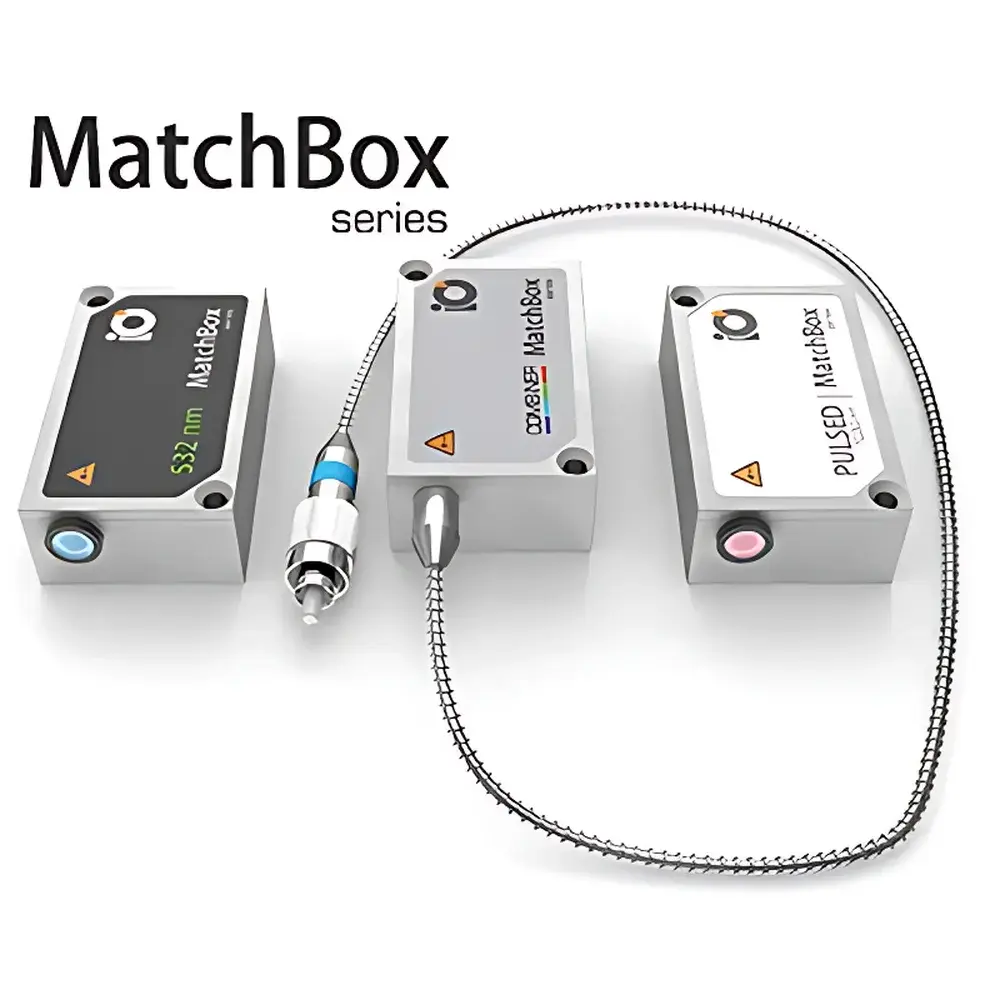

Integrated Optics MatchBox2 0405L–1342L Ultra-Compact Continuous-Wave DPSS Laser Series
| Brand | Integrated Optics |
|---|---|
| Model | 0405L–1342L |
| Wavelength Range | 405–1342 nm (discrete lines) |
| Output Type | Free-space, SM/PM/MM fiber-coupled |
| Dimensions | 50 × 30 × 18 mm |
| Power Supply | +5 V DC |
| Cooling | Integrated TEC |
| Power Stability (RMS, 8 h) | <1–2% |
| Intensity Noise (RMS, 20 Hz–20 MHz) | <0.6–3% |
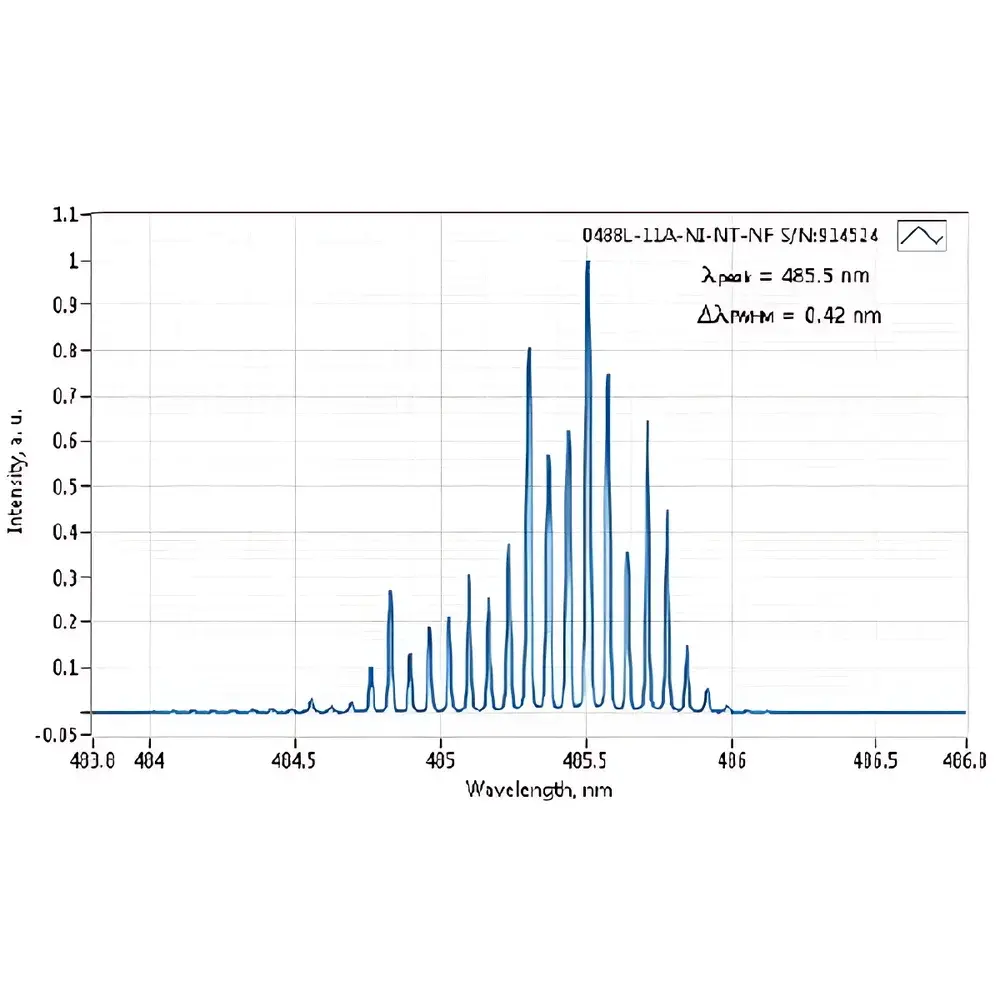
| Spectral Bandwidth | <0.5–20 nm |
| Modulation | Analog & Digital TTL |
| Compliance | RoHS, CE |
Overview
The Integrated Optics MatchBox2 0405L–1342L series represents a class of ultra-compact, diode-pumped solid-state (DPSS) continuous-wave (CW) lasers engineered for high-reliability integration into space-constrained optical systems. Based on intracavity frequency-doubling and Nd:YVO4/Nd:YAG or similar gain media configurations, these lasers deliver stable, low-noise output across 20 discrete wavelengths from the violet (405 nm) to the near-infrared (1342 nm). Each unit integrates the pump diode, nonlinear crystal, resonator optics, thermoelectric cooler (TEC), driver electronics, and feedback photodiode within a monolithic 50 × 30 × 18 mm housing — eliminating external alignment requirements and enabling plug-and-play OEM deployment. The architecture supports both free-space collimated output and fiber-coupled variants (single-mode, polarization-maintaining, and multimode), with coupling efficiencies up to 70% for MM and ~50% for SM/PM fibers. Designed for operation under ambient temperature fluctuations, the integrated TEC ensures wavelength stability and long-term power reproducibility without external chillers.
Key Features
- Ultra-compact footprint (50 × 30 × 18 mm) with standardized mechanical and electrical interface — enables drop-in replacement across wavelength variants
- +5 V DC single-rail power input; typical power consumption <2.5 W — suitable for battery-powered or portable instrumentation
- Onboard automatic power control (APC) with real-time photodiode feedback, delivering RMS power stability ≤1% over 8 hours
- Dual modulation capability: analog (0–5 V, bandwidth ≥100 kHz) and digital TTL (rise/fall time <100 ns)
- Integrated thermal management with TEC and over-temperature shutdown — operational ambient range: 15–35 °C
- Low-intensity noise performance: RMS noise <0.6% (405–830 nm) to <3% (1030–1342 nm) over 20 Hz–20 MHz bandwidth
- Spectral purity optimized per line: linewidth <0.5 nm (e.g., 532 nm, 1064 nm) to <20 nm (broadened 450 nm, 850 nm variants)
- Standardized SMA905 or FC/PC fiber connectors; optional custom fiber pigtails with length, coating, and connector type specified
Sample Compatibility & Compliance
The MatchBox2 laser series is compatible with standard optical breadboards, micro-optical mounts, and fiber launch assemblies used in benchtop and embedded platforms. Free-space models feature adjustable collimation (M² <1.3 typical) and beam circularization. Fiber-coupled variants comply with IEC 61290-1 (laser safety), IEC 60825-1 (Class 3B/4 depending on output power), and RoHS 2015/863/EU. All units are CE-marked and manufactured under ISO 9001-certified processes. For regulated environments — including clinical diagnostics (FDA 21 CFR Part 820), pharmaceutical R&D (USP , ), and environmental monitoring (EPA Method 18) — the lasers support GLP/GMP-compliant traceability via batch-specific calibration certificates and factory test reports documenting power stability, pointing stability (<5 µrad/°C), and spectral center wavelength verification against NIST-traceable reference standards.
Software & Data Management
Integrated Optics provides the MatchBox Control Suite — a cross-platform (Windows/macOS/Linux) GUI application supporting USB-C or UART serial communication. The software enables real-time monitoring of output power, TEC current/temperature, diode current, and internal sensor status. Users may configure modulation profiles, set safety interlocks, log timestamped power data (CSV export), and perform firmware updates. For system integrators, a documented ASCII command protocol (ASCII over USB/VCP) allows full remote control via Python, LabVIEW, MATLAB, or C++ applications. Audit trails — including parameter changes, power-on cycles, and error events — are stored in non-volatile memory and retrievable via software query, satisfying FDA 21 CFR Part 11 requirements for electronic records when deployed with appropriate system-level validation.
Applications
- Flow cytometry: Multi-laser excitation platforms leveraging 405 nm, 488 nm, 532 nm, and 638 nm sources for simultaneous fluorophore detection with minimal crosstalk
- Confocal microscopy: Compact CW sources for point-scanning systems requiring diffraction-limited focus, low temporal noise, and rapid on/off switching
- DNA sequencing: Illumination in next-generation sequencing (NGS) instruments where wavelength accuracy (±0.1 nm at 532 nm) and power stability directly impact base-calling fidelity
- Raman spectroscopy: Excitation at 785 nm, 830 nm, and 1064 nm for reduced fluorescence background in pharmaceutical and material analysis
- Medical diagnostics: Integration into handheld or endoscopic devices for optical coherence tomography (OCT) light sources and fluorescence-guided surgery systems
- Environmental sensing: Tunable multi-wavelength excitation in differential absorption lidar (DIAL) and cavity ring-down spectroscopy (CRDS) platforms
FAQ
What is the typical lifetime of the MatchBox2 laser modules?
Rated MTBF exceeds 10,000 hours under continuous operation at 25 °C ambient, validated per Telcordia GR-468-CORE reliability testing.
Can multiple MatchBox2 lasers be synchronized for pulsed operation?
While inherently CW, precise external TTL gating enables sub-microsecond pulse generation; synchronization across units is achievable using shared clock signals and matched propagation delays.
Is spectral narrowing (e.g., using external gratings) supported?
Free-space models permit external cavity integration; however, factory-installed narrow-linewidth options (Δλ <0.1 nm) are available for select wavelengths (e.g., 532 nm, 1064 nm) upon request.
How is beam pointing stability characterized?
Beam deviation is ≤5 µrad over the full operating temperature range (15–35 °C), measured per ISO 11554 using quadrant photodetector tracking.
Are custom wavelengths outside the standard list available?
Yes — custom DPSS designs (e.g., 543 nm, 561 nm, 589 nm) can be developed under NDA, subject to minimum order quantity and lead time assessment.




