
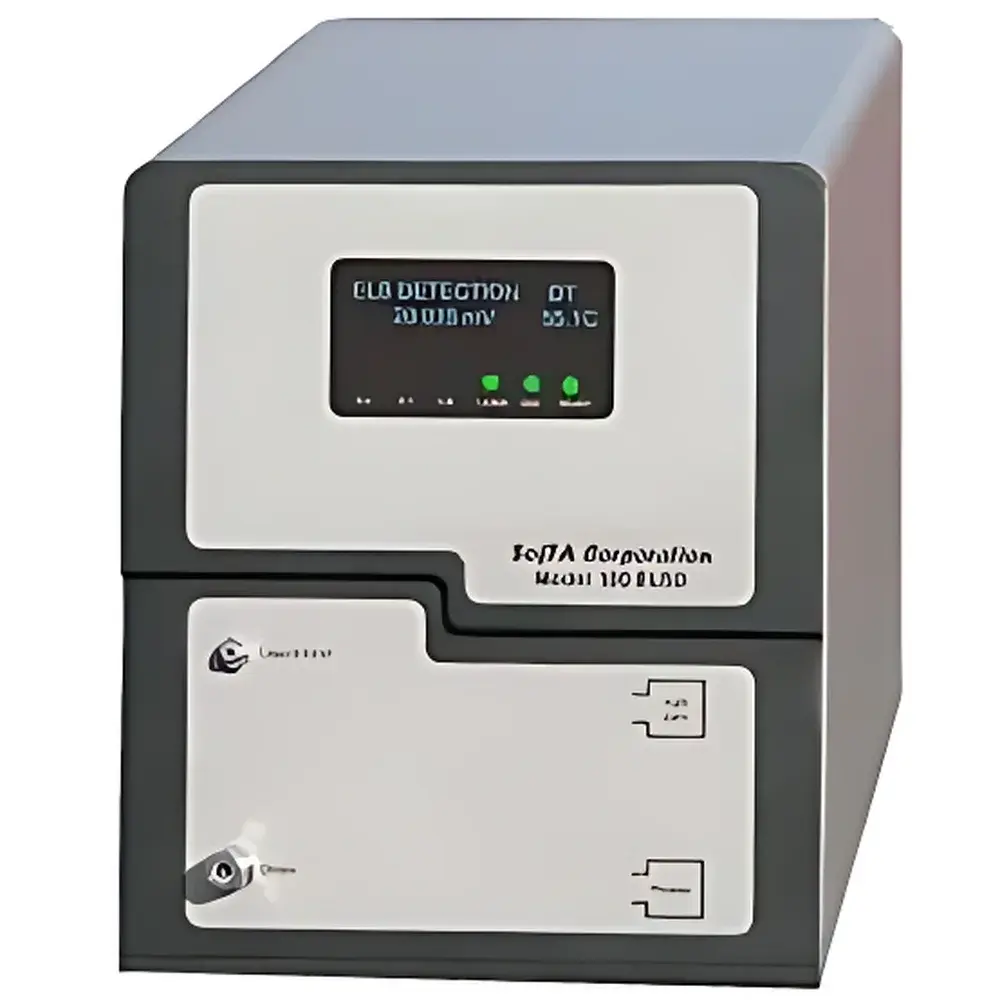
SofTA Model 100 Evaporative Light Scattering Detector
| Brand | SofTA |
|---|---|
| Origin | Imported |
| Manufacturer Type | Authorized Distributor |
| Model | Model 100 |
| Detection Principle | Evaporative Light Scattering Detection (ELSD) |
| Compatible System | HPLC / UHPLC |
| Light Source | 670 nm Laser (<5 mW) |
| Nebulizer Gas | N₂ or inert gas (50 psi, ~2.5 SLPM) |
| Operating Temperature | 55 °C (evaporator), ambient to 85 °C (environment) |
| Flow Rate Range | 0–5 mL/min |
| Detector Response | Mass-sensitive, gradient-compatible |
| Detection Limit | 10 ng (on-column, typical) |
| Dynamic Range | >4 orders of magnitude |
| Precision | <2% RSD |
| Output Signal | 0–5 VDC analog |
| Interface | RS-232 |
| Power Requirement | 120/240 VAC, 50/60 Hz, 600 W |
| Dimensions | 9.8" W × 18" D × 11.5" H |
| Weight | 23 lbs |
| Construction Materials | Stainless steel fluid path, Teflon™ tubing, fused silica optical windows |
| Environmental Rating | Indoor use only |
Overview
The SofTA Model 100 Evaporative Light Scattering Detector (ELSD) is a robust, benchtop-compatible detection system engineered for integration with high-performance liquid chromatography (HPLC) and ultra-high-performance liquid chromatography (UHPLC) platforms. Unlike UV-Vis absorbance detectors, the Model 100 operates on the principle of nebulization, solvent evaporation, and light scattering—making it inherently mass-sensitive and fully compatible with gradient elution methods. This physical detection mechanism eliminates dependence on chromophore presence, enabling reliable quantification of non-UV-absorbing analytes including lipids, carbohydrates, surfactants, polymers, and small-molecule APIs lacking conjugated systems. The detector’s design adheres to fundamental aerosol physics: liquid-phase effluent is atomized into fine droplets using controlled inert gas flow; volatile mobile phase is thermally removed in a heated drift tube; non-volatile analyte particles remain suspended as a dry aerosol; and these particles scatter laser light (670 nm, <5 mW) proportionally to their mass. The scattered signal is captured by a pre-amplified photodiode and converted to a stable 0–5 VDC analog output.
Key Features
- Mass-sensitive detection independent of UV absorbance or refractive index changes—ideal for universal compound screening and unknown identification.
- Full gradient compatibility without baseline drift or negative peak artifacts common in refractive index (RI) detectors.
- Rapid system readiness: factory-programmed optimization enables sample injection within 30 minutes of power-on—no manual method development required for standard applications.
- Low operational cost: no consumable lamps or flow cells; laser source lifetime exceeds 10,000 hours; minimal gas consumption (~2.5 SLPM at 50 psi).
- Integrated diagnostics: real-time self-checks for gas pressure, temperature stability, optical alignment, and signal integrity reduce troubleshooting time and support GLP-compliant operation.
- Compact footprint (9.8″ × 18″ × 11.5″) and dual-voltage capability (120/240 VAC) ensure seamless deployment across global laboratory environments.
- Chemically resistant fluid path constructed from 316 stainless steel, PTFE™ tubing, and fused silica optical components ensures long-term compatibility with aggressive solvents (e.g., THF, chloroform, high-% acetonitrile).
Sample Compatibility & Compliance
The Model 100 supports broad analyte classes—including glycosides, fatty acids, phospholipids, oligosaccharides, synthetic polymers, and excipients—without derivatization. Its mass-proportional response aligns with ASTM D7217 for polymer molecular weight distribution analysis and supports ICH Q5C stability-indicating assay development. While not intrinsically 21 CFR Part 11 compliant, the analog 0–5 VDC output and RS-232 interface enable secure integration with validated chromatography data systems (CDS) that provide electronic signatures, audit trails, and user access controls per FDA and EMA regulatory expectations. The detector meets CE marking requirements for electromagnetic compatibility (EN 61326-1) and safety (EN 61010-1), and operates reliably under ISO 14644 Class 8 cleanroom conditions when installed in climate-controlled laboratories (≤90% RH, non-condensing).
Software & Data Management
The Model 100 communicates via industry-standard RS-232 serial protocol, supporting bidirectional command exchange with third-party CDS platforms (e.g., Thermo Chromeleon, Waters Empower, Agilent OpenLab). Raw signal acquisition is synchronized to pump and autosampler events through TTL triggers. All operational parameters—including evaporator temperature (fixed at 55 °C), gas pressure setpoint, and gain calibration—are stored in non-volatile memory and recalled automatically at startup. The front-panel VFD display (2×20 characters) and dual multifunction buttons allow local verification of status codes, diagnostic logs, and basic configuration—minimizing dependency on host software during routine operation. For labs requiring full traceability, metadata (date/time stamps, gas pressure logs, temperature history) can be exported programmatically via ASCII text files for inclusion in analytical reports compliant with ALCOA+ principles.
Applications
- Quantitative analysis of non-chromophoric pharmaceutical excipients (e.g., lactose, mannitol, polysorbates) per USP & Ph. Eur. monographs.
- Stability-indicating assays for degradation products lacking UV activity in forced degradation studies.
- Characterization of natural product extracts where UV spectra are overlapping or ambiguous.
- Method development for lipidomics workflows involving triacylglycerols and sphingolipids.
- Quality control of surfactant-based formulations (e.g., detergents, emulsifiers) where RI detection suffers from solvent mismatch artifacts.
- Support of green chemistry initiatives by enabling methanol- or ethanol-based mobile phases incompatible with traditional UV detectors.
FAQ
Can the Model 100 replace my existing UV detector without hardware modification?
Yes—the unit features standardized 1/16″ OD stainless steel inlet/outlet ports and accepts common HPLC tubing (e.g., PEEK, stainless steel), allowing direct substitution in most column effluent paths.
Is nitrogen the only acceptable nebulizer gas?
No—any dry, oil-free inert gas (e.g., argon, CO₂) meeting purity ≥99.995% and dew point ≤−40 °C may be used; nitrogen remains preferred due to cost and availability.
Does ELSD response vary with compound volatility?
Yes—analytes must be non-volatile or semi-volatile under the evaporator’s thermal conditions (55 °C); highly volatile compounds (e.g., organic acids, low-MW ketones) may partially co-evaporate and yield sublinear response.
How is baseline stability maintained during gradient runs?
The Model 100 employs active solvent vapor compensation and real-time drift correction algorithms—calibrated during system equilibration—to suppress mobile-phase composition-induced noise.
What maintenance intervals are recommended for routine operation?
No scheduled maintenance is required beyond quarterly visual inspection of nebulizer capillary and periodic cleaning of exhaust filter; laser alignment is factory-set and non-user-serviceable.
Related Products





