
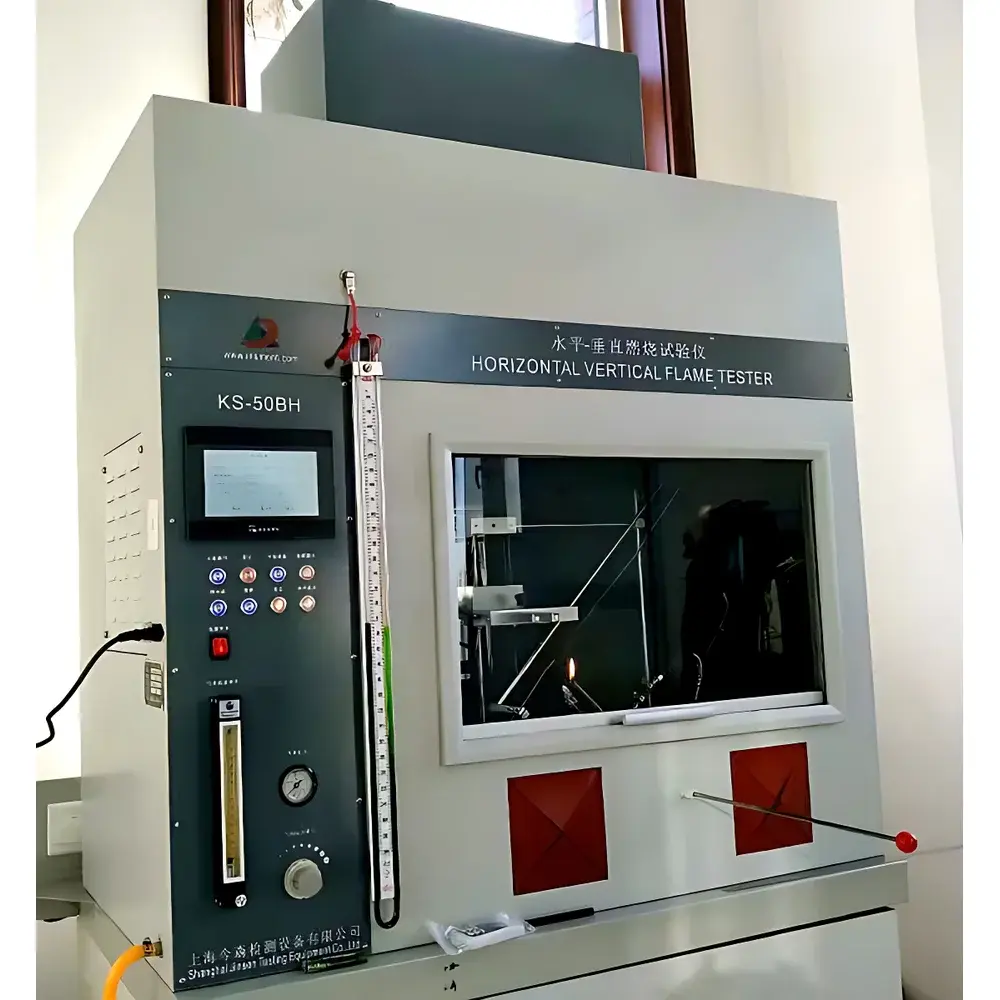
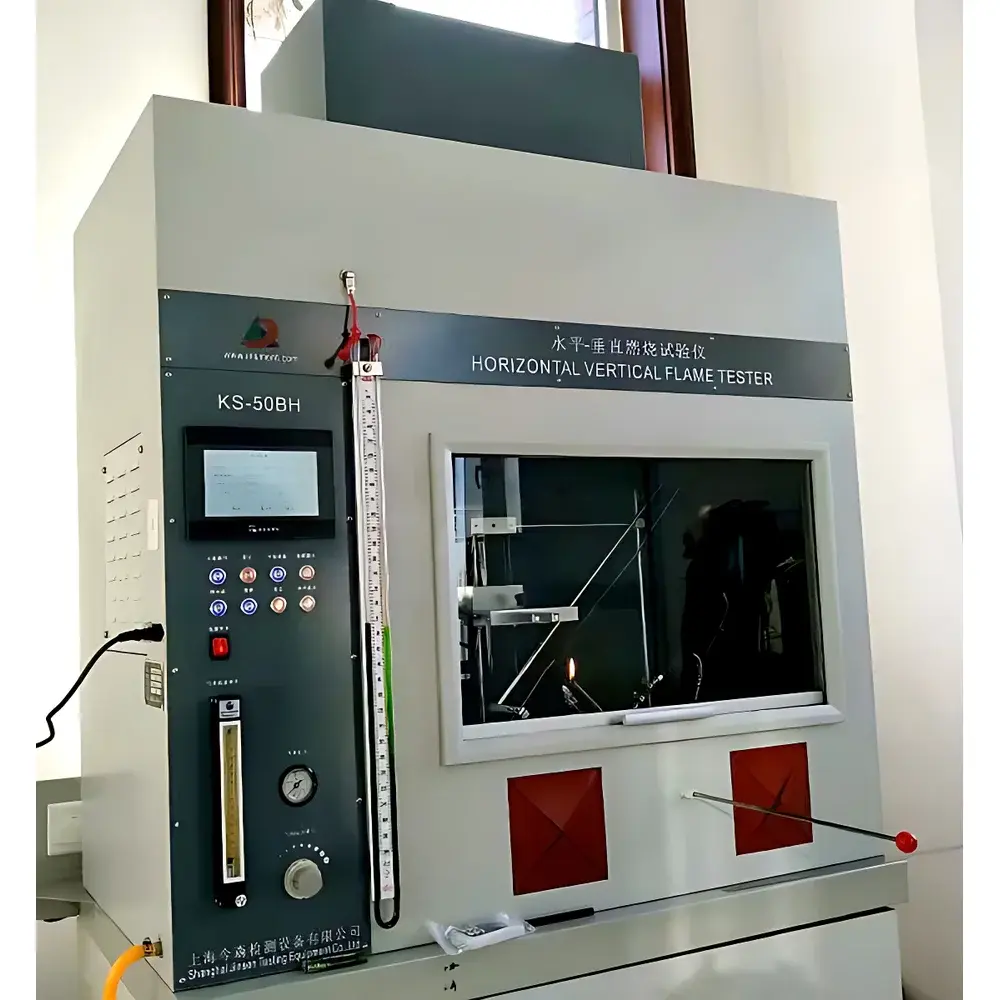
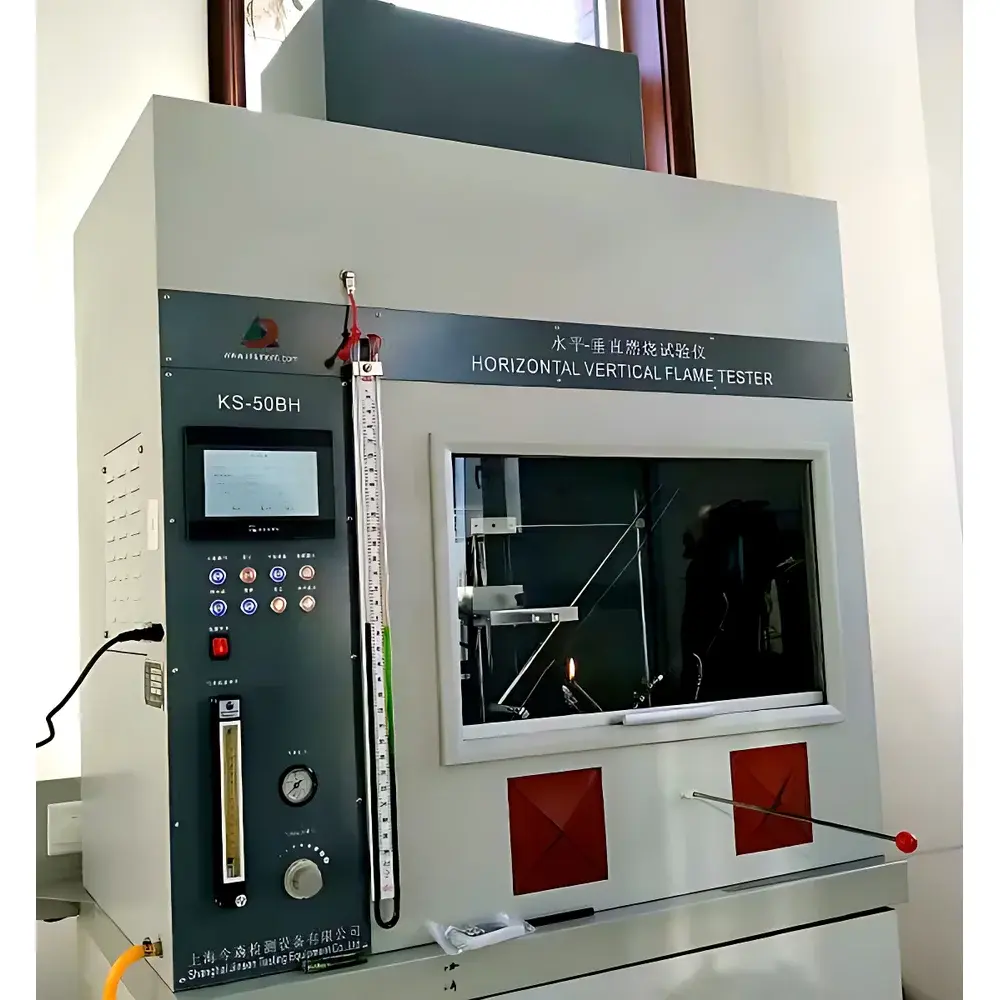
Insment KS-50BH UL94 Horizontal–Vertical Combustion Tester
| Brand | Insment (Shanghai Jinsen) |
|---|---|
| Origin | Shanghai, China |
| Model | KS-50BH |
| Control System | PLC-based with 7-inch Weinview TFT touchscreen (16:9) |
| Flame Sources | ASTM D5025-compliant Bunsen burner (50 W & 500 W configurations) |
| Flame Calibration | Copper block thermocouple verification per IEC 60695-11-xx |
| Gas Supply | High-purity methane (≥98%, 37.1 MJ/m³), regulated via Matheson/Dwyer flow control system |
| Temperature Sensing | K-type armored thermocouple (Φ0.5 mm, 1100 °C max), calibrated copper blocks (20 mm & 125 mm) |
| Timing Resolution | 0.1 s, dual-event and afterflame duration logging |
| Test Chamber Volume | ≥0.75 m³, matte black interior |
| Power Supply | 220 V, 50–60 Hz, 0.5 kVA |
| Compliance | UL 94, ASTM D5025/D5207, IEC 60695-11-3/4/10/20, ISO 9772/9773/1210, GB/T 2408/5169.16/5169.17/8332 |
Overview
The Insment KS-50BH UL94 Horizontal–Vertical Combustion Tester is an engineered test platform designed to evaluate the flammability behavior of solid non-metallic materials under standardized ignition conditions. It operates on the principle of controlled flame impingement using a calibrated Bunsen burner fueled by high-purity methane, delivering reproducible thermal fluxes at defined power levels (50 W for V-0/V-1/V-2 classification; 500 W for 5VA/5VB; 225 W for horizontal HB testing). The instrument replicates the critical parameters specified in UL 94 and its harmonized international counterparts—including flame geometry, burner orientation (0°, 20°, 45°, or 90° relative to specimen axis), exposure duration, and post-ignition observation protocols—to determine material self-extinguishing capability, afterflame time, afterglow time, and whether drips ignite surgical cotton or other secondary ignition media. Its design adheres strictly to the physical constraints and procedural rigor mandated by IEC 60695-11 series standards, ensuring metrological traceability for regulatory submissions and internal quality assurance workflows.
Key Features
- PLC-driven automation with integrated Weinview 7-inch TFT touchscreen interface (16:9 aspect ratio), supporting parameter configuration, real-time event logging, and remote operation via Ethernet-enabled control logic.
- Dual-flame calibration system: Pre-qualified copper blocks (20 mm and 125 mm diameters) with certified mass tolerances (±0.01 g) and K-type thermocouples (0.5 mm diameter, 1100 °C rated) for precise flame temperature verification per IEC 60695-11-10 Annex A.
- Modular burner assembly compliant with ASTM D5025-99: Adjustable mounting bracket enabling rapid repositioning between horizontal (90°), vertical (20° tilt), and HF-classification (45°) orientations; burner tip specifications: 0.90 ± 0.03 mm orifice, 1.60 ± 0.05 mm nozzle length, 102 mm air inlet height.
- Gas delivery subsystem featuring Matheson-certified methane flowmeter (0–1000 mL/min range), Dwyer U-tube manometer (±5 mm H₂O resolution), SMC pressure regulators (dual-stage), and certified CH₄ supply line—ensuring stable stoichiometric combustion across all test modes.
- Test chamber with ≥0.75 m³ volume, matte black interior surface, integrated LED lighting, safety-rated transparent observation window, manual access ports, and top-mounted exhaust ducting compatible with external fume hoods.
Sample Compatibility & Compliance
The KS-50BH accommodates specimens conforming to UL 94 thickness requirements (typically 0.8–12.7 mm for rigid plastics; 0.1–3.2 mm for films) and dimensional tolerances defined in IEC 60695-11-10 (125 × 13 mm for vertical tests; 125 × 13 mm or 150 × 13 mm for horizontal tests). It supports full-spectrum UL 94 classifications—including HB, V-0/V-1/V-2, 5VA/5VB, VTM-0/VTM-1/VTM-2, and HF-1/HF-2/HBF—as well as ISO 9772 (foam horizontal burn), ISO 9773 (thin film vertical burn), and GB/T 5169.16–2017 (500 W vertical flame). All operational procedures align with GLP documentation practices; audit-ready data logs include timestamped operator ID, test sequence number, ambient temperature/humidity, gas pressure, flame temperature ramp profiles, and pass/fail determinations per clause-specific criteria.
Software & Data Management
Control firmware implements deterministic cyclic scanning logic for flame timing, ignition sequencing, and thermal event capture. Touchscreen UI stores up to 1000 test records locally, each containing raw thermocouple voltage traces, calibrated temperature curves, elapsed times (first/second afterflame, afterglow), and annotated pass/fail flags. Export formats include CSV and PDF reports compliant with ISO/IEC 17025 documentation requirements. Optional integration with LIMS platforms via Modbus TCP enables centralized data archival, electronic signature support, and 21 CFR Part 11–compliant audit trails when deployed in regulated environments (e.g., medical device or automotive component validation labs).
Applications
This tester serves quality control laboratories evaluating flame-retardant additives in engineering thermoplastics (e.g., PC/ABS, PBT, PA66), insulation materials for wire & cable assemblies, housing components for IT equipment and household appliances, gasketing compounds in industrial enclosures, and polymeric substrates used in transportation interiors. It is routinely deployed during material qualification per UL Recognition Services, CSA Component Acceptance, and CE marking conformity assessments under Directive 2014/68/EU (PED) and EN 60335-1. Research applications include comparative analysis of halogen-free vs. brominated flame retardants, aging studies of fire-resistant coatings, and development of novel intumescent formulations.
FAQ
Does the KS-50BH comply with FDA 21 CFR Part 11 requirements for electronic records?
Yes—when configured with optional LIMS integration and user authentication modules, the system supports electronic signatures, audit trail generation, and record retention protocols aligned with Part 11 Annex A guidance.
What methane purity and certification documentation are required for valid test execution?
Methane must be ≥98% pure, with supplier-provided Certificate of Analysis confirming BTU content (998 BTU/ft³) and absence of sulfur compounds; certificates must be retained as part of test documentation.
Can the instrument perform both horizontal and vertical tests without hardware reconfiguration?
Yes—the burner mount allows tool-free adjustment between 0°, 20°, 45°, and 90° positions; all orientation changes are mechanically indexed and verified via built-in alignment guides.
Is flame temperature calibration performed manually or automated within the software?
Calibration is fully automated: users initiate the procedure via touchscreen, and the PLC controls gas flow, thermocouple sampling, and copper block heating cycles per IEC 60695-11-10 Annex A methodology.
What maintenance intervals are recommended for critical consumables like thermocouples and burner nozzles?
K-type thermocouples should be verified weekly using reference copper blocks; burner nozzles require visual inspection and ultrasonic cleaning after every 50 test cycles or upon visible carbon buildup.



