
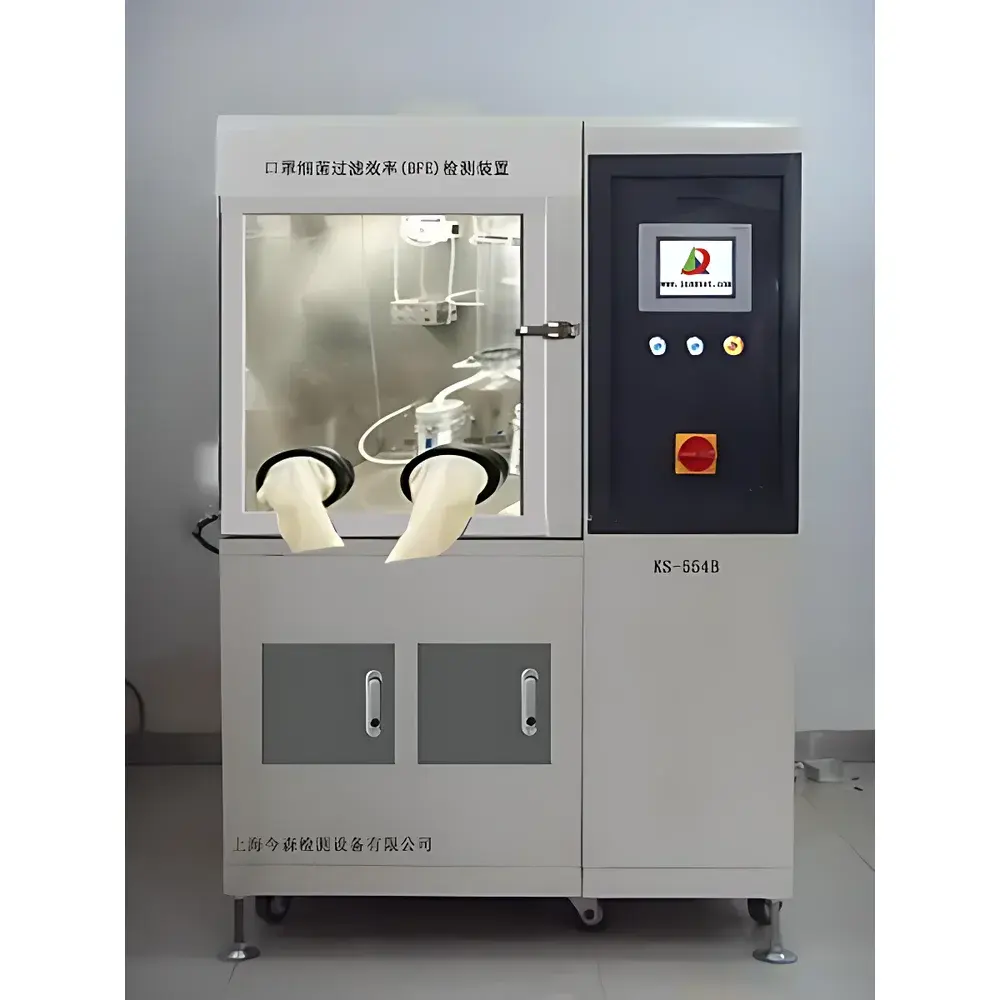
Insment KS-554B Bacterial Filtration Efficiency (BFE) Tester for Medical Masks
| Key | Brand: Insment |
|---|---|
| Model | KS-554B |
| Origin | Shanghai, China |
| Compliance | YY 0469-2011 Annex B, ASTM F2100, ASTM F2101, EN 14683 |
| Control System | PLC with 7-inch WELIN 16:9 touchscreen HMI |
| A/B Sampling Flow Rate | 28.3 L/min ±2.5% (0.1 L/min resolution) |
| Nebulizer Flow Rate | 8–10 L/min ±5.0% (0.1 L/min resolution) |
| Peristaltic Pump Flow Range | 0.006–3 mL/min ±2.5% (0.001 mL/min resolution) |
| Aerosol Chamber Negative Pressure | −90 to −120 Pa ±2.0% (0.1 Pa resolution) |
| Cabinet Negative Pressure | −50 to −200 Pa |
| Aerosol MMAD | 3.0 ±0.3 µm, GSD ≤1.5 |
| Andersen Cascade Impactor Stages | 4-stage (Stage I >7 µm, II: 4.7–7 µm, III: 3.3–4.7 µm, IV: 2.1–3.3 µm) |
| HEPA Filter Efficiency | ≥99.99% @ ≥0.3 µm |
| Data Storage Capacity | >100,000 test records |
| Power Supply | AC 220 V ±10%, 50 Hz |
| Noise Level | <65 dB(A) |
Overview
The Insment KS-554B Bacterial Filtration Efficiency (BFE) Tester is a purpose-built, regulatory-compliant instrumentation system engineered for quantitative assessment of bacterial aerosol filtration performance in medical face masks and respirators. It operates on the principle of controlled bioaerosol challenge using viable Staphylococcus aureus (ATCC 6538) or equivalent test organisms, delivered as a monodisperse aerosol with a mass median aerodynamic diameter (MMAD) of 3.0 ±0.3 µm and geometric standard deviation (GSD) ≤1.5 — parameters rigorously aligned with YY 0469-2011 Annex B, ASTM F2101, and EN 14683 Class I/II/III requirements. The system employs a dual-path negative-pressure architecture: one path delivers the standardized microbial aerosol into the test chamber; the other draws air through the mask sample and a paired agar plate via a 4-stage Andersen cascade impactor. Colony-forming units (CFU) are enumerated post-incubation to calculate BFE as: BFE (%) = [(Ccontrol − Ctest) / Ccontrol] × 100, where Ccontrol and Ctest denote CFU counts upstream and downstream of the specimen, respectively.
Key Features
- Negative-pressure biosafety cabinet design with real-time pressure monitoring (−50 to −200 Pa cabinet, −90 to −120 Pa aerosol chamber), ensuring operator protection and containment integrity per ISO 15190 and WHO Laboratory Biosafety Manual guidance.
- Dual independent sampling channels (A & B), each equipped with precision mass flow controllers calibrated to ±2.5% full scale (28.3 L/min nominal), enabling parallel validation and redundancy in compliance-critical environments.
- Integrated peristaltic pump (0.006–3 mL/min, ±2.5% accuracy) and adjustable nebulizer (8–10 L/min, ±5.0% accuracy) for reproducible microbial aerosol generation and delivery control.
- Four-stage Andersen impactor with defined cut-points (Stage I: >7 µm; II: 4.7–7 µm; III: 3.3–4.7 µm; IV: 2.1–3.3 µm) ensures physiologically relevant particle size fractionation consistent with respiratory deposition models.
- Embedded industrial PLC controller with 7-inch WELIN 16:9 resistive touchscreen HMI provides intuitive, audit-ready operation — supporting user-defined protocols, parameter locking, and timestamped event logging.
- Onboard data management: automatic pass/fail determination per preset thresholds, report generation with unique sequential numbering, USB export (CSV/PDF), and >100,000-record local storage capacity.
- Structural integration of HEPA filtration (≥99.99% @ ≥0.3 µm), high-intensity LED chamber lighting, front-access swing door (1000 × 730 mm), and low-noise operation (<65 dB[A]) supports GLP-aligned laboratory workflows.
Sample Compatibility & Compliance
The KS-554B accommodates flat, layered, or contoured mask specimens up to 150 mm × 150 mm (customizable fixture options available). It supports testing of surgical masks, procedure masks, and non-powered filtering facepiece respirators intended for healthcare use. Regulatory alignment includes mandatory clauses from YY 0469-2011 (China), ASTM F2100-23 (US), ASTM F2101-22 (quantitative BFE), and EN 14683:2019+AC:2023 (European Union). The system’s pressure stability, flow accuracy, and aerosol characteristics meet traceability requirements for ISO/IEC 17025-accredited laboratories. Optional IQ/OQ documentation packages and 21 CFR Part 11–compliant software modules are available for GMP-regulated manufacturing QA/QC environments.
Software & Data Management
The embedded control firmware logs all critical parameters — flow rates, pressures, nebulization duration, incubation timestamps, and colony counts — with immutable timestamps and user ID tagging. Reports conform to ISO 17025 clause 7.8.2: they include instrument ID, calibration due dates, environmental conditions (temperature range: 0–50 °C), test standard reference, raw CFU values, calculated BFE, and pass/fail status. USB export enables secure transfer to LIMS or ELN systems. Optional PC-based analysis software extends functionality with statistical process control (SPC) charts, batch trending, multi-instrument fleet management, and electronic signature support compliant with FDA 21 CFR Part 11 Subpart C.
Applications
- Pre-market validation of surgical and procedural masks per YY 0469-2011 and EN 14683 Class II/III specifications.
- In-process quality control during mask production lines, including raw material screening (e.g., melt-blown polypropylene layers).
- Regulatory submission testing for NMPA, FDA 510(k), and CE Marking dossiers requiring BFE evidence.
- Research on filtration mechanisms, electrostatic decay effects, and humidity-dependent performance degradation.
- Reference laboratory inter-laboratory comparison studies under ISO/IEC 17043 proficiency testing schemes.
- Training and method verification in metrology institutes and university biomedical engineering labs.
FAQ
Does the KS-554B support both qualitative and quantitative BFE testing?
Yes — it implements the quantitative suspension method per ASTM F2101 and YY 0469-2011 Annex B, requiring viable S. aureus enumeration. Qualitative “pass/fail” screening is derived automatically from the quantitative result against user-defined thresholds.
Can the system be integrated into an existing LIMS or MES environment?
Standard USB data export (CSV, PDF) enables manual import. Optional Ethernet-enabled software modules provide HL7 or REST API interfaces for automated bidirectional data exchange with validated LIMS/MES platforms.
What calibration standards and traceability documentation are provided?
Each unit ships with NIST-traceable flow calibrator certificates (A/B channel, nebulizer, peristaltic pump), pressure transducer calibration reports, and HEPA filter test certificates. Annual recalibration services include on-site verification and ISO/IEC 17025-compliant certificates.
Is the Andersen impactor supplied with certified calibration plates?
Yes — the 4-stage impactor is pre-calibrated using polystyrene latex (PSL) spheres and accompanied by a stage-specific cut-point verification report per ISO 14644-3 Annex B.
How is biological safety maintained during operation?
The sealed negative-pressure cabinet, HEPA exhaust filtration, UV sterilization cycle (optional), and validated decontamination protocols ensure biosafety level 2 (BSL-2) containment per CDC/NIH guidelines. All aerosol pathways are leak-tested prior to commissioning.



