
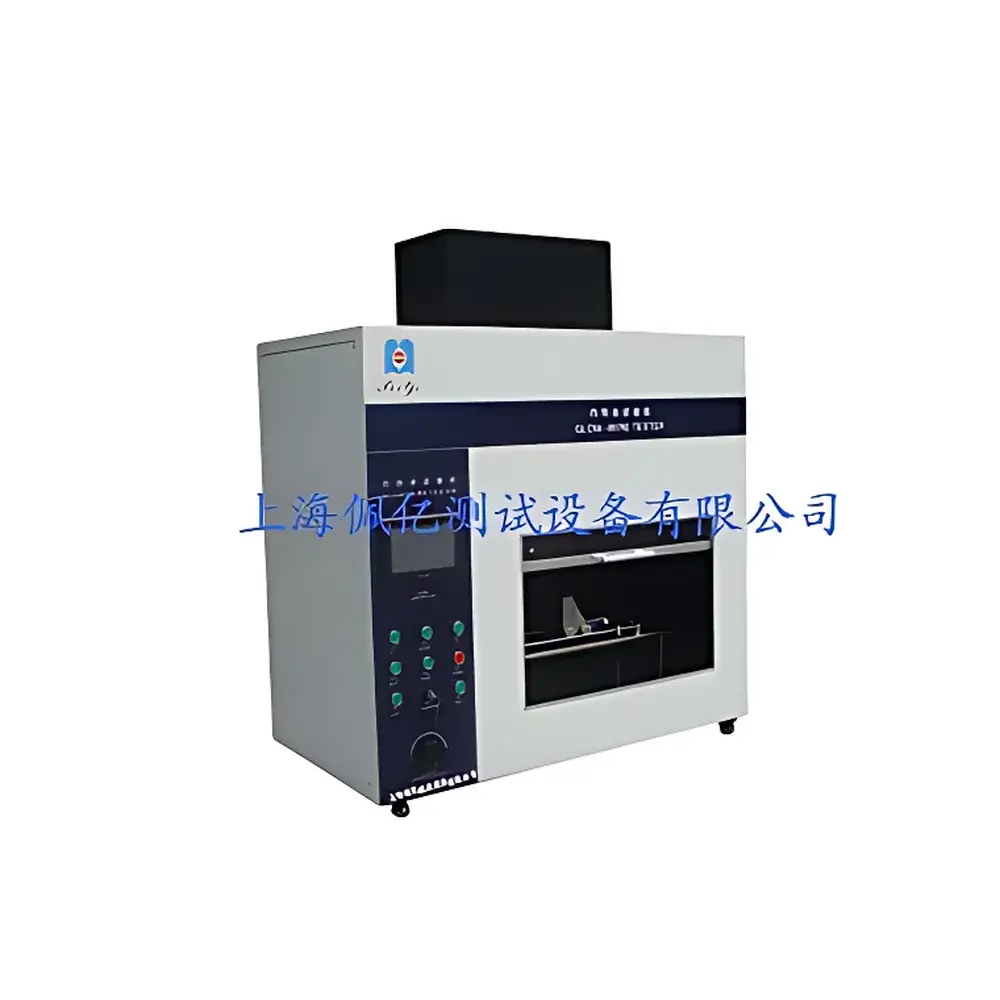
Peiyi PY-ZRS09 Glow-Wire Test Apparatus
| Brand | Peiyi |
|---|---|
| Model | PY-ZRS09 |
| Origin | Shanghai, China |
| Construction | Stainless steel frame with tempered glass viewport |
| Glow Wire | Ø4 mm Ni/Cr (80/20) alloy |
| Thermocouple | Ø0.5 mm Type K |
| Temperature Range | 50 °C to 1050 °C |
| Specimen Force | 1.0 N ± 0.1 N |
| Specimen Travel Speed | 10–25 mm/s (independent forward/reverse control) |
| Application Time | 0.01–99.99 s (adjustable) |
| Ignition Time (Ti) | 0.01–99.99 s |
| Flame Duration (Te) | 0.01–99.99 s |
| Control System | PLC-based with stepper motor actuation |
| Display | Digital panel interface |
| Compliance | GB 4706.1-2008, GB/T 5169.10–5169.13-2006, IEC 60695-2-10:2013, IEC 60695-2-11:2014, IEC 60695-2-12:2014, IEC 60695-2-13:2016, UL 746A, DIN VDE 0471, DIN 695 |
Overview
The Peiyi PY-ZRS09 Glow-Wire Test Apparatus is a precision-engineered instrument designed for evaluating the ignition resistance and flame propagation behavior of non-metallic materials used in electrical and electronic equipment housings, insulating components, and structural parts. It operates on the principle of glow-wire testing—a standardized, flameless thermal stress method that simulates abnormal heat conditions caused by electrically heated conductors or overloaded resistive elements. The apparatus heats a calibrated nickel-chromium wire (Ø4 mm, 80/20 composition) to a precisely controlled temperature (50–1050 °C), then applies it to a specimen under defined mechanical force (1.0 N ± 0.1 N) for a user-defined application time. Critical response parameters—including ignition time (Ti), flame duration (Te), and whether flaming combustion persists beyond 30 seconds—are recorded to determine compliance with material classification thresholds (e.g., GWFI and GWIT values per IEC 60695-2 series). Its design adheres strictly to the thermomechanical boundary conditions specified in IEC 60695-2-10 through -2-13, ensuring metrological traceability and inter-laboratory reproducibility.
Key Features
- PLC-based motion and thermal control architecture with stepper motor-driven specimen carriage for repeatable positioning and consistent contact dynamics
- High-stability Type K thermocouple (Ø0.5 mm) integrated directly into the glow-wire tip for real-time, closed-loop temperature feedback and ±2 °C accuracy across full operating range
- Digital front-panel interface with independent parameter entry for application time, ignition timing, and flame duration—each resolved to 0.01-second increments
- Stainless steel test chamber with reinforced tempered glass viewport enabling unobstructed observation while maintaining operator safety and environmental containment
- Custom-designed stainless steel specimen holders accommodating standard test specimens (e.g., 10 mm × 10 mm × 0.5–1.0 mm thick plates) with precise orthogonal alignment relative to the glow wire axis
- One-touch automatic timing sequence initiation: synchronized start of wire heating, specimen advance, contact application, and post-contact observation window
Sample Compatibility & Compliance
The PY-ZRS09 supports rigid and semi-rigid polymeric materials, laminates, and composite substrates commonly employed in consumer electronics enclosures, circuit board substrates, connectors, and internal insulation systems. Specimens must conform to dimensional requirements defined in IEC 60695-2-10 (e.g., minimum thickness ≥0.5 mm; surface flatness ≤0.1 mm deviation). The system fully implements the procedural rigor required for certification testing under national and international regulatory frameworks—including GB/T 5169.10–5169.13 (China), IEC 60695-2-10:2013 to -2-13:2016 (IEC), UL 746A (North America), and DIN VDE 0471 (Germany). All operational parameters—including force calibration, travel speed verification, and temperature uniformity mapping—are documented in accordance with GLP principles and support audit-ready traceability for ISO/IEC 17025-accredited laboratories.
Software & Data Management
While the PY-ZRS09 operates via embedded digital controls without PC dependency, its parameter configuration and timing logs are structured to support manual data transcription into LIMS or quality management systems compliant with FDA 21 CFR Part 11 requirements. Each test record includes operator ID, date/time stamp, setpoint temperature, applied force, actual contact duration, observed Ti and Te values, and pass/fail determination against relevant GWFI/GWIT classification tables. Optional RS-232 or USB-to-serial interfaces (available upon request) enable automated export of timestamped event logs for integration with laboratory informatics platforms. Calibration certificates for the thermocouple and load cell are issued with NIST-traceable documentation.
Applications
- Verification of polymer flame retardancy for UL Recognition and CE marking of power supplies, adapters, and household appliances
- Material screening during R&D of halogen-free flame-retardant compounds (e.g., phosphorus- or nitrogen-based additives)
- Production line QA/QC of injection-molded components prior to final assembly
- Root-cause analysis of field failures linked to thermal runaway or proximity-induced ignition
- Supporting comparative studies between virgin and recycled resin batches for thermal stability consistency
FAQ
What standards does the PY-ZRS09 comply with?
It meets the mechanical, thermal, and procedural requirements of IEC 60695-2-10:2013, -2-11:2014, -2-12:2014, and -2-13:2016, as well as GB/T 5169.10–5169.13-2006, UL 746A, and DIN VDE 0471.
Is temperature calibration traceable to national standards?
Yes—the integrated Type K thermocouple is calibrated using reference junctions traceable to NIST or CNAS-accredited sources, with certificate of calibration provided at delivery.
Can the apparatus be used for both GWFI and GWIT determinations?
Yes—by configuring application time, temperature ramp profiles, and pass/fail criteria per IEC 60695-2-12 (GWFI) and -2-13 (GWIT), respectively.
What maintenance is required for long-term accuracy?
Annual verification of glow-wire geometry (diameter, tip radius), thermocouple response time, and load cell linearity is recommended; consumables include replacement Ni/Cr wires and calibration shims.
Does the system support automated reporting?
The base configuration uses manual logging; however, optional serial output enables integration with third-party data acquisition software for automated report generation aligned with ISO/IEC 17025 documentation requirements.



