
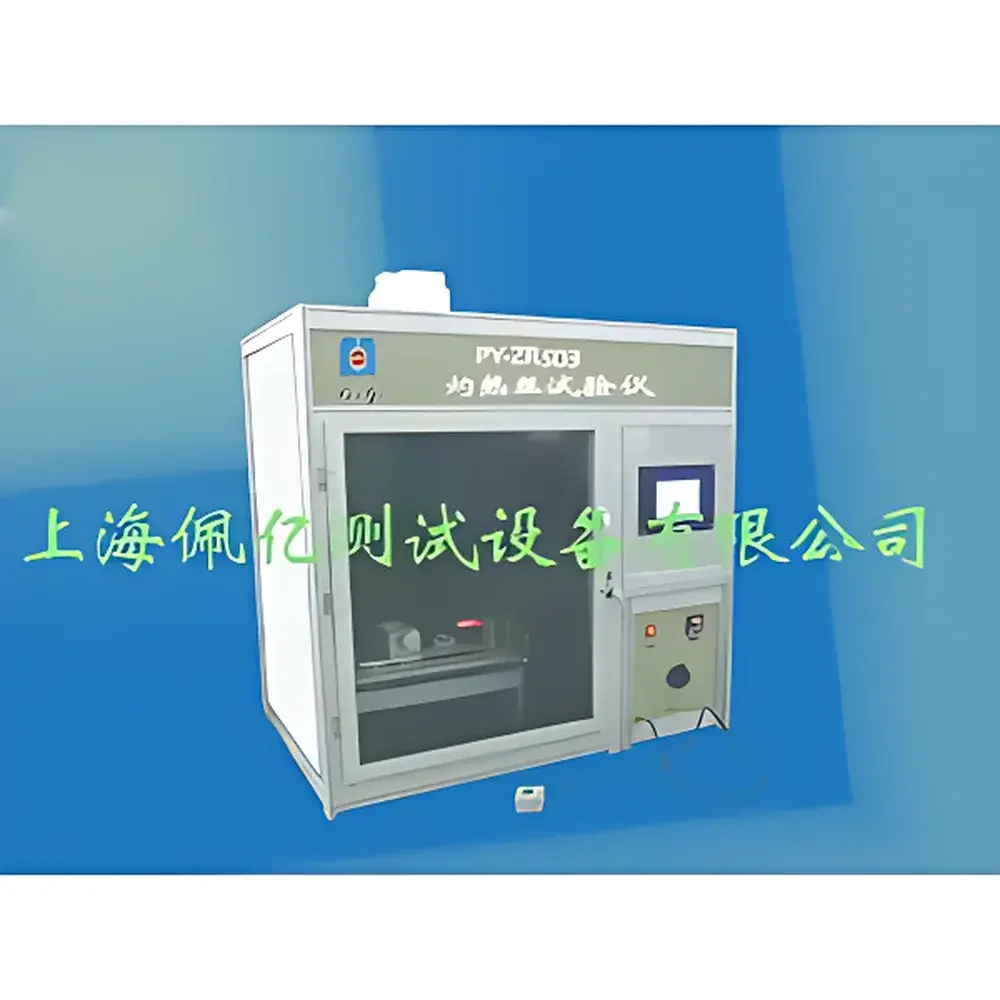
Peiyi PY-ZRS03 Glow-Wire Test Apparatus
| Brand | Peiyi |
|---|---|
| Origin | Shanghai, China |
| Manufacturer Type | Authorized Distributor |
| Country of Origin | China |
| Model | PY-ZRS03 |
| Price | USD 2,250 (FOB Shanghai) |
| Glow Wire Temperature Range | 500–1000 °C ±2 °C |
| Glow Time | 0–999.9 s ±0.1 s |
| Ignition Time & Extinction Time Measurement | 0–999.9 s ±0.1 s, auto-recorded with manual hold |
| Glow Wire Diameter & Composition | Φ4 mm Ni–Cr alloy (Ni >77%, Cr 20±1%) |
| Applied Force | 0.95±0.1 N |
| Penetration Depth | 7.0±0.5 mm |
| Test Speed | 14 mm/s |
| Thermocouple | Φ0.5 mm imported K-type armored thermocouple |
| Chamber Volume | 0.5 m³ (optional 0.75 or 1.0 m³) |
| Exterior Dimensions | 1000 mm (W) × 650 mm (D) × 1300 mm (H) |
| Background | Matte black interior |
| Ventilation | Independent exhaust system |
| Compliance Standards | IEC 60695-2-10:2021, UL 746A, GB/T 5169.10–2017, GB 4706.1–2015 |
Overview
The Peiyi PY-ZRS03 Glow-Wire Test Apparatus is a precision-engineered instrument designed to evaluate the ignition resistance and thermal hazard potential of non-metallic materials used in electrical and electronic equipment. It operates on the principle of simulating thermal stress induced by overheated conductive components—such as malfunctioning resistors or overloaded contacts—without flame involvement. The apparatus heats a standardized nickel-chromium glow wire (Φ4 mm, Ni >77%, Cr 20±1%) to a precisely controlled temperature (500–1000 °C ±2 °C), maintains it for 60 seconds (per IEC 60695-2-10:2021), then applies it vertically to a test specimen under a defined mechanical load (0.95±0.1 N) for 30 seconds. The resulting ignition behavior—including whether flaming combustion occurs, its duration (ignition time), and persistence after removal (extinction time)—is recorded to determine critical safety indices: Glow-Wire Ignition Temperature (GWIT) and Glow-Wire Flammability Index (GWFI). This method provides quantitative, repeatable data essential for compliance with global safety standards governing end-product fire risk assessment.
Key Features
- High-stability temperature control system with ±2 °C accuracy across the full 500–1000 °C range, verified via calibrated K-type armored thermocouple (Φ0.5 mm)
- Programmable timing resolution of 0.1 s for glow duration, ignition time, and extinction time—enabling strict adherence to test sequences in IEC 60695-2-10 and UL 746A
- Electromechanically regulated linear actuator ensuring consistent 14 mm/s approach speed and exact 7.0±0.5 mm penetration depth
- Stainless steel test chamber (0.5 m³ standard volume) with matte black interior to enhance flame visibility and reduce optical interference during observation
- Dedicated exhaust ducting with flow-rate monitoring to maintain safe fume extraction without cross-contamination between tests
- Independent microprocessor-based controller with real-time parameter display, automatic sequence execution, and manual intervention capability (e.g., pause on ignition detection)
- Modular chamber design supporting optional upgrades to 0.75 m³ or 1.0 m³ volumes for larger assemblies or extended observation requirements
Sample Compatibility & Compliance
The PY-ZRS03 accommodates solid insulating materials—including thermoplastics, thermosets, laminates, and elastomers—as well as finished components such as housings, connectors, terminal blocks, and PCB substrates. Specimens are mounted per IEC 60695-2-10 Annex A, with dimensional constraints aligned to standard test coupons (e.g., 60×60×10 mm) or actual product geometries where permitted. The apparatus fully satisfies the mechanical, thermal, and procedural requirements of IEC 60695-2-10:2021 (Ed. 3.0), UL 746A Section 22, GB/T 5169.10–2017, and GB 4706.1–2015. Its design supports traceable calibration against national metrology standards and facilitates audit readiness for ISO/IEC 17025-accredited laboratories. All operational parameters—including temperature ramp profiles, dwell times, force application, and environmental conditions—are documented in accordance with GLP principles and support FDA 21 CFR Part 11-compliant data integrity when integrated with validated laboratory information management systems (LIMS).
Software & Data Management
While the PY-ZRS03 operates via embedded firmware for deterministic real-time control, it includes RS-232 and optional USB interfaces for external data logging. Test logs export timestamped records of setpoints, measured temperatures, ignition/extinction timestamps, operator annotations, and pass/fail status per test cycle. Raw data files comply with ASTM E2500-18 guidelines for instrument-generated records and can be imported into statistical process control (SPC) platforms for trend analysis across material lots or supplier qualifications. Optional PC-based software modules provide graphical visualization of thermal profiles, comparative GWIT/GWFI benchmarking, and automated report generation aligned with EN 60335 or IEC 62368-1 technical documentation requirements.
Applications
- Qualification testing of polymer compounds prior to injection molding of consumer electronics enclosures
- Verification of flame-retardant efficacy in printed circuit board laminates (e.g., FR-4, polyimide)
- Design validation of low-voltage power distribution components (switches, relays, busbars) per UL 60950-1 and IEC 61000-4-11
- Regulatory submission support for CE marking (LVD Directive 2014/35/EU) and UKCA certification
- In-process quality assurance in Tier-1 automotive electronics manufacturing (ISO/TS 16949 environments)
- Material screening for medical device housing compliance with IEC 60601-1 Clause 11.2.2
FAQ
What standards does the PY-ZRS03 explicitly support?
It conforms to IEC 60695-2-10:2021, UL 746A, GB/T 5169.10–2017, and GB 4706.1–2015 for glow-wire end-product and material testing.
Is calibration certification included with shipment?
Yes—a NIST-traceable calibration certificate for the K-type thermocouple and force transducer is provided, valid for 12 months from date of dispatch.
Can the chamber volume be customized beyond the standard 0.5 m³?
Yes; optional configurations of 0.75 m³ and 1.0 m³ are available upon request, with structural reinforcement and airflow recalibration included.
How is operator safety maintained during high-temperature operation?
The unit integrates dual interlock doors with thermal cutoff switches, Class H insulation on all internal wiring, and automatic power-down if chamber temperature exceeds 1050 °C or airflow drops below 0.5 m³/min.
Does the system support automated GWIT determination?
Yes—the controller executes incremental temperature trials (in 25 °C steps per IEC 60695-2-12) and identifies the lowest temperature at which no ignition occurs in three consecutive tests, fulfilling GWIT protocol requirements.



