
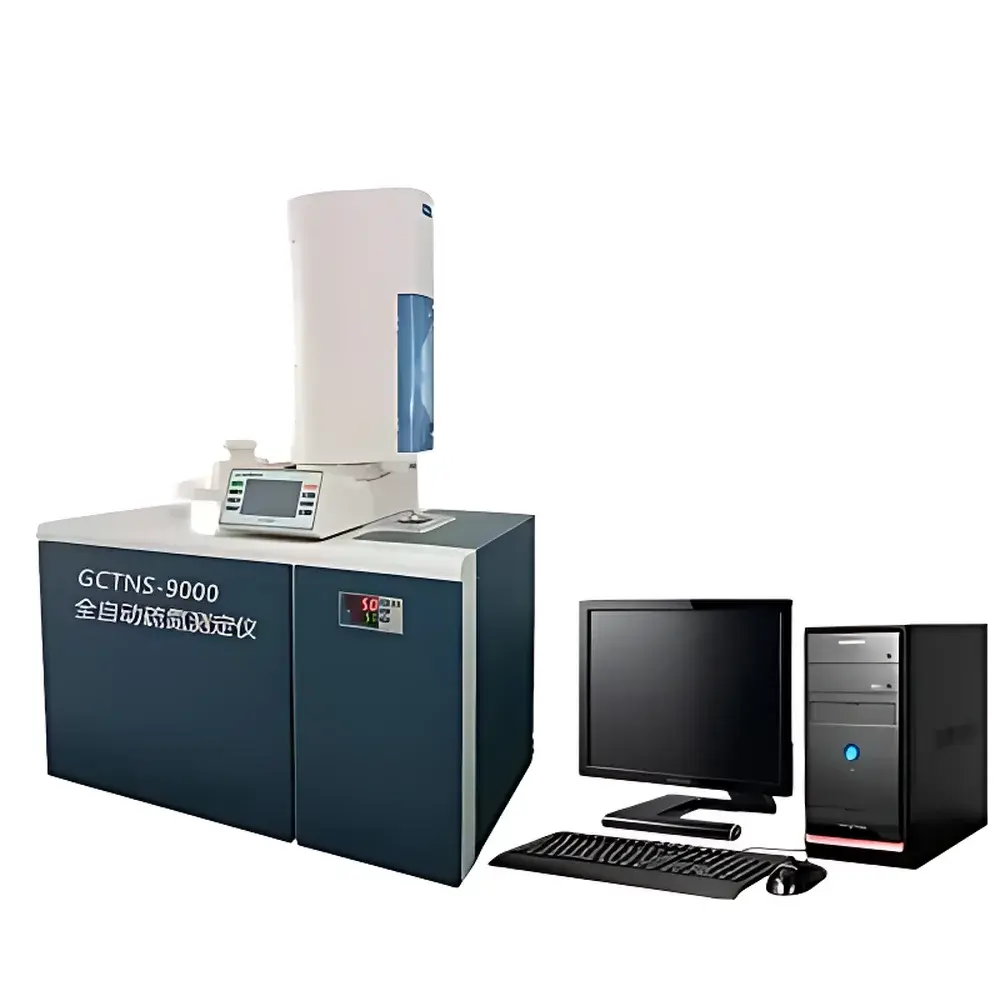
GUOCHUANG GCTNS-9000 Fully Automated Sulfur and Nitrogen Analyzer
| Brand | GUOCHUANG |
|---|---|
| Origin | Jiangsu, China |
| Manufacturer Type | Direct Manufacturer |
| Model | GCTNS-9000 |
| Measured Elements | Sulfur (S), Nitrogen (N) |
| Measurement Principles | UV Fluorescence (S), Chemiluminescence (N) |
| Measurement Range | 0.02–10,000 mg/L (S) |
| Detection Limit | 0.02 mg/L |
| Combustion Furnace Temperature Range | Ambient to 1300 °C |
| Temperature Control Accuracy | ±1 °C |
| Sample Type | Liquid |
| Sample Volume | 2–25 µL |
| Gas Requirements | High-purity Argon (≥99.98%), High-purity Oxygen (≥99.98%) |
| Power Supply | AC 220 V ±10%, 50 Hz, 1500 W |
| Dimensions | 760 × 460 × 1000 mm (L×W×H) |
| Weight | 40 kg |
Overview
The GUOCHUANG GCTNS-9000 Fully Automated Sulfur and Nitrogen Analyzer is a dual-detection elemental analyzer engineered for high-precision quantification of total sulfur and total nitrogen in liquid hydrocarbon matrices—including gasoline, diesel, jet fuel, lubricants, aromatic solvents, and liquefied petroleum gas (LPG). It implements two orthogonal, ASTM-validated detection principles in a single integrated platform: ultraviolet fluorescence (UVF) for sulfur determination and chemiluminescence (CLD) for nitrogen analysis. This architecture eliminates cross-interference between analytes while delivering robust performance across wide dynamic ranges (0.02–10,000 mg/L for both S and N). The instrument employs high-temperature oxidative combustion (up to 1300 °C) in a quartz-lined pyrolysis furnace to ensure complete conversion of organosulfur and organonitrogen compounds into SO₂ and NO, respectively—critical for accurate speciation-independent quantification. All thermal, pneumatic, and sampling subsystems are under closed-loop computer control, enabling trace-level reproducibility and compliance-ready operation.
Key Features
- Fully automated workflow: Integrated 16-position or 110-position autosampler with programmable sample volume (2–25 µL), automatic needle washing, sequential sample loading, and post-analysis system purging.
- Precision thermal management: Dual-zone furnace with PID-controlled heating up to 1300 °C and ±1 °C stability; ceramic-insulated quartz combustion tube resists carbon deposition and requires no routine disassembly.
- Optimized optical detection: UVF reaction chamber with intensity-compensated deuterium lamp source and low-noise photomultiplier tube; CLD reaction chamber with enhanced NO–O₃ mixing efficiency and rapid exhaust clearance to minimize peak tailing.
- Intelligent gas handling: Mass-flow-controlled argon/oxygen delivery with real-time pressure/temperature monitoring; high-temperature ozone destruct unit (not activated carbon) ensures stable baseline and prevents gas-line clogging.
- Compliance-enabling hardware: Built-in over-temperature protection, automatic shutdown on gas flow/pressure deviation, and configurable sleep/wake cycles for unattended overnight operation.
- Import-critical components: UV light source, PMT detector, mass flow controllers, and furnace heating elements sourced from Tier-1 international suppliers to ensure long-term signal stability and low electronic noise.
Sample Compatibility & Compliance
The GCTNS-9000 is validated for use with volatile and non-volatile liquid fuels and petrochemical intermediates per globally recognized standards, including ASTM D5453 (UVF sulfur), ASTM D4629/D5762/D6069 (CLD nitrogen), ISO 20846, EN 15486, SH/T 0689, and SH/T 0657. Its design supports GLP/GMP-aligned workflows: all method parameters, calibration events, run logs, and audit trails are timestamped and stored in an immutable database. Optional software modules support 21 CFR Part 11-compliant electronic signatures, user access levels, and data integrity validation—enabling deployment in regulated QC laboratories serving refineries, fuel distributors, and third-party testing facilities. The aromatic hydrocarbon barrier filter with selective membrane technology prevents contamination of the UVF detector by unsaturated hydrocarbons—a known interference source in legacy systems.
Software & Data Management
The Windows-based acquisition and analysis software provides full instrument control, real-time diagnostics, and ISO/IEC 17025-aligned reporting. Key capabilities include: automatic standard curve generation (linear, quadratic, or weighted regression); RSD calculation per concentration tier (e.g., <6% RSD at 1–10 ppm S/N); customizable report templates with embedded chromatograms, calibration history, and QA/QC flags; and export to CSV, PDF, or LIMS-compatible XML formats. The software enforces method-defined acceptance criteria (e.g., peak symmetry, baseline drift thresholds) and triggers alerts for out-of-spec conditions. All data files are SHA-256 hashed upon save, and the system maintains a tamper-evident audit log of user actions, parameter changes, and instrument status transitions—fully traceable for regulatory review.
Applications
- Refinery quality control: Real-time sulfur monitoring of FCC naphtha, hydrotreated diesel, and reformulated gasoline per EPA Tier 3 and Euro 6 specifications.
- Aerospace fuel certification: Trace nitrogen analysis in Jet A-1 per ASTM D6069 to verify absence of basic nitrogen compounds that catalyze oxidation instability.
- Chemical manufacturing: Quantification of residual sulfur/nitrogen in BTX streams, alkylate, and synthetic lubricant base stocks where ppm-level impurities affect catalyst lifetime.
- Environmental compliance: Testing of bio-blended fuels (e.g., ethanol-gasoline, FAME-diesel) for total sulfur per EN 14214 and ASTM D7467.
- R&D laboratories: Method development for novel feedstocks, including pyrolysis oils and Fischer–Tropsch liquids, where heteroatom speciation impacts upgrading catalyst selection.
FAQ
What regulatory standards does the GCTNS-9000 comply with?
It meets ASTM D5453, D4629, D5762, ISO 20846, EN 15486, SH/T 0689, and SH/T 0657—covering sulfur and nitrogen analysis in fuels, lubricants, and petrochemicals.
Can the instrument analyze solid or gaseous samples?
No—it is optimized exclusively for liquid samples; gaseous or solid matrices require pre-treatment (e.g., dissolution, dilution, or headspace extraction) prior to injection.
Is the software compliant with FDA 21 CFR Part 11?
Yes—when configured with optional validation packages, it supports electronic signatures, role-based access control, and audit-trail archiving required for regulated environments.
How often does the quartz combustion tube require maintenance?
Under normal operation with clean fuel samples, the tube operates >12 months without cleaning; its design eliminates carbon buildup, eliminating routine disassembly.
What gas purity is required for optimal performance?
Argon and oxygen must each be ≥99.98% pure; impurities such as moisture, hydrocarbons, or nitrogen oxides will elevate background noise and compromise detection limits.







