
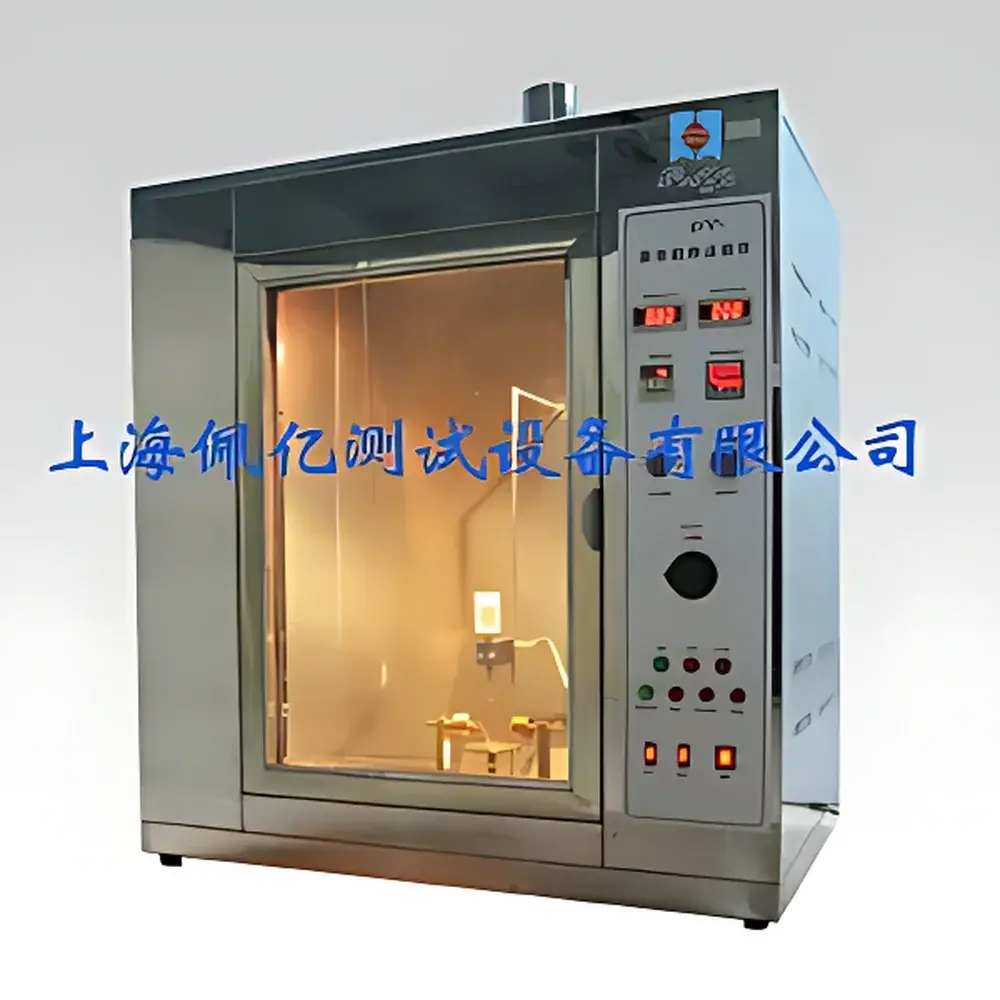
Peiyi PY-LD01 Tracking Resistance Tester (Comparative and Proof Tracking Index Tester)
| Brand | Peiyi |
|---|---|
| Model | PY-LD01 |
| Origin | Shanghai, China |
| Electrode Material | Platinum (Pt) |
| Electrode Force | 1.0 ± 0.05 N |
| Electrode Spacing | 4.0 ± 0.01 mm, Angle: 60° ± 5° |
| Test Voltage Range | 100–600 V AC (48–60 Hz), Voltage Drop <10% at Short-Circuit Current of 1.0 ± 0.1 A |
| Droplet Height Adjustment | 30–40 mm |
| Droplet Volume Calibration | 44–55 drops per cm³ |
| Dropping Interval | 30 ± 5 s |
| Maximum Droplet Count | 0–9999 cycles |
| Leakage Detection Threshold | ≥0.5 A sustained for ≥2 s |
| Chamber Volume | 0.1 m³ (customizable to 0.5 m³ or 0.75 m³ per standard requirements) |
| External Dimensions | 630 × 390 × 750 mm (W×D×H) |
| Compliance Standards | IEC 60112, GB/T 4207, GB 4706.1, UL 746A, ASTM D3638-92 |
Overview
The Peiyi PY-LD01 Tracking Resistance Tester is an engineered instrument for evaluating the comparative tracking index (CTI) and proof tracking index (PTI) of solid insulating materials under controlled electrotchemical stress. It operates on the principle of simulating surface degradation caused by leakage current in the presence of conductive electrolyte contamination—specifically a 0.1% ammonium chloride (NH₄Cl) solution—under defined voltage, electrode geometry, and environmental conditions. This test method replicates real-world failure mechanisms observed in electrical enclosures, connectors, and housings exposed to humidity, dust, and ionic contaminants. The device conforms strictly to the test protocols outlined in IEC 60112, GB/T 4207, UL 746A, and ASTM D3638-92, ensuring metrological traceability and interlaboratory reproducibility required for certification and regulatory submission.
Key Features
- Precision-machined platinum (Pt) electrodes with certified dimensional tolerances: 4.0 ± 0.01 mm spacing and 60° ± 5° included angle—ensuring consistent electric field distribution across the test specimen surface.
- Electrode loading mechanism calibrated to apply 1.0 ± 0.05 N force, maintaining uniform contact pressure without deformation of soft polymeric substrates.
- Programmable high-voltage AC supply (100–600 V, 48–60 Hz) with real-time current monitoring; voltage regulation maintains stability within ±10% during short-circuit events up to 1.0 ± 0.1 A.
- Adjustable droplet delivery system enabling precise control over drop height (30–40 mm), volumetric rate (44–55 drops/cm³), and timing interval (30 ± 5 s), all independently configurable per test sequence.
- Automated pass/fail logic based on leakage current threshold: relay disengagement triggered only when current exceeds 0.5 A for ≥2 consecutive seconds—eliminating transient noise artifacts.
- Dedicated ventilation chamber with independent exhaust ducting minimizes vapor accumulation and ensures operator safety during prolonged testing cycles.
- Modular test chamber volume (standard 0.1 m³; optional 0.5 m³ or 0.75 m³ configurations) accommodates varying specimen sizes and standard-specific enclosure requirements.
Sample Compatibility & Compliance
The PY-LD01 supports flat, rigid specimens up to 15 mm thick and 100 mm × 100 mm in planar dimension, compatible with thermoplastics (e.g., PC, PBT, PA66), thermosets (e.g., epoxy, phenolic resins), laminates, and filled engineering composites. All test procedures adhere to ISO/IEC 17025-accredited laboratory practices. The instrument satisfies functional verification requirements for GLP-compliant environments and supports audit-ready documentation for FDA 21 CFR Part 11–aligned quality systems when integrated with validated software modules. Compliance documentation includes calibration certificates for electrode geometry, force transducer, voltage/current sensors, and droplet volumetric dispensers—traceable to national metrology institutes.
Software & Data Management
While the base PY-LD01 operates via front-panel digital controls and discrete LED indicators, optional firmware upgrades enable RS-232 or USB-C serial communication for integration with LIMS or custom test management platforms. Logged parameters include timestamped voltage, current waveform snapshots (via external oscilloscope interface), cumulative droplet count, and event-triggered fault records. Data export formats include CSV and XML, supporting automated parsing into statistical process control (SPC) dashboards. All test sequences are stored with metadata including operator ID, sample ID, ambient temperature/humidity (when interfaced with optional environmental sensors), and compliance standard version (e.g., IEC 60112:2020 Ed. 4.0).
Applications
- Qualification of insulating housings for household appliances (per GB 4706.1 and IEC 60335-1).
- Material screening for printed circuit board (PCB) substrates, terminal blocks, and busbar insulation systems.
- Validation of flame-retardant additives in polymeric compounds used in lighting fixtures and industrial control panels.
- Design verification of electrical connectors and cable glands subjected to coastal or industrial atmospheric exposure.
- Supporting UL Recognition and CE marking submissions where CTI/PTI data are mandatory for material classification (e.g., UL 746A Table 25.1).
- Research applications investigating synergistic effects of surface topography, filler dispersion, and hydrophobicity on tracking resistance.
FAQ
What is the difference between CTI and PTI?
CTI (Comparative Tracking Index) is the highest voltage at which a material withstands 50 drops without tracking; PTI (Proof Tracking Index) is the lowest voltage at which tracking occurs within 50 drops—both determined under identical test conditions per IEC 60112.
Can the PY-LD01 be used for UL 746A testing?
Yes—the instrument meets all mechanical, electrical, and procedural specifications required by UL 746A Section 25 for polymeric material evaluation, including electrode geometry, solution concentration, and voltage ramping criteria.
Is calibration documentation provided with shipment?
Each unit ships with a factory calibration report covering electrode spacing, applied force, voltage output accuracy, and droplet volume consistency—all verified against NIST-traceable references.
Does the chamber meet fire containment requirements for Class B testing?
The standard 0.1 m³ chamber is constructed from non-combustible stainless steel with gasketed access doors; optional larger chambers comply with NFPA 255 and ISO 5659-2 radiant panel smoke density test housing specifications.
How is operator safety ensured during high-voltage operation?
The system incorporates dual interlocks: a physical door switch that de-energizes high-voltage circuits upon chamber opening, and an isolated ground-fault detection circuit that interrupts power within 10 ms if leakage exceeds 5 mA outside the test path.



