
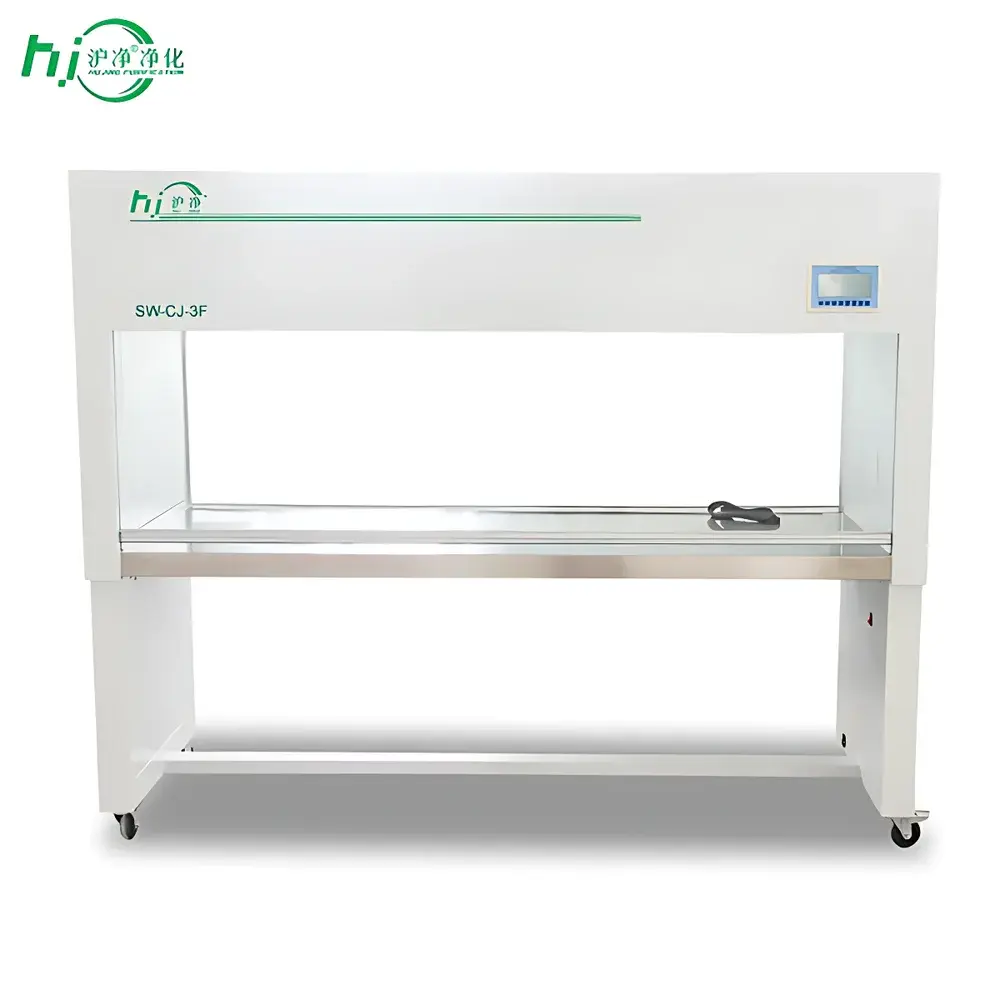
HJ SW-CJ3F Stainless Steel Triple-User Vertical Laminar Flow Clean Bench
| Brand | HJ Purification |
|---|---|
| Origin | Shanghai, China |
| Manufacturer Type | Direct Manufacturer |
| Product Category | Domestic |
| Model | SW-CJ3F |
| Price Range | USD 1,400 – 2,800 |
| Instrument Type | Vertical Laminar Flow Clean Bench |
| Cleanliness Class | ISO Class 5 (equivalent to Federal Standard 209E Class 100 @ ≥0.5 µm) |
| Noise Level | ≤62 dB(A) |
| User Capacity | Triple-user, dual-sided operation |
| Airflow Pattern | Vertical downward laminar flow |
| Work Area Dimensions (W×D×H) | 1800 × 650 × 580 mm |
| Overall Dimensions (W×D×H) | 1960 × 720 × 1600 mm |
| Average Air Velocity | 0.25–0.45 m/s |
| Microbial Count | ≤0.5 CFU/plate·hour (Φ90 mm Petri dish) |
| Vibration Half-Peak | ≤5 µm (X/Y/Z axes) |
| Illumination | ≥300 lux |
| Power Supply | AC 220 V, 50 Hz |
| Max. Power Consumption | 700 W |
| Net Weight | 200 kg |
| HEPA Filter Spec. | 1785 × 555 × 50 mm (1 unit) |
| Fluorescent Lamp | 20 W (1 unit) |
| UV Lamp | 36 W (1 unit) |
| Control Interface | Digital LCD display with UV timer and interlocked safety logic |
Overview
The HJ SW-CJ3F Stainless Steel Triple-User Vertical Laminar Flow Clean Bench is an ISO Class 5-certified (Federal Standard 209E Class 100) laboratory containment system engineered for consistent, particle-controlled environments in microbiological, pharmaceutical, and cell culture applications. It operates on the principle of vertical unidirectional laminar airflow: ambient air is drawn through a pre-filter, conditioned, and then forced downward at a controlled velocity (0.25–0.45 m/s) through a certified HEPA filter (≥99.995% efficiency at 0.3 µm). This creates a sterile, low-turbulence work envelope that protects both samples and personnel from airborne particulate and microbial contamination. Unlike horizontal flow hoods, the vertical configuration minimizes cross-contamination risk between users and accommodates dual-sided access—critical for collaborative workflows in QC labs, academic core facilities, and GMP-aligned preparation areas.
Key Features
- Triple-user, dual-sided stainless steel enclosure constructed from cold-rolled steel with electrostatic powder coating; work surface fabricated from brushed AISI 304 stainless steel for corrosion resistance, non-porosity, and cleanability.
- Vertically oriented laminar airflow with a fully enclosed, downward-blowing design—ensuring stable air curtain formation across the entire work area (1800 × 650 × 580 mm).
- Interlocked lighting and UV sterilization system: fluorescent lamp (20 W) and germicidal UV lamp (36 W) operate independently with automatic cut-off when sash is opened, complying with IEC 61000-6-3 EMC and IEC 62471 photobiological safety standards.
- Digital LCD control panel with programmable UV exposure timer, real-time airflow status indication, and fault diagnostics—designed for intuitive operation and audit-ready parameter logging.
- Integrated primary pre-filter extends HEPA service life by capturing coarse particulates; HEPA filter conforms to EN 1822-1:2019 (H14 grade) and is validated per ISO 14644-3 for installation and post-installation integrity testing.
- Acoustically optimized blower assembly achieves ≤62 dB(A) operational noise—meeting ISO 7779 and ANSI S12.55 requirements for laboratory ambient comfort.
Sample Compatibility & Compliance
The SW-CJ3F supports a broad range of sterile manipulations including aseptic transfer of microbial cultures, media plate preparation, reagent aliquoting, and sterile packaging of medical devices. Its ISO Class 5 environment satisfies minimum cleanliness requirements for USP compounding (non-hazardous), ISO 13485 device manufacturing support, and GLP-compliant sample handling. While not classified as a biological safety cabinet (BSC), it meets ASTM E2500-13 Annex A2 criteria for equipment qualification in non-hazardous applications. Structural vibration (≤5 µm half-peak) ensures compatibility with sensitive optical instrumentation placed adjacent to or integrated within the work zone. All electrical components comply with CE marking directives (LVD 2014/35/EU, EMC 2014/30/EU).
Software & Data Management
This clean bench operates as a standalone mechanical system without embedded firmware or network connectivity. However, its digital control interface provides timestamped event logging—including UV activation duration, runtime hours, and alarm triggers (e.g., filter pressure differential exceedance)—exportable via USB for internal QA documentation. The control logic adheres to ALCOA+ principles (Attributable, Legible, Contemporaneous, Original, Accurate, Complete, Consistent, Enduring, Available) for regulated environments. For laboratories operating under FDA 21 CFR Part 11, optional third-party data acquisition modules can be integrated to support electronic signature and audit trail requirements during routine performance verification.
Applications
- Microbiology: Inoculation of agar plates, serial dilution, and isolation of pure cultures under reproducible particle-free conditions.
- Pharmaceutical QA/QC: Sterile sampling of bulk intermediates, environmental monitoring kit preparation, and stability study sample handling.
- Cell & Tissue Culture: Media change, passaging, and cryovial thawing where biosafety level 1 (BSL-1) containment suffices.
- Medical Device Manufacturing: Assembly of non-implantable Class I/II devices requiring ISO 14644-1 Class 5 background environments.
- Academic & Teaching Labs: High-throughput student training in aseptic technique with dual-sided access supporting up to three concurrent users.
FAQ
Does this clean bench provide personnel protection?
No. The SW-CJ3F is a laminar flow clean bench—not a biological safety cabinet. It protects samples from environmental contamination but does not protect operators from hazardous aerosols.
Can the HEPA filter be replaced in-house?
Yes. Filter replacement follows ISO 14644-3 procedures and requires post-replacement integrity testing (e.g., DOP/PAO scanning) to verify seal integrity and uniform airflow distribution.
Is calibration required before first use?
Yes. Initial qualification must include airflow velocity mapping (ASTM F2357), particle count verification (ISO 14644-1), and illumination measurement (IESNA RP-27) to establish baseline performance.
What maintenance intervals are recommended?
Pre-filters should be inspected weekly and cleaned or replaced monthly; HEPA filters typically require replacement every 18–24 months depending on ambient particulate load and usage frequency.
Does it meet Chinese YY/T 0567.1-2013 or international GMP Annex 1 requirements?
It satisfies foundational ISO Class 5 air cleanliness criteria referenced in both standards, though full Annex 1 compliance requires integration into a qualified cleanroom infrastructure with continuous monitoring and environmental controls.



