
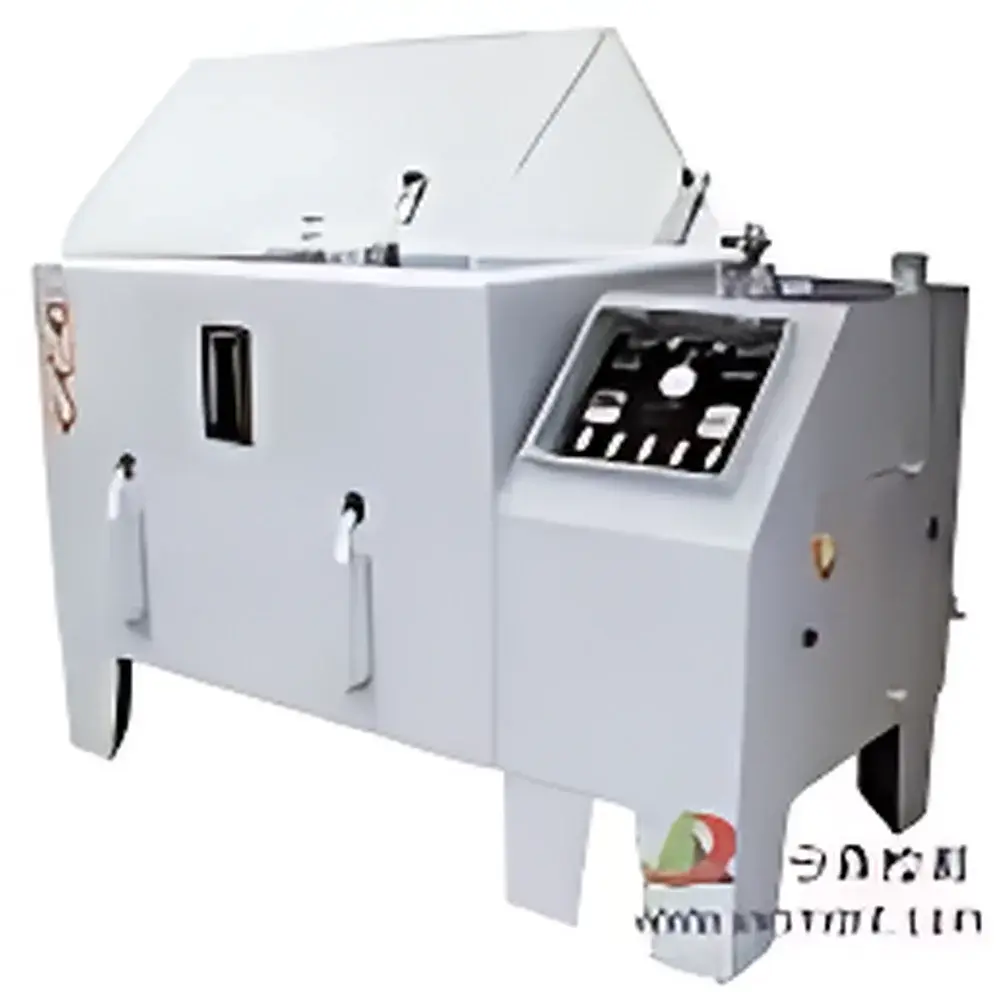
Insment KS-YW120 Advanced Salt Spray Test Chamber
| Brand | Insment |
|---|---|
| Model | KS-YW120 |
| Origin | Shanghai, China |
| Chamber Dimensions (W×H×D) | 120 × 85 × 50 cm |
| External Dimensions (W×H×D) | 220 × 170 × 145 cm |
| Test Temperature Range | +5°C to 55°C |
| NSS Test Temp | 35°C ±1°C (Chamber), 47°C ±1°C (Saturated Air Tank) |
| CASS Test Temp | 50°C ±1°C (Chamber), 63°C ±1°C (Saturated Air Tank) |
| Temperature Uniformity | ≤±2°C |
| Temperature Stability | ≤±0.5°C |
| Salt Spray Deposition Rate | 1–2 mL/80 cm²/h |
| Spray Nozzle | Precision PYREX Glass |
| Spray Distribution | Adjustable Conical Atomizer |
| Control System | LED Digital PID + SSR Microcomputer Controller (±0.1°C Accuracy) |
| Humidity & Temp Monitoring | PT100 Platinum Resistance Sensor + Mercury Thermometer |
| Heating System | Independent Ni-Cr Alloy Heaters |
| Safety Protections | Over-temperature, Low-water, Leakage, Short-circuit, Over-current, End-of-test Auto-Shutdown |
| Power Supply | AC 220V ±10%, 50 Hz / AC 380V ±10%, 50 Hz |
| Compliance | GB/T 2423.17, ASTM B117, ASTM B268, ISO 3768/3769/3770, JIS Z 2371, CNS 3627/3885/4159/7669/8866, GJB 150.11A |
Overview
The Insment KS-YW120 Advanced Salt Spray Test Chamber is an engineered environmental test system designed for accelerated corrosion evaluation of metallic components, protective coatings, electronic assemblies, and industrial products under controlled saline atmospheric conditions. It operates on the principle of continuous or cyclic salt fog exposure—generating a highly reproducible, uniformly dispersed sodium chloride aerosol within a thermally stabilized chamber. The system conforms to internationally recognized accelerated corrosion testing protocols, including neutral salt spray (NSS), acetic acid salt spray (AASS), and copper-accelerated acetic acid salt spray (CASS) methods. Its robust architecture ensures long-term operational stability in quality control laboratories, R&D facilities, and third-party certification labs requiring compliance with ASTM, ISO, JIS, GB, and GJB standards.
Key Features
- Corrosion-resistant chamber construction using imported high-strength, UV-stabilized PVC panels (5–8 mm thickness) for both interior walls and water bath; seamless welded joints prevent leakage and chemical ingress.
- Transparent 5 mm-thick acrylic observation lid enables real-time visual monitoring without interrupting test cycles.
- Dual-zone temperature control: independent heating and regulation of test chamber (±1°C tolerance) and saturated air tank (critical for consistent fog generation and droplet size distribution).
- Tower-type spray system with precision PYREX glass nozzles and adjustable conical atomizers—ensuring uniform fog deposition (1–2 mL/80 cm²/h) across the entire test area per ASTM B117 requirements.
- Integrated automatic water level control for both the main chamber water bath and saturated air tank—eliminating manual refilling and minimizing operator intervention.
- Microprocessor-based PID + SSR temperature controller with LED digital display (±0.1°C accuracy), programmable test duration (1 min to 999 hours), and cycle timing functionality.
- Comprehensive safety suite: over-temperature cut-off, low-water detection, earth leakage protection, short-circuit interruption, over-current relay, and end-of-test auto-shutdown with audible alert.
Sample Compatibility & Compliance
The KS-YW120 accommodates diverse sample geometries via its adjustable PVC test rack—supporting standardized inclination angles of 15° and 30° per ISO 3768 and ASTM B117. Standard fixtures include V-shaped and cylindrical sample holders, two calibrated funnels, and dual graduated collection cylinders for quantitative salt deposition verification. All wetted components—including spray nozzles, tubing, and reservoirs—are fabricated from non-reactive materials (stainless steel, PYREX, or corrosion-resistant polymers) to prevent cross-contamination and ensure metrological integrity. The chamber meets GLP-aligned documentation requirements when paired with optional data logging modules and supports audit-ready operation under ISO/IEC 17025-accredited laboratory environments.
Software & Data Management
While the base KS-YW120 utilizes a standalone microcontroller interface, it is compatible with external RS-485 or USB-enabled data loggers for time-stamped temperature, humidity, and runtime acquisition. Optional PC-based software packages support automated report generation compliant with FDA 21 CFR Part 11 (with electronic signature and audit trail configuration). All temperature setpoints, actual readings, alarm events, and test durations are stored internally with non-volatile memory retention—even during power loss. Calibration records, maintenance logs, and user access history can be exported in CSV or PDF formats for internal QA review or regulatory submission.
Applications
This chamber serves critical roles in evaluating coating adhesion, galvanic protection efficacy, passivation layer durability, and material selection for marine, automotive, aerospace, and electronics applications. Typical use cases include validation of electroplated zinc/nickel/chromium layers, assessment of anodized aluminum surfaces, qualification of conformal coatings on PCBs, and comparative testing of stainless steel grades under aggressive chloride environments. It is routinely deployed by OEMs, tier-1 suppliers, and accredited testing laboratories—including UL, TÜV Rheinland, CNAS-certified institutes, and national metrology centers—to support product certification against IEC 60068-2-11, MIL-STD-810H Method 509.6, and EN 60068-2-52.
FAQ
What standards does the KS-YW120 fully support for salt spray testing?
It is configured and validated for ASTM B117 (neutral salt spray), ASTM B268 (CASS), ISO 3768 (NSS), ISO 3769 (AASS), ISO 3770 (CASS), JIS Z 2371, GB/T 2423.17, and GJB 150.11A.
Can the chamber operate continuously for extended durations (e.g., 1,000+ hours)?
Yes—its sealed PVC construction, redundant water-level controls, and thermal stability design enable unattended operation up to 999 hours per cycle, with periodic maintenance intervals aligned to ISO 9001 preventive maintenance schedules.
Is calibration traceability available for temperature and deposition rate?
Factory calibration certificates are provided with NIST-traceable PT100 sensors and gravimetrically verified spray deposition rates; on-site recalibration services are available through authorized Insment service partners in APAC and EMEA regions.
Does the system include provisions for GLP/GMP-compliant recordkeeping?
When equipped with optional data logger and software, it supports electronic signatures, user-level access control, change history tracking, and immutable audit trails meeting 21 CFR Part 11 and EU Annex 11 requirements.
What maintenance is required to sustain long-term accuracy?
Recommended quarterly inspections include nozzle cleaning (ultrasonic bath), saturation tank descaling, sensor verification, and gasket integrity checks; full preventive maintenance is advised every 12 months or after 2,000 operational hours.



