
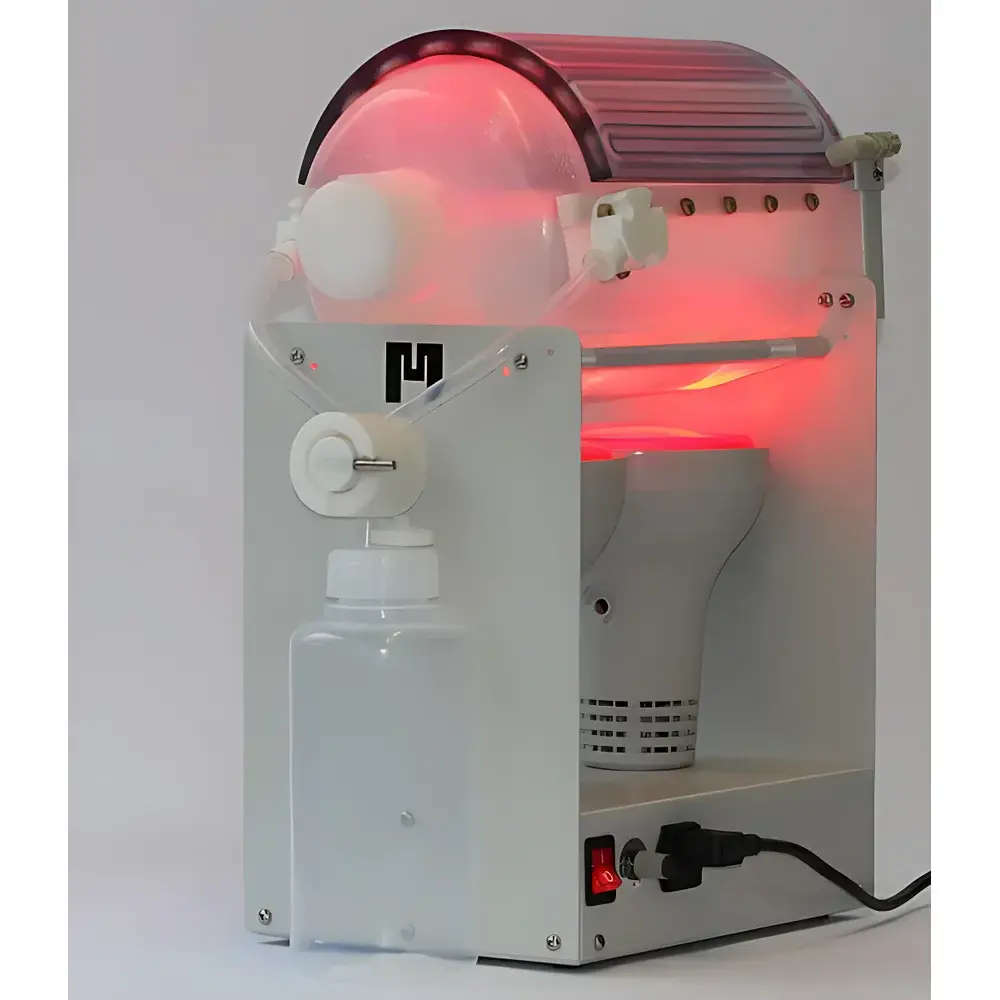
Maassen PFA ECO-IR Sub-Boiling Acid Purifier
| Brand | Maassen |
|---|---|
| Origin | Germany |
| Model | PFA ECO-IR |
| Instrument Type | Sub-boiling Distillation Apparatus |
| Heating System | Dual 150 W Infrared Emitters |
| Sample Capacity | Up to 2 L per Cycle |
| Collection Vessel | 1 L PFA Bottle |
| Feed Reservoir | 2.5 L PFA Bottle |
| Cooling Flow Rate | 1–2 L/min (tap water or recirculating chiller) |
| Material Construction | All-PFA Wetted Path (incl. reservoir, condenser, collector, and pressure-equalizing filter) |
| Power Control | Adjustable IR intensity via front-panel regulator |
| Consumable | Infrared heating emitters only |
| Acid Compatibility | HCl, HNO₃, HF, H₂O (excludes H₂SO₄) |
Overview
The Maassen PFA ECO-IR Sub-Boiling Acid Purifier is an engineered solution for the high-purity preparation of trace-metal-grade mineral acids in analytical laboratories. Operating on the principle of sub-boiling distillation—where acid solutions are heated gently below their atmospheric boiling point—the system minimizes volatile impurity carryover and suppresses aerosol formation. This thermal regime ensures that only the purest vapor phase is generated, subsequently condensed and collected in an all-fluoropolymer (PFA) path. Designed and manufactured in Germany, the ECO-IR integrates dual 150 W infrared emitters for precise, contactless, and uniform heating of the PFA reservoir. Unlike conventional hotplate-based systems, infrared heating eliminates metal contamination risks and enables rapid thermal response with excellent reproducibility across repeated purification cycles.
Key Features
- All-wetted-path construction from high-purity PFA (perfluoroalkoxy alkane), including feed reservoir (2.5 L), condenser, collection vessel (1 L), and integrated pressure-equalizing PFA filter—ensuring zero leachable metal content and compatibility with aggressive media such as hydrofluoric acid (HF).
- Dual independent infrared heating elements with continuously adjustable power output via front-panel regulator—enabling optimization of evaporation kinetics for each acid type (e.g., lower intensity for HF, higher for HNO₃).
- Modular cooling interface compatible with standard tap water supply or external recirculating chillers; recommended flow rate of 1–2 L/min ensures consistent condensation efficiency and stable distillate yield.
- Gravity-fed condensate transport through dual lateral channels in the reservoir body—eliminating pumps or tubing that could introduce contamination or failure points.
- Self-balancing PFA membrane filter maintains atmospheric equilibrium between reservoir and ambient environment while preventing particulate ingress during operation.
- Minimal consumables: only infrared emitters require periodic replacement—no gaskets, seals, or quartz components subject to degradation or outgassing.
Sample Compatibility & Compliance
The ECO-IR is validated for sub-boiling purification of hydrochloric acid (HCl), nitric acid (HNO₃), hydrofluoric acid (HF), and deionized water (H₂O). Sulfuric acid (H₂SO₄) is explicitly excluded due to its high boiling point, thermal decomposition behavior, and risk of sulfate residue formation under sub-boiling conditions. The all-PFA architecture conforms to ASTM D5127 (Standard Guide for High-Purity Water Used in Semiconductor Processing) and supports compliance with ISO/IEC 17025 requirements for method validation in trace elemental analysis. When operated within specified parameters and maintained per Maassen’s technical documentation, the system delivers distillates meeting ICP-MS and ICP-OES grade specifications (e.g., ≤10 pg/g for Al, Fe, Cr, Ni, Cu, Zn, Pb). It is routinely deployed in laboratories adhering to EPA Method 200.8, USP , and CLSI EP29-A guidelines for reagent qualification.
Software & Data Management
The Maassen PFA ECO-IR is a stand-alone, analog-controlled instrument with no embedded microprocessor or digital interface. Operation relies entirely on manual adjustment of infrared power and monitoring of visual indicators (e.g., steady vapor generation, condensate drip rate). While it does not support electronic data logging or 21 CFR Part 11-compliant audit trails, its mechanical simplicity ensures long-term operational stability and ease of qualification under GLP or GMP frameworks. Laboratories requiring full traceability may integrate the unit into broader SOPs that document batch numbers, operator IDs, start/stop times, cooling flow verification, and post-purification ICP-MS verification reports—all retained in paper or LIMS-managed electronic records.
Applications
- Preparation of ultra-trace metal-free acids for sample digestion prior to ICP-MS, ICP-OES, and GF-AAS analysis of environmental, geological, and biological matrices.
- Generation of calibration standards and blank solutions in accredited testing laboratories performing heavy metal screening per EN 14385, EPA 6020B, or ISO 17294-2.
- Production of high-purity rinse solutions for semiconductor wafer cleaning processes where Na⁺, K⁺, and transition metal residuals must remain below 10¹⁰ atoms/cm².
- On-demand purification of small-volume HF batches for etching applications in MEMS fabrication and glass substrate processing.
- Supporting QA/QC workflows in nuclear fuel cycle facilities where chloride and fluoride ion purity directly impact uranium hexafluoride (UF₆) synthesis integrity.
FAQ
Can the ECO-IR purify sulfuric acid?
No. Due to its high boiling point (337 °C), thermal instability above 200 °C, and tendency to form non-volatile sulfate residues, H₂SO₄ is incompatible with sub-boiling distillation and is explicitly excluded from use with this system.
Is external cooling mandatory?
Cooling is required for optimal throughput and distillate purity. Operation without active cooling reduces condensation efficiency and yields significantly lower volumes (<30% of rated capacity); prolonged dry operation may also accelerate IR emitter aging.
What is the typical purification cycle time for 2 L of HNO₃?
At nominal IR power and 1.5 L/min cooling flow, complete distillation of 2 L of 65% HNO₃ requires approximately 8–10 hours, yielding ~1.8 L of purified acid at consistent concentration.
How often must the infrared emitters be replaced?
Under normal usage (2–3 cycles/week), emitters maintain stable output for ≥12 months. Replacement is indicated by visible discoloration, reduced vapor generation, or inconsistent distillate rate despite unchanged settings.
Does the system require annual recalibration?
No. As a passive thermal distillation device with no sensors or feedback loops, the ECO-IR does not require calibration. Routine performance verification is conducted via ICP-MS analysis of representative distillate batches against certified reference materials (e.g., NIST SRM 3100 series).



