
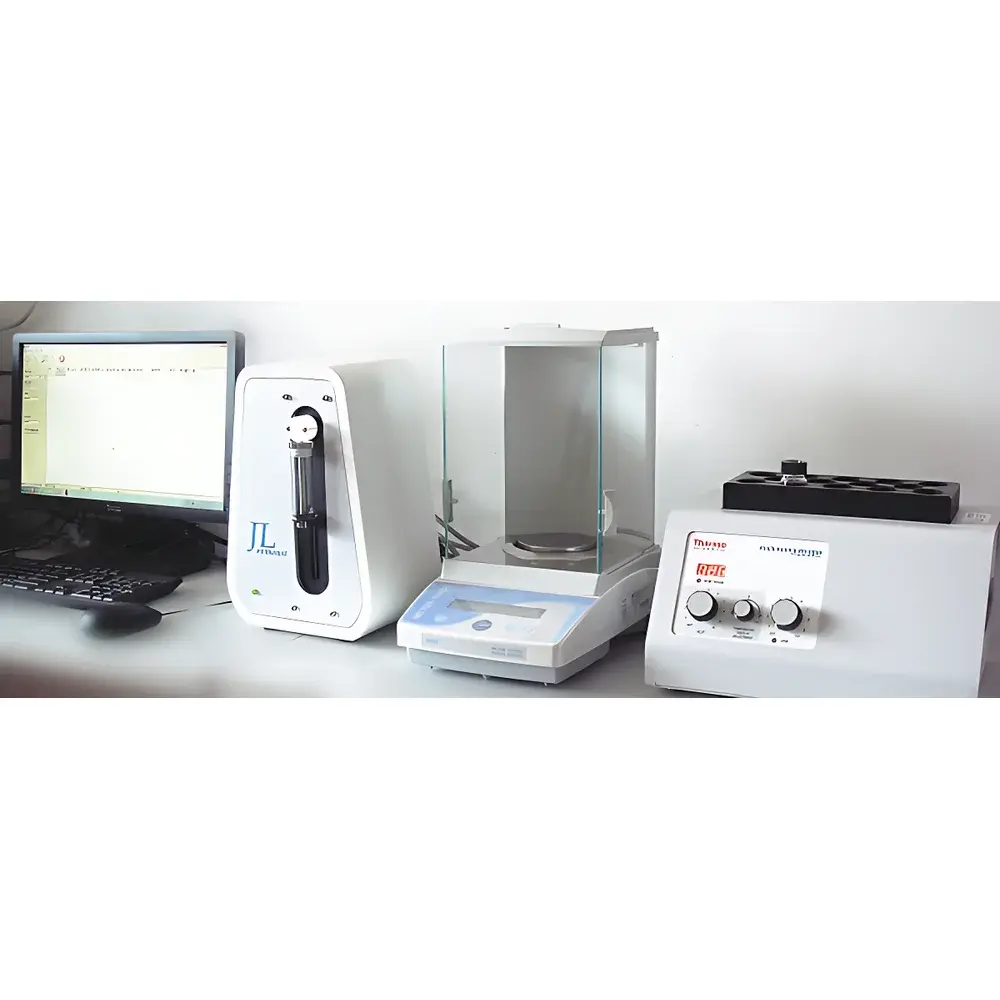
SASP Semi-Automatic Sample Preparation System
| Origin | Shanghai, China |
|---|---|
| Manufacturer Type | Authorized Distributor |
| Origin Category | Domestic (PRC) |
| Model | SASP |
| Pricing | Available Upon Request |
Overview
The SASP Semi-Automatic Sample Preparation System is an engineered solution for precise, temperature-compensated liquid sample formulation in analytical and quality control laboratories. Unlike fully manual or conventional volumetric dilution methods, the SASP system integrates real-time thermal expansion correction into the solvent dispensing workflow—leveraging the known coefficient of thermal expansion (CTE) of solvents to calculate volume adjustments required to achieve target concentrations *at the specified analysis temperature*. This eliminates systematic errors arising from thermal contraction/expansion between preparation (room temperature) and measurement (e.g., 25 °C, 40 °C, or 60 °C), a common source of bias in HPLC, GC, UV-Vis, and titration workflows. The system operates on a gravimetric–volumetric hybrid principle: users weigh the analyte (solid or liquid) within defined mass limits; the embedded control software then computes the exact solvent volume needed—factoring in ambient solvent temperature, user-input CTE, analyte mass, moisture/impurity content (if provided), and target concentration at the final analysis temperature—before triggering high-accuracy liquid dispensing.
Key Features
- Thermal expansion–compensated solvent dispensing: Automatically adjusts dispensed solvent volume based on real-time ambient solvent temperature and pre-configured thermal expansion coefficients
- Moisture and impurity correction algorithm: Accepts user-defined water content or impurity percentage to recalculate stoichiometric solvent mass/volume for pure-analyte-equivalent concentration
- Gravimetric input interface: Supports integration with certified analytical balances (RS-232 or USB HID mode) for direct mass acquisition
- Concentration-targeted output: Delivers solutions calibrated to exact molarity, mass/volume %, or weight/weight % at user-specified analysis temperature—not room temperature
- Intuitive PC-based control software: Provides step-by-step guided workflows, audit-trail logging, and parameter validation before dispensing initiation
- Modular liquid handling architecture: Compatible with standard glass or polymer volumetric flasks (10 mL to 1000 mL), adjustable pipette tips, and common organic/aqueous solvents (e.g., methanol, acetonitrile, water, chloroform)
Sample Compatibility & Compliance
The SASP system accommodates solid powders, crystalline materials, viscous liquids, and hygroscopic samples. It supports moisture correction inputs per ICH Q5C and USP guidelines for residual solvent and water content quantification. While not a GMP-certified instrument out-of-the-box, its software architecture enables configuration for GLP-compliant environments: all dispensing events—including balance readings, temperature sensor values, CTE parameters, moisture inputs, and final calculated volumes—are timestamped and stored in a non-editable log file. When deployed with 21 CFR Part 11–compliant electronic signature modules (optional add-on), the system meets documentation requirements for regulated pharmaceutical and contract research laboratory use.
Software & Data Management
The SASP Control Suite runs on Windows 10/11 and provides a validated, password-protected interface with role-based access (Operator, Supervisor, Administrator). Each preparation session generates a unique batch ID linked to raw data files (.csv and .xml), including metadata such as operator ID, balance serial number, ambient lab temperature/humidity (if external sensors are connected), and full calculation traceability. Export functions support LIMS integration via ODBC or flat-file transfer. Audit trails comply with ISO/IEC 17025:2017 clause 7.10.2 (result reporting) and ASTM E2500-18 (verification of computerized systems). Backups are automated daily to network drives or cloud storage (user-configurable).
Applications
- Preparation of reference standards for HPLC assay validation (ICH Q2(R2))
- Formulation of calibration standards for elemental analysis (ICP-MS/OES) where thermal density shifts affect ppm accuracy
- Pharmaceutical dissolution media preparation per USP and , ensuring concentration fidelity at 37 °C
- Environmental testing labs preparing EPA Method 8082A or 8270D extracts with temperature-sensitive organics
- Academic research requiring reproducible molal concentrations across variable ambient lab conditions (e.g., seasonal temperature fluctuations)
- QC labs performing Karl Fischer titration sample prep with automatic water-content compensation
FAQ
Does the SASP system require calibration of the liquid dispenser?
Yes—periodic gravimetric verification per ISO 8655-6 is recommended every 3 months or after maintenance. Factory calibration certificates are provided with initial delivery.
Can the system handle volatile or hazardous solvents?
It supports Class II solvents when used inside a certified fume hood; optional solvent-resistant tubing and sealed tip ejection modules are available for chlorinated or ketonic solvents.
Is third-party balance compatibility guaranteed?
The system communicates with METTLER TOLEDO, SARTORIUS, and OHAUS analytical balances supporting standard ASCII command protocols (e.g., “SI” for stable weight readout). Custom drivers can be developed for other models upon request.
How is thermal expansion coefficient data managed?
Users select from a built-in library of >40 solvents (with literature-sourced CTE values per CRC Handbook and NIST TRC), or enter custom coefficients with uncertainty values for internal method validation.
What happens if ambient temperature changes during dispensing?
The system samples solvent temperature continuously via a PT100 probe immersed in the reservoir; calculations update dynamically, ensuring final volume remains traceable to the analysis temperature condition.



