
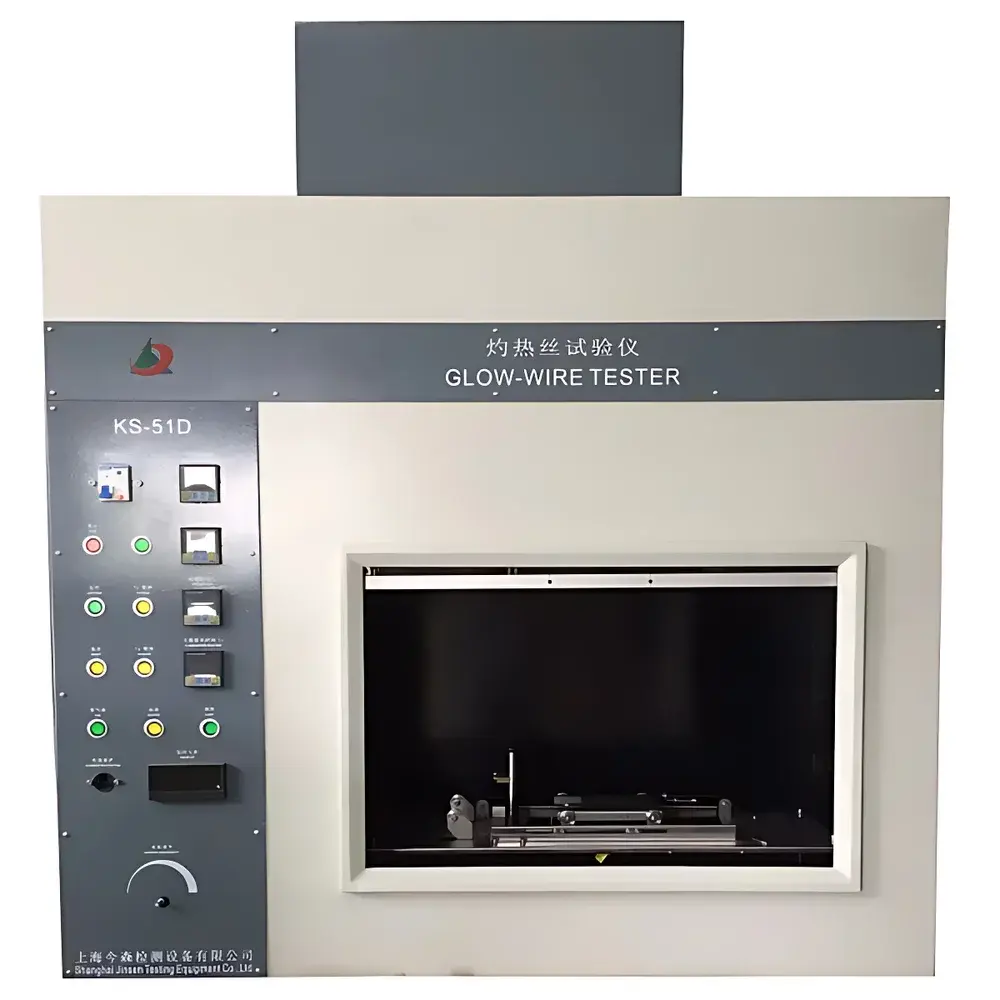
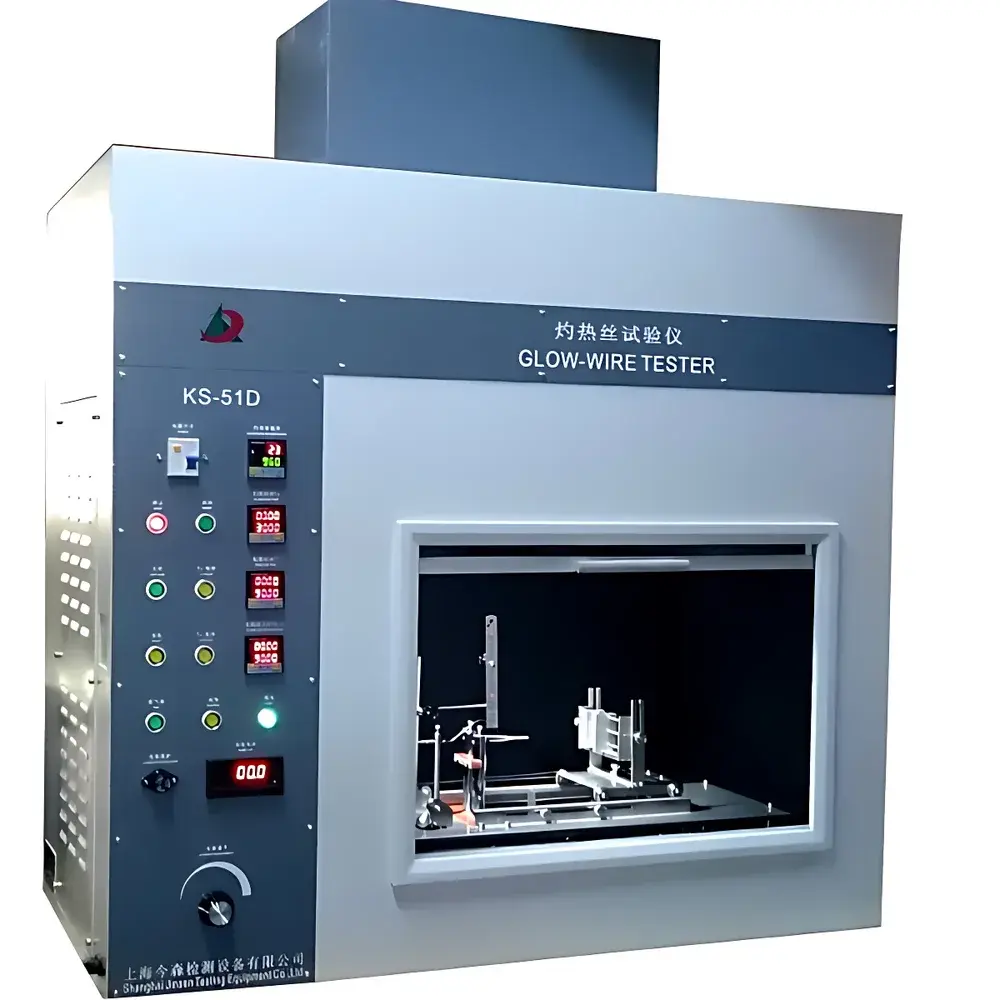
INSMENT KS-51SD Glow-Wire Test Apparatus
| Brand | INSMENT |
|---|---|
| Origin | Shanghai, China |
| Model | KS-51SD |
| Compliance | IEC 60695-2-10:2013, GB/T 5169.10–2017, UL 746A, IEC 829, DIN 695, VDE 0471 |
| Heating Temperature Range | 300–1000 °C (±10 °C accuracy at 960 °C) |
| Glow-Wire Diameter | 4.0 mm ± 0.07 mm (Ni ≥77%, Cr 19–21%) |
| Applied Force | 0.95 N ± 0.10 N |
| Contact Duration | 0.1–999.9 s (adjustable, ±0.1 s resolution) |
| Thermocouple | K-type, mineral-insulated, sheath-rated to 1100 °C |
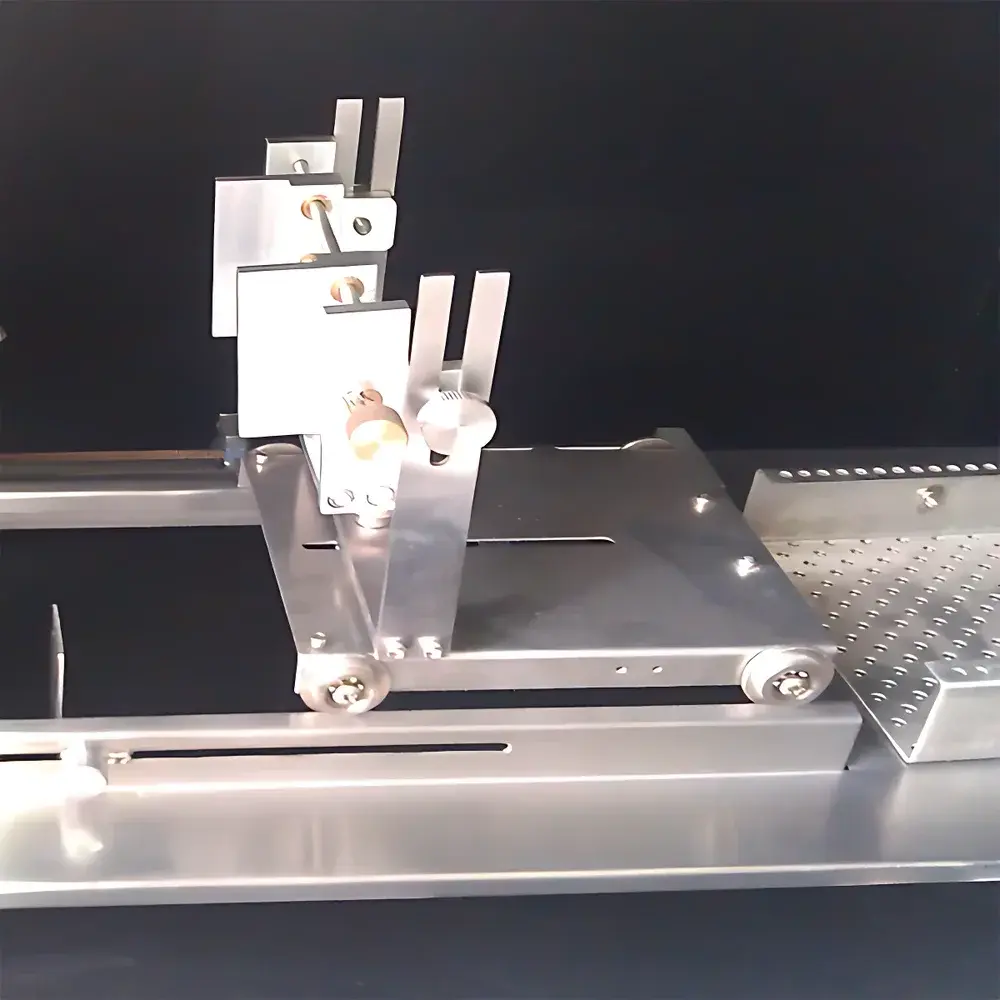
| Specimen Support | 10 mm pine board + 12–30 g/m² standard silk paper, positioned 200 mm ± 5 mm below glow-wire tip |
| Power Supply | 220 V AC, 50 Hz, ≤500 W |
| Dimensions (W×D×H) | 1120 × 520 × 1250 mm |
| Exhaust Port | Ø100 mm |
Overview
The INSMENT KS-51SD Glow-Wire Test Apparatus is a precision-engineered instrument designed to evaluate the ignition resistance of non-metallic materials used in electrical and electronic equipment under simulated fault conditions. It operates on the principle defined in IEC 60695-2-10:2013 — applying controlled thermal stress via a standardized nickel-chromium glow-wire (Φ4.0 mm) heated to predetermined temperatures (300–1000 °C), then brought into contact with test specimens under a defined mechanical load (0.95 N) for a fixed duration (typically 30 s). The apparatus measures critical fire safety parameters including time to ignition (Ti), flame extinction time (Te), and whether ignition propagates to specified bedding material (e.g., pine board overlaid with standardized silk paper). This method replicates worst-case thermal failure scenarios such as overheating due to poor contacts, overcurrent, or component overload — enabling objective assessment of comparative flammability and compliance with global regulatory frameworks governing end-product safety.
Key Features
- Robust enclosure fabricated from 1.5 mm thick 304 stainless steel with high-temperature resistant powder coating, ensuring long-term corrosion resistance and structural integrity in laboratory environments.
- Imported German-made K-type mineral-insulated thermocouple (Φ1.0 mm) with a ceramic-sheathed design rated to 1100 °C — exceeding the 1050 °C minimum requirement specified in IEC 60695-2-10 and enabling stable, repeatable temperature monitoring during extended 960 °C endurance tests (>6 h).
- Large tempered glass observation window with anti-fog treatment and integrated LED illumination, allowing unobstructed real-time visual monitoring of specimen behavior without compromising operator safety or test chamber integrity.
- Precision electromechanical actuation system delivering consistent 0.95 N ± 0.10 N contact force and accurate depth control (7.0 mm ± 0.5 mm penetration limit), minimizing inter-test variability.
- Dual independent timing circuits for automatic recording of Ti (time to ignition), Te (flame extinction time), and total glow-wire application time — all adjustable in 0.1 s increments with manual pause capability for procedural intervention.
- Integrated overtemperature protection circuitry that interrupts heating current if preset limits are exceeded, safeguarding both operator and instrumentation while maintaining traceability per GLP-compliant operation protocols.
Sample Compatibility & Compliance
The KS-51SD accommodates flat, rigid, or semi-rigid specimens up to 10 mm thick and 60 mm × 60 mm in planar dimension, conforming to dimensional requirements outlined in IEC 60695-2-10 and GB/T 5169.10–2017. Specimens are mounted on a standardized support assembly comprising a 10 mm-thick white pine board overlaid with 12–30 g/m² silk paper, positioned precisely 200 mm ± 5 mm beneath the glow-wire tip. All mechanical and thermal calibration procedures align with mandatory verification steps in Clause 9 of IEC 60695-2-10, including silver foil calibration at 960 °C (±10 °C tolerance). The apparatus supports full documentation trails required for ISO/IEC 17025-accredited testing laboratories and satisfies evidentiary requirements under FDA 21 CFR Part 11 when paired with validated data capture workflows.
Software & Data Management
While the KS-51SD operates as a stand-alone hardware platform, its analog/digital hybrid interface enables seamless integration with external PC-based logging systems via RS-232 or optional USB-to-serial adapters. Time-stamped event logs (Ti, Te, glow-wire activation/deactivation, temperature setpoint, actual thermocouple reading) can be exported in CSV format for post-processing in Excel or LIMS environments. For regulated environments, users may implement third-party audit-trail software compliant with 21 CFR Part 11 to ensure electronic records meet ALCOA+ principles (Attributable, Legible, Contemporaneous, Original, Accurate, Complete, Consistent, Enduring, Available). Calibration certificates for thermocouples and force transducers are issued with NIST-traceable references upon installation and annually thereafter.
Applications
The KS-51SD is routinely deployed in quality assurance laboratories serving electronics manufacturers, component suppliers, and certification bodies (e.g., UL, TÜV, SGS, CCC). Primary use cases include: evaluation of housing materials (PC, ABS, PBT, PA66) for consumer appliances and IT equipment; validation of insulating spacers, terminal blocks, and connector housings prior to UL 746A listing; comparative GWFI (Glow-Wire Flammability Index) and GWIT (Glow-Wire Ignition Temperature) determination per IEC 60695-2-12 and -13; root-cause analysis of field failures linked to thermal runaway; and pre-compliance screening during product development phases to reduce late-stage redesign risk. Its reproducible thermal loading profile makes it suitable for internal specification development and supplier qualification programs aligned with IPC-TR-579 or IPC-J-STD-001 requirements.
FAQ
What standards does the KS-51SD fully support?
It meets all mechanical, thermal, and procedural requirements of IEC 60695-2-10:2013, GB/T 5169.10–2017, UL 746A, IEC 829, DIN 695, and VDE 0471 for glow-wire testing of solid electrical insulation materials.
How is temperature calibration verified?
Using certified 960 °C silver reference foil: when the foil melts, the controller must read 960 °C ±10 °C. This verification is performed before each test series and documented per ISO/IEC 17025 clause 7.7.
Can the apparatus operate continuously at 960 °C?
Yes — the upgraded 1100 °C-rated thermocouple sheath and reinforced heating circuit enable uninterrupted operation at 960 °C for ≥6 hours, satisfying endurance test requirements in Annex A of IEC 60695-2-10.
Is routine maintenance required between tests?
Yes — cleaning of the combustion chamber (power-off), inspection of glow-wire geometry (replacement threshold: diameter <3.9 mm), and verification of contact force using calibrated load cells are mandated weekly per manufacturer guidelines.
Does the system include GLP/GMP-compliant data handling?
The base unit provides timestamped digital outputs; full 21 CFR Part 11 compliance requires integration with validated third-party software supporting electronic signatures, audit trails, and role-based access control.



