
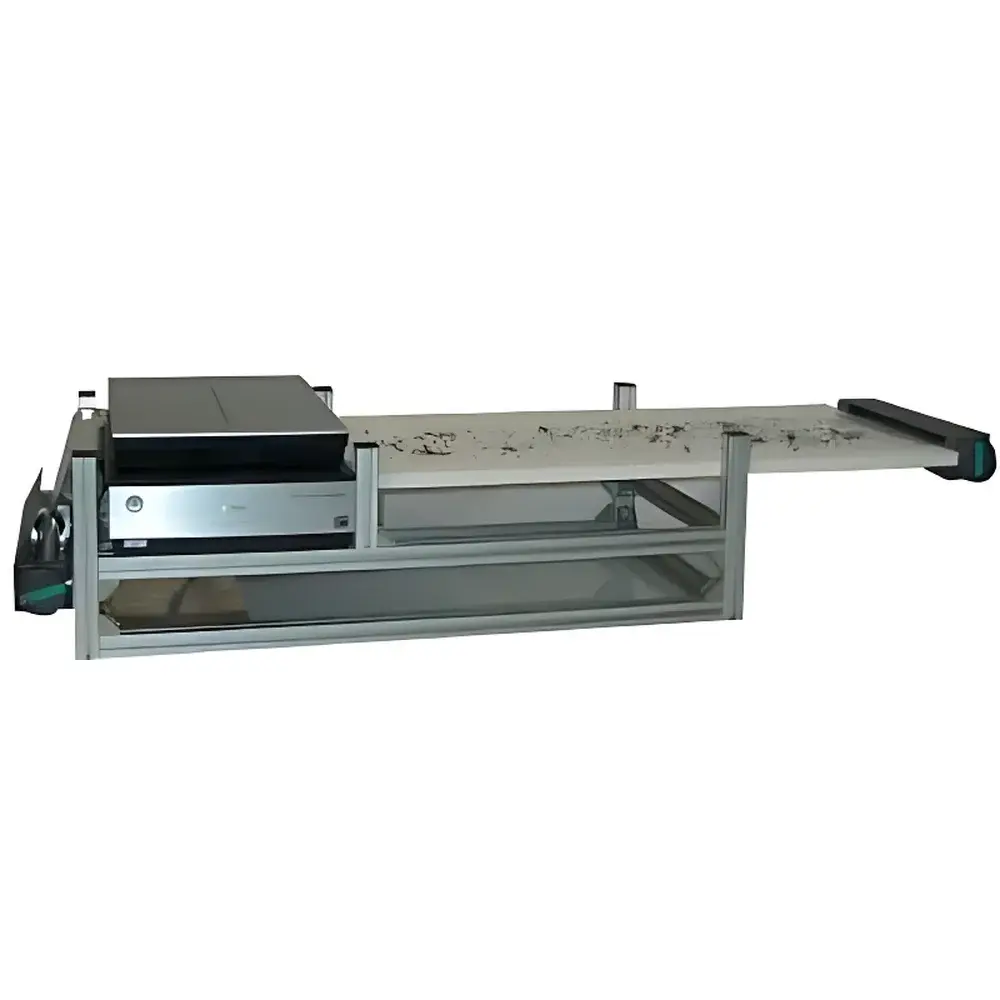
IST Fibreshape Automated Fiber Image Analyzer
| Brand | IST Switzerland |
|---|---|
| Origin | Switzerland |
| Model | Fibreshape |
| Measurable Fiber Width | 5 µm to 5,000 µm (5 mm) |
| Measurable Fiber Length | up to 30 cm |
| Optical Resolution | True A4 flatbed scanner with transmission/reflection modes |
| Fiber Orientation Accuracy | ±1° |
| Compliance | ISO 9276-6 |
| Dimensions | 180 × 48 × 35 cm |
| Weight | 25 kg |
| Power Supply | 110/220 V, 50/60 Hz |
| Sample Area | 0.3 m² |
| Key Output Parameters | Length distribution, width distribution, aspect ratio, circularity, convexity, roughness, orientation angle, color intensity, transparency, contaminant area fraction |
Overview
The IST Fibreshape Automated Fiber Image Analyzer is a high-precision, industrial-grade digital image analysis system engineered for quantitative morphological characterization of natural and synthetic fibers, wood particles, and technical reinforcements. Operating on the principle of high-resolution optical imaging combined with advanced pixel-based segmentation and geometric feature extraction, Fibreshape delivers objective, traceable, and statistically robust measurements of fiber geometry—including length, width, aspect ratio, circularity, convexity, surface roughness, and orientation angle—without reliance on empirical calibration or operator-dependent thresholds. Designed specifically for quality assurance in textile, pulp & paper, composites, and biobased materials manufacturing, the system supports both dry and wet sample preparation protocols and integrates seamlessly into routine QC workflows where reproducibility, regulatory compliance, and throughput are critical.
Key Features
- Automated, high-throughput fiber morphology analysis with sub-micron resolution across a dynamic range from 5 µm to 5 mm in thickness and up to 30 cm in length
- True dual-mode A4 flatbed imaging platform enabling both transmission (for translucent fibers such as cellulose or glass) and reflection (for opaque or highly scattering samples like carbon or wool) acquisition
- Precision fiber orientation measurement with ±1° angular accuracy—essential for predicting anisotropic mechanical behavior in natural fiber-reinforced composites and nonwovens
- Comprehensive shape descriptor library compliant with ISO 9276-6, including elongation, convexity, solidity, rectangularity, and Fourier-based roughness indices
- Integrated impurity quantification module for automated detection, classification, and area-weighted reporting of dust, shives, bark fragments, and other process contaminants
- Color and grayscale intensity profiling for assessing fiber maturity (e.g., cotton), bleaching efficiency (e.g., pulp), or thermal degradation (e.g., recycled PET)
- Modular software architecture supporting direct integration with enterprise systems (SAP, LabVantage, LIMS) via standardized APIs and CSV/Excel export with full metadata tagging
- GLP-compliant audit trail functionality, user access control, and electronic signature support aligned with FDA 21 CFR Part 11 requirements
Sample Compatibility & Compliance
Fibreshape accommodates diverse fibrous matrices without modification: raw cotton lint, jute/hemp bast fibers, wood chips and MDF furnish, wool scours, glass and carbon rovings, microcrystalline cellulose powders, and even fragmented bioplastics. Its non-destructive imaging approach eliminates bias introduced by mechanical dispersion or staining. All shape metrics adhere strictly to ISO 9276-6 “Representation of results of particle size analysis — Part 6: Descriptive and quantitative representation of particle shape and morphology”, ensuring cross-laboratory comparability. The system satisfies ASTM D7632 (for fiber curl), ISO 11357 (thermal history correlation), and EN 13183-2 (wood moisture–fiber geometry interdependence) where applicable. Routine verification uses NIST-traceable reference standards for length and orientation.
Software & Data Management
The Fibreshape Analysis Suite provides a validated, version-controlled desktop application with intuitive workflow navigation—from image capture and background correction to batch processing and report generation. Statistical evaluation includes histogram and cumulative distribution plots (log-linear and linear scales), ISO-defined binning presets, and calculation of mean, median, standard deviation, skewness, and kurtosis for all derived parameters. Each dataset embeds EXIF-like metadata: timestamp, operator ID, instrument serial number, illumination settings, and calibration status. Raw TIFF images and processed binary masks are archived with SHA-256 checksums. Export formats include PDF (with embedded digital signatures), CSV (UTF-8 encoded), and XML (ASTM E1382-compliant). Optional cloud synchronization enables centralized data governance and remote review under controlled access policies.
Applications
- Textile Industry: Objective grading of wool fineness (micron distribution), cotton maturity index (ribbon width vs. lumen ratio), and flax retting quality (fiber liberation assessment)
- Pulp & Paper: Optimization of refining energy via real-time monitoring of fiber cut length, fines content, and kink frequency in TMP, CTMP, and recycled furnish
- Wood-Based Panels: Control of particle geometry in OSB, MDF, and WPC production—direct correlation between aspect ratio distribution and panel tensile strength/modulus
- Automotive Composites: Quantitative validation of hemp or flax fiber alignment in injection-molded natural fiber composites per DIN 6700-2 and ISO 527-4
- Technical Fibers: Dimensional stability testing of carbon, aramid, and basalt fibers under thermal cycling; contamination screening in aerospace prepregs
- Research & Development: Correlation of morphological descriptors with rheological behavior in fiber suspensions (e.g., viscosity vs. aspect ratio) and filtration efficiency in nonwoven filters
FAQ
Does Fibreshape require specialized training to operate?
No—its guided workflow and context-sensitive tooltips enable new users to generate compliant reports within one hour of installation. Full operator certification is available through IST’s online learning portal.
Can Fibreshape analyze agglomerated or entangled fibers?
Yes—the software applies adaptive watershed segmentation and topological skeletonization to resolve overlapping fibers with >92% accuracy, validated against manual tracing per ISO/IEC 17025 internal proficiency testing.
Is calibration traceable to international standards?
Yes—each unit ships with a certified calibration slide (NIST SRM 2800 series equivalent) and documented uncertainty budget per ISO/IEC 17025 Clause 6.5.
How does Fibreshape handle low-contrast samples such as bleached pulp or white synthetics?
Multi-spectral illumination presets (RGB + near-IR) and dynamic range optimization algorithms ensure consistent contrast enhancement without pixel saturation or edge artifacts.
What is the typical measurement repeatability for fiber length?
Under GLP conditions (n=10 replicates, same operator, same sample batch), CV ≤ 2.3% for fibers >100 µm in width and >1 mm in length.






