
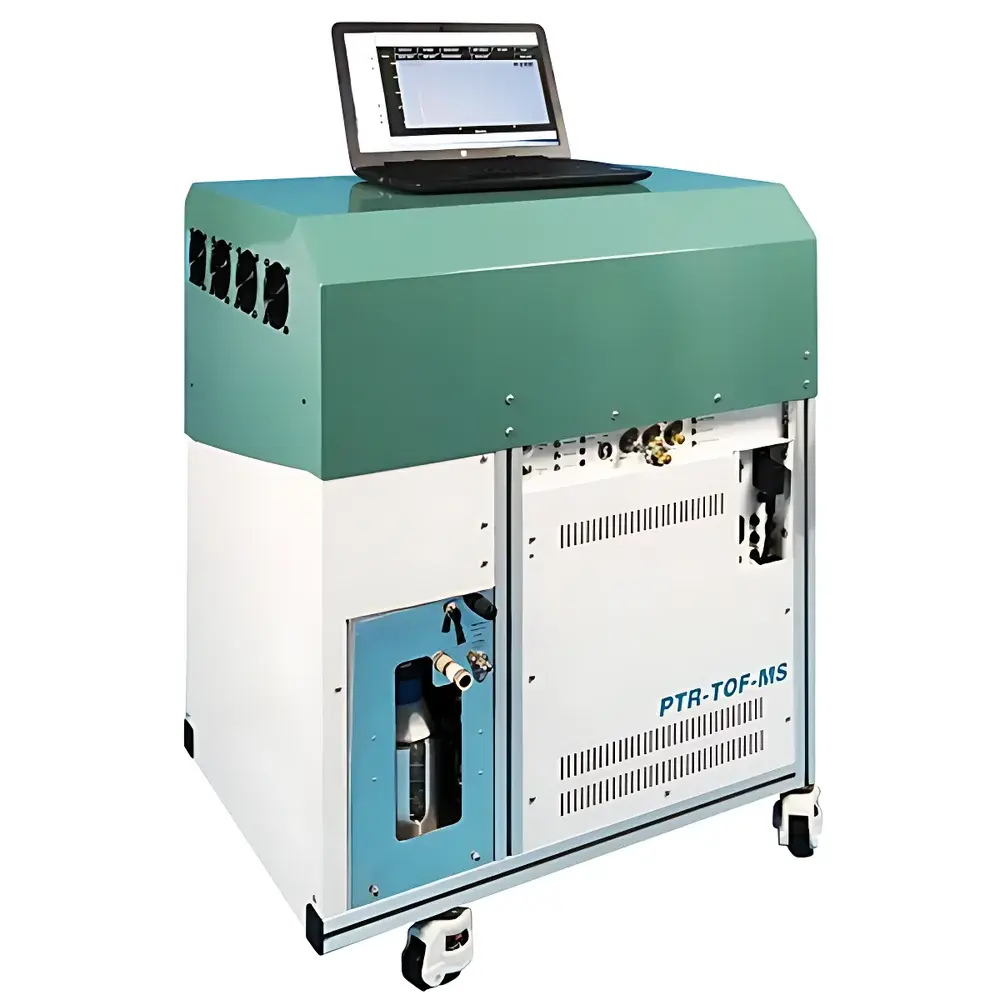
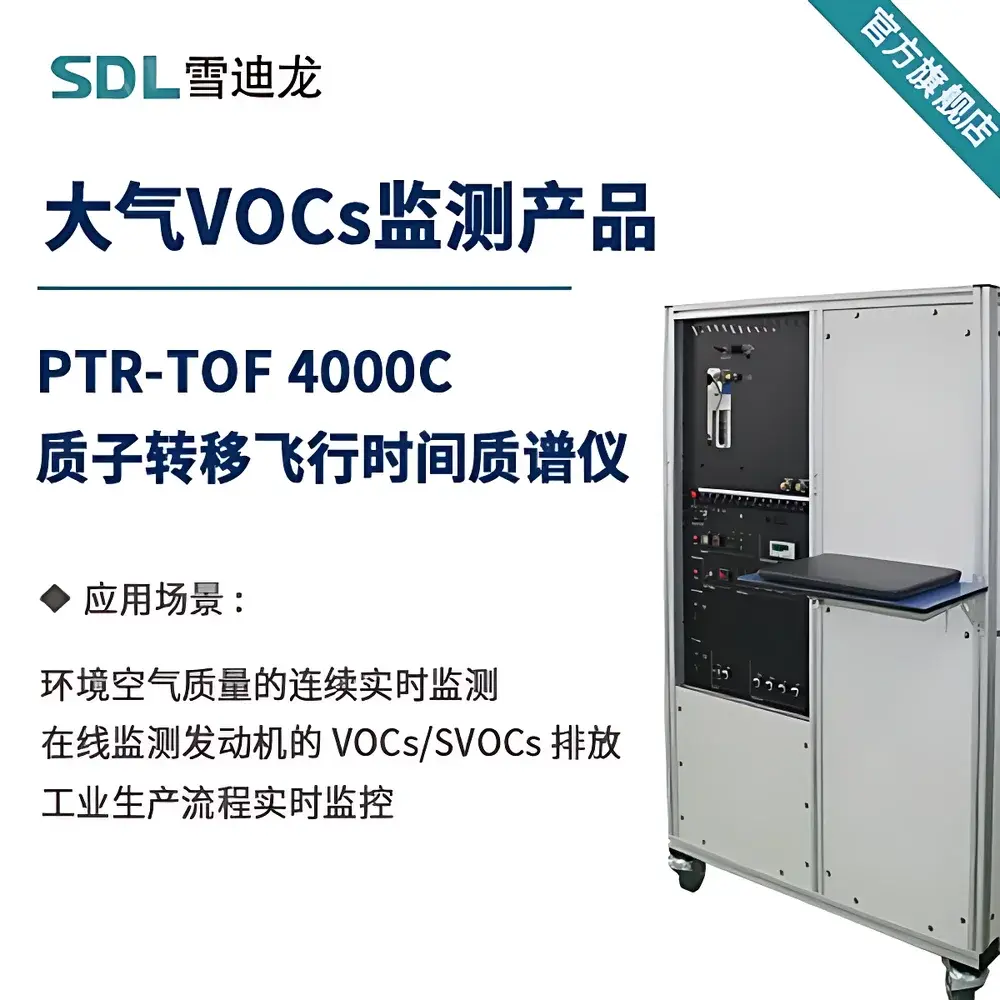
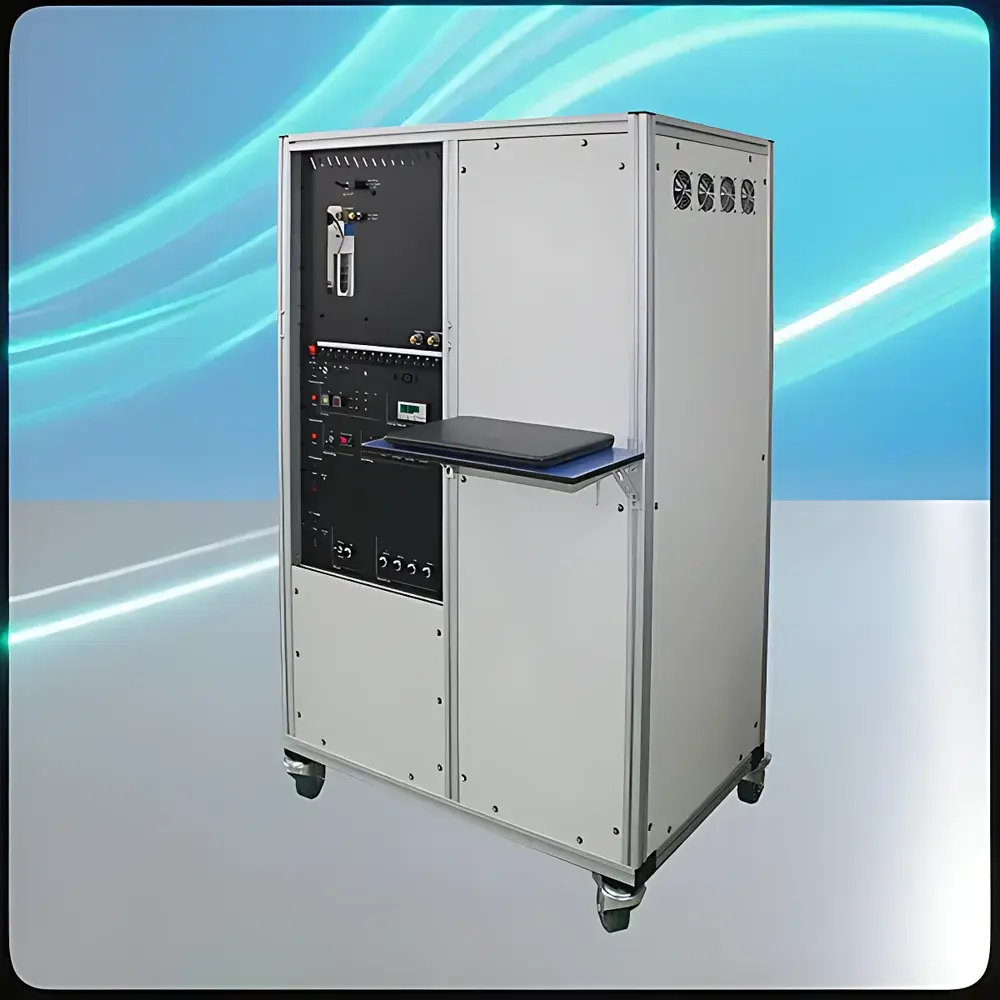
SDL PTR-TOF 4000C Proton Transfer Reaction Time-of-Flight Mass Spectrometer
| Brand | SDL |
|---|---|
| Origin | Beijing, China |
| Manufacturer Type | Original Equipment Manufacturer (OEM) |
| Model | PTR-TOF 4000C |
| Principle | Proton Transfer Reaction coupled with Time-of-Flight Mass Spectrometry |
| Detection Limit | Sub-pptv (parts-per-trillion by volume) for selected VOCs/SVOCs |
| Response Time | <100 ms (typical duty-cycle acquisition) |
| Software Compliance | Supports audit trail, user access control, and data integrity per FDA 21 CFR Part 11 requirements |
| Regulatory Alignment | Designed to support ISO 16000-6, EPA TO-15/TO-17, and EU Directive 2008/50/EC monitoring protocols |
Overview
The SDL PTR-TOF 4000C is a high-performance, real-time Proton Transfer Reaction Time-of-Flight Mass Spectrometer engineered for continuous, quantitative trace gas analysis of volatile and semi-volatile organic compounds (VOCs and SVOCs). It integrates a soft chemical ionization source—proton transfer reaction (PTR)—with a high-resolution orthogonal acceleration time-of-flight (oa-TOF) mass analyzer. Unlike electron impact (EI) or other hard ionization methods, PTR selectively transfers H⁺ ions from H₃O⁺ reagent ions to analyte molecules with proton affinity higher than water, yielding predominantly intact [M+H]⁺ molecular ions with minimal fragmentation. This enables unambiguous molecular identification, accurate mass assignment (<5 ppm mass accuracy), and direct quantification without calibration curves for many compounds. The instrument operates at ambient pressure in the ion source and achieves sub-second temporal resolution, making it suitable for dynamic process monitoring, atmospheric chemistry studies, and rapid emission profiling.
Key Features
- Real-time, direct injection analysis—no sample preconcentration, thermal desorption, or chromatographic separation required
- Sub-pptv detection limits (e.g., 0.1–5 pptv for benzene, toluene, isoprene, formaldehyde) under standard operating conditions
- Mass resolution (m/Δm) > 4,000–6,000 FWHM across m/z 20–300, enabling separation of isobaric interferences (e.g., C₂H₄O⁺ vs. CH₆N⁺)
- Full mass spectrum acquisition at 1–10 Hz, with configurable dwell time and mass range (m/z 10–300 or extended to 500)
- Robust, maintenance-optimized design: no carrier gas required; only ultra-high purity water vapor and zero air supplied to the ion source
- Integrated vacuum system with turbomolecular pumping stages achieving base pressure <5×10⁻⁷ mbar in the TOF analyzer region
- Modular architecture supporting optional add-ons including heated inlet lines (up to 200 °C), particle-phase interface (for SVOCs), and external synchronization for laser photolysis or smog chamber experiments
Sample Compatibility & Compliance
The PTR-TOF 4000C accepts gaseous samples directly from ambient air, stack emissions, reactor effluents, or controlled environmental chambers. It is compatible with sampling flows from 50–500 mL/min via PFA or SilcoNert®-treated stainless-steel inlet tubing. The system meets essential performance criteria outlined in ISO 16000-6 (indoor air VOC measurement), EPA Compendium Method TO-15 (ambient air), and EU Reference Measurement Methods for VOCs under Directive 2008/50/EC. For regulated industrial applications, the instrument’s firmware and software support GLP/GMP-aligned workflows—including electronic signatures, role-based access control, and immutable audit trails compliant with FDA 21 CFR Part 11. All calibration and performance verification records are stored within the secure database with timestamped metadata.
Software & Data Management
The proprietary TOF-DAQ v5.x software suite provides real-time spectral visualization, automated peak integration, library-assisted compound identification (NIST MS Search + custom VOC libraries), and time-series concentration plotting. Raw .tdf files are stored in vendor-neutral HDF5 format, ensuring long-term archival compatibility. Batch processing supports batch normalization, background subtraction, isotopic pattern fitting, and time-resolved PCA/MCR-ALS analysis. Export options include CSV, MATLAB (.mat), and mzML for third-party tools (e.g., MZmine, XCMS). Remote monitoring and diagnostics are enabled via TLS-secured HTTP API, allowing integration into SCADA or LIMS environments. Software validation documentation (IQ/OQ/PQ templates) is provided for laboratory accreditation (ISO/IEC 17025) and pharmaceutical manufacturing compliance.
Applications
- Ambient air quality networks: Continuous monitoring of aromatic hydrocarbons, oxygenated VOCs, biogenic emissions (isoprene, monoterpenes), and oxidation products (e.g., carbonyls, multifunctional species)
- Mobile emission testing: On-vehicle or chassis-dynamometer measurements of cold-start VOC/SVOC profiles from gasoline/diesel engines and EV battery off-gassing
- Industrial process analytics: Real-time leak detection in petrochemical plants, solvent usage tracking in coating/printing facilities, and precursor monitoring in semiconductor cleanroom ambient air
- Atmospheric simulation: Kinetic studies in large-volume smog chambers (e.g., EUPHORE, SAPHIR), including photochemical aging of VOC mixtures and secondary organic aerosol (SOA) precursor quantification
- Indoor air and occupational hygiene: Source apportionment of building material emissions, cleaning product volatiles, and microbial VOC markers in healthcare or educational settings
FAQ
Does the PTR-TOF 4000C require carrier gas or calibration standards for routine operation?
No—only high-purity water vapor (for H₃O⁺ generation) and zero air (for drift tube conditioning) are consumed. Quantitative analysis relies on known reaction kinetics and instrument sensitivity factors; certified gas standards are recommended for initial method validation and periodic verification.
Can the system detect compounds with low proton affinity, such as methane or CO?
No—methane (PA = 130 kJ/mol) and CO (PA = 105 kJ/mol) have proton affinities significantly lower than water (PA = 691 kJ/mol), so they do not undergo efficient proton transfer. The technique is selective for VOCs/SVOCs with PA > ~700 kJ/mol.
Is the instrument suitable for field deployment or only laboratory use?
The PTR-TOF 4000C is designed for both fixed-site monitoring and mobile applications. Its vibration-damped optical bench, wide operating temperature range (15–30 °C), and modular power supply (100–240 VAC, 50/60 Hz) enable stable operation in containerized labs, vehicle-mounted platforms, or rooftop monitoring stations.
How is mass calibration performed and how often is it required?
Internal calibration uses two or more reference ions (e.g., H₃O⁺(H₂O)ₙ clusters) generated continuously in the drift tube. Automatic recalibration occurs every 30 minutes during acquisition; manual calibration using external standards is recommended weekly for critical regulatory applications.
What data security and traceability features are implemented?
All user actions (login, method change, data export) are logged with timestamps and operator IDs. Raw spectra and processed results are write-protected after acquisition. Audit trail reports can be exported in PDF or XML format, satisfying ALCOA+ (Attributable, Legible, Contemporaneous, Original, Accurate, Complete, Consistent, Enduring, Available) data integrity principles.



