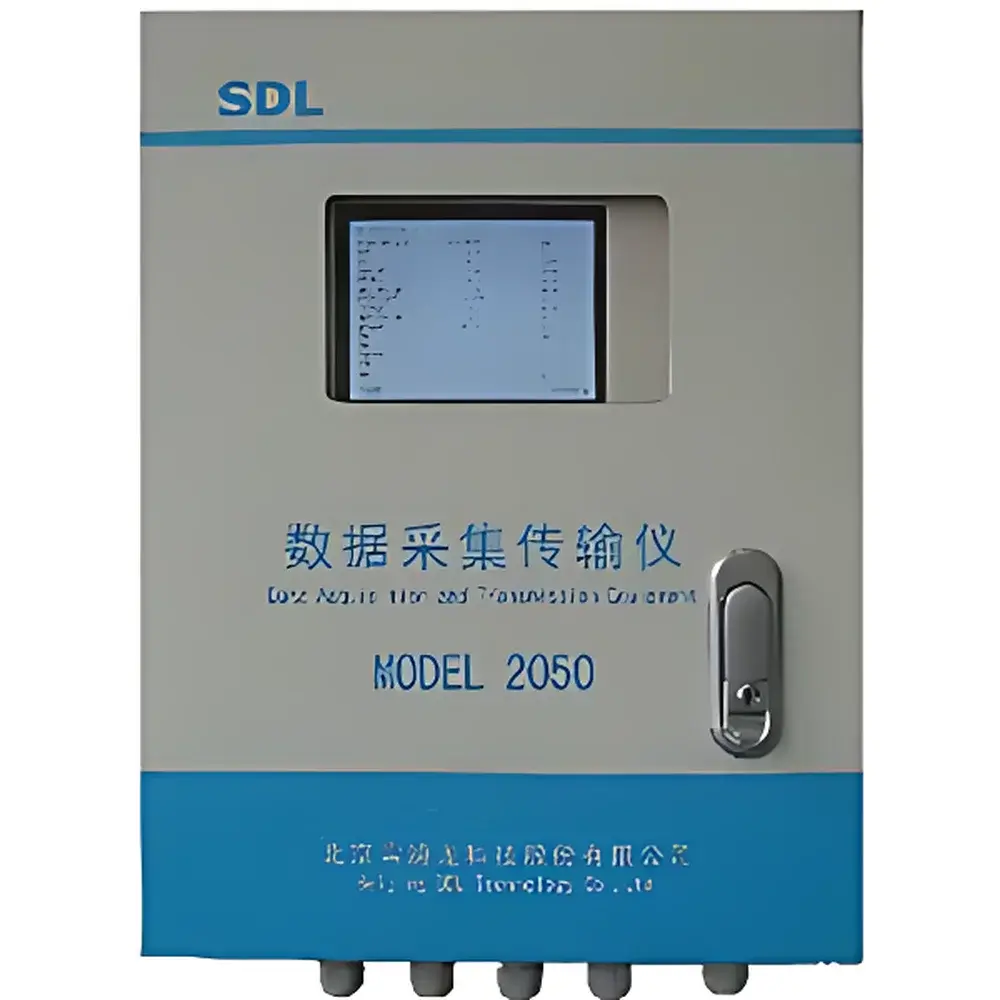
SDL MODEL 2050 Data Acquisition and Transmission Unit
| Brand | SDL |
|---|---|
| Origin | Beijing, China |
| Manufacturer Type | Original Equipment Manufacturer (OEM) |
| Country of Origin | China |
| Model | MODEL 2050 |
| Price Range | USD 1,400 – 4,200 |
Overview
The SDL MODEL 2050 Data Acquisition and Transmission Unit is an industrial-grade environmental monitoring interface engineered for regulatory-compliant continuous emission monitoring systems (CEMS) and water quality monitoring networks. It operates as a protocol-agnostic edge acquisition node that collects, validates, time-stamps, and securely transmits real-time process and analytical instrument data—including flue gas analyzers (e.g., SO₂, NOₓ, O₂, CO), water quality sensors (pH, COD, NH₃-N, heavy metals), and auxiliary status signals—via embedded GPRS/CDMA cellular modules. Its architecture adheres to the core functional requirements defined in China’s HJ 212–2017 and HJ 353–2019 technical specifications for pollutant online monitoring data transmission, while maintaining hardware and firmware design compatibility with international IEC 61131-3 and ISO/IEC 17025-aligned data integrity principles. The unit functions as both a Modbus master and slave, enabling bidirectional integration with field devices and central supervisory control systems without requiring proprietary gateways.
Key Features
- Multi-protocol support: Native implementation of Modbus RTU/ASCII/TCP, DL/T 645, HJ 212–2017 data frame protocol, and custom ASCII-based instrument protocols
- Dual-role Modbus capability: Configurable as Modbus Master (to poll analyzers, flow meters, and transmitters) or Modbus Slave (to interface with DCS, SCADA, or PLC controllers)
- Multi-center data forwarding: Simultaneous transmission to up to three independent environmental monitoring platforms (e.g., provincial EPA cloud, municipal dispatch center, enterprise internal MIS)
- Remote command execution: Securely receives and executes control commands from authorized upper-level systems—including instrument calibration triggers, zero/span verification initiation, and sampling pump activation
- Data gap recovery: Local non-volatile storage (≥30 days at 1-minute interval) with automatic retransmission upon network restoration, ensuring audit-trail continuity per HJ 355–2019 data validity requirements
- Hardware watchdog and dual-reboot logic: Ensures uninterrupted operation under voltage fluctuation, electromagnetic interference, or extended network outage conditions
Sample Compatibility & Compliance
The MODEL 2050 interfaces with a broad spectrum of environmental analyzers and sensors certified under China’s CEMS Type Approval system (HJ 76–2017), including UV-DOAS, NDIR, electrochemical, and atomic absorption spectrometry-based instruments. It supports analog inputs (4–20 mA, 0–5 V, 0–10 V), digital I/O (dry contact), and RS-232/RS-485 serial channels—each independently configurable for scaling, filtering, and alarm thresholding. All firmware operations comply with HJ 353–2019 (Technical Specification for Installation and Acceptance of Online Monitoring Systems for Pollution Sources) and support GLP/GMP-aligned audit trails, including user login logs, configuration change history, and command execution timestamps. While not FDA 21 CFR Part 11-certified out-of-the-box, its secure authentication, immutable event logging, and role-based access control provide a foundation for validation in regulated industrial hygiene or wastewater treatment applications.
Software & Data Management
The unit embeds a Linux-based real-time operating system with deterministic I/O scheduling and TLS 1.2 encrypted data transmission. Configuration and diagnostics are performed via web-based interface (HTTPS) or local USB-C console, supporting CSV export of historical logs and firmware updates signed with SHA-256 cryptographic verification. Data packets conform to HJ 212–2017 frame structure—including device ID, measurement values, data quality flags (e.g., “valid”, “maintenance”, “calibration”), and CRC-16 checksums—to ensure interoperability with national environmental monitoring platforms such as the China National Environmental Monitoring Centre (CNEMC) data hub. Optional OEM SDK enables integration with third-party middleware for MQTT/OPC UA bridging in Industry 4.0 deployments.
Applications
- Continuous emission monitoring at thermal power plants, cement kilns, and waste incinerators
- Real-time water quality surveillance in municipal wastewater treatment plants and surface water intake stations
- Heavy metal speciation monitoring (e.g., Pb, Cd, As, Hg) in industrial effluent discharge points
- Multi-parameter stack testing during environmental compliance audits and permit renewal assessments
- Edge-layer data aggregation in distributed sensor networks where low-bandwidth cellular connectivity is the only viable telemetry option
FAQ
Does the MODEL 2050 support TLS encryption for data transmission?
Yes—it implements TLS 1.2 with certificate pinning for secure communication with designated monitoring centers.
Can it operate in environments with unstable power supply?
It includes wide-input DC power tolerance (9–36 VDC) and an internal supervisor circuit that initiates graceful shutdown and state preservation during brownout events.
Is firmware upgrade possible remotely?
Firmware updates require authenticated HTTPS upload with digital signature verification; remote push deployment is disabled by default for security compliance.
What is the maximum number of analog input channels supported?
The standard configuration provides 8 isolated 4–20 mA inputs, expandable via optional RS-485 expansion modules supporting up to 32 additional channels.
Does it meet EMC immunity standards for industrial installations?
It complies with GB/T 17626.2–2018 (IEC 61000-4-2) ESD, GB/T 17626.3–2016 (IEC 61000-4-3) radiated RF, and GB/T 17626.4–2018 (IEC 61000-4-4) fast transient burst requirements.